





How different cultural traditions understood the tiger's protective power, instinctual wisdom, and role as boundary between human and wild
Few animals occupy such consistent symbolic space across unrelated cultures as the tiger. From the frozen forests of Siberia to the tropical jungles of Indonesia, from Chinese imperial courts to Korean mountain temples, the tiger emerges again and again—not merely as a powerful predator, but as a sophisticated symbol of protection, boundary, instinctual wisdom, and the wild intelligence that exists beyond human civilization.
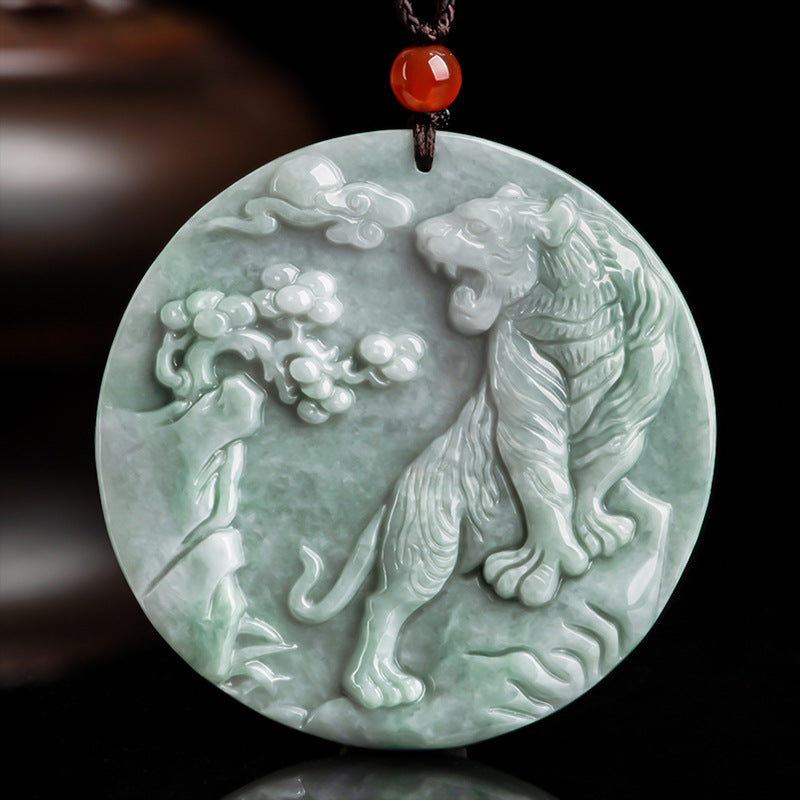
What's particularly fascinating isn't the tiger's universal association with strength—that much is obvious—but the specific qualities of strength different cultures attributed to it. For some, the tiger represented celestial protection; for others, moral judgment; for still others, the dangerous wisdom of untamed instinct. Yet across these variations, consistent themes emerge: boundaries, protection through presence rather than aggression, and the capacity to see what humans cannot.
Chinese Cosmology: The White Tiger of the West
In Chinese tradition, the tiger's symbolism is remarkably systematic and integrated into a comprehensive cosmological framework. As one of the Four Celestial Animals (Si Xiang), the White Tiger (Bai Hu) governs the west, the autumn season, the metal element, and the constellation of the same name.
But this isn't merely astronomical classification. Each element of the tiger's symbolism reveals a deeper understanding of protective energy:
- West: The direction of sunset, completion, and harvest—but also potential danger from nomadic tribes historically. The tiger protects what has been accomplished, what is being gathered in.
- Autumn: The season of discernment—separating wheat from chaff, preserving what will last through winter, releasing what won't. The tiger embodies this discriminative intelligence.
- Metal: The element of structure, boundaries, and clarity. Metal can be both weapon and tool—its use depends on discernment. The tiger represents this dual capacity.
- White: Not the absence of color, but the presence of all colors refined to essence. In Daoist alchemy, white represents the purified metal element—protection that has been refined to its essential nature.
Perhaps most revealing is what the White Tiger doesn't represent: it's not associated with spring (new beginnings), not with the east (the direction of sunrise and new ventures), not with wood (the element of growth and expansion). The tiger's domain is protection of what already exists, discernment about what to preserve, boundary-maintenance rather than boundary-crossing.

Korean Mythology: The Mountain Judge
Korean tradition presents a particularly nuanced tiger symbolism that differs significantly from its Chinese counterpart. Here, the tiger (Beom) is often depicted as a mountain spirit (Sanshin) or as a moral judge who tests human character.
In many Korean folk tales, the tiger doesn't attack indiscriminately. Instead, it observes humans from the mountain, judging their actions, and intervening only when moral boundaries are violated. The tiger becomes what anthropologists call a "liminal being"—existing at the boundary between human civilization and untamed wilderness, capable of moving between both realms and enforcing the laws of each.
One particularly revealing folktale features a tiger that spares a woodcutter who has shown filial piety toward his mother, while punishing greedy merchants who exploit the poor. The tiger here isn't mere predator; it's moral agent—enforcing a natural justice that human society sometimes forgets.
This judicial function reveals something profound: the tiger as enforcer of natural law. Not human law with its complexities and compromises, but the simpler, starker laws of integrity, reciprocity, and balance. When humans violate these deeper laws, the tiger reminds them—often fatally—that some boundaries cannot be crossed without consequence.

Hindu and Buddhist Traditions: Divine Vehicle and Dharma Protector
In Hindu iconography, the tiger serves as the vahana (vehicle) of Goddess Durga—a particularly significant association. Durga represents the divine feminine's protective, combative aspect (different from Lakshmi's nourishing aspect or Saraswati's wisdom aspect). She rides into battle against demons not on a horse (associated with conquest) or elephant (associated with royalty), but on a tiger.
The symbolism is precise: Durga's power isn't civilized, trained, or domesticated. It's wild, instinctual, and untamed—yet completely under her control. The tiger represents power that hasn't been softened or socialized, yet is perfectly directed toward protective ends.
In Buddhist tradition, particularly in Tibet and Mongolia, tiger skins are often depicted as meditation seats for certain deities and accomplished practitioners. Here, the symbolism shifts: sitting on a tiger skin represents mastery over aggressive energy, transformation of raw instinct into enlightened activity. The tiger's ferocity hasn't been eliminated; it has been integrated, transformed into protective wisdom.
This dual theme—wild power in service of protection, instinct transformed into wisdom—recurs throughout South Asian tiger symbolism. The power is never denied or suppressed; it's harnessed, directed, integrated.

Siberian and Tungusic Shamanism: Spirit Guide and Shape-Shifter
In the frozen forests where tigers still roam (the Amur/Siberian tiger), indigenous traditions present a different but equally sophisticated tiger symbolism. For the Udege, Nanai, and other Tungusic peoples, the tiger (Amba) is often seen as a spirit relative, a shape-shifting being, and a guide between worlds.
What's particularly distinctive here is the tiger's role in shamanic initiation. In some traditions, aspiring shamans must encounter the tiger spirit and either be "killed" by it (in vision) or learn to shape-shift into tiger form. This initiation death-and-rebirth symbolizes the dissolution of ordinary human consciousness and the acquisition of animal wisdom—specifically, the tiger's capacity to see in darkness, move between realms, and protect spiritual boundaries.
The tiger in these traditions is less about physical protection and more about spiritual boundary maintenance. It guards the threshold between ordinary reality and spirit world, ensuring that only those properly prepared can cross, and that harmful energies don't leak back across the boundary.

Comparative Analysis: Common Themes Across Cultures
Chinese Tradition
Primary Role: Celestial Guardian
Key Quality: Discernment (autumn separation)
Domain: Protection of accomplishments
Element: Metal (structure, boundaries)
Direction: West (completion, harvest)
Korean Tradition
Primary Role: Mountain Judge
Key Quality: Moral discernment
Domain: Enforcement of natural law
Element: Earth/mountain (stability)
Direction: Boundary (human/wild)
Hindu Tradition
Primary Role: Divine Vehicle
Key Quality: Directed wild power
Domain: Protection through power
Element: Fire (transformative energy)
Direction: Battle (against demons)
Siberian Tradition
Primary Role: Spirit Guide
Key Quality: Boundary crossing
Domain: Spiritual threshold guardian
Element: Air/spirit (between worlds)
Direction: Vertical (earth/spirit)
Despite these differences, common themes emerge unmistakably:
- Boundary Consciousness: Every tradition associates the tiger with boundaries—between seasons, directions, elements, human/wild, ordinary/spiritual.
- Protective Discernment: The tiger doesn't protect everything indiscriminately; it protects what aligns with natural order, moral law, or spiritual integrity.
- Power with Restraint: Even when representing raw power, the tiger symbolizes power that can be restrained until precisely needed.
- Instinctual Wisdom: The tiger sees what civilized humans often miss—true threats, moral violations, spiritual dangers.
Modern Relevance: What the Tiger Teaches Now
In contemporary life, tiger symbolism offers particular wisdom for challenges our ancestors couldn't have imagined:
Digital Boundaries: The tiger's boundary consciousness translates directly to digital life. Just as the tiger patrols territorial edges, we need to patrol our attention boundaries, protecting focus from endless digital fragmentation.
Moral Discernment in Complexity: In a world of conflicting values and diluted ethics, the tiger's moral clarity—especially in Korean tradition—reminds us that some boundaries shouldn't be crossed regardless of social permission or personal advantage.
Instinct in Over-Rationalized Culture: Modern life often privileges rational analysis over instinctual knowing. The tiger represents reconnection with gut wisdom—the capacity to sense danger or opportunity before it's fully analyzable.
Protection Without Aggression: In polarized times where protection often manifests as aggression, the tiger—especially in Chinese celestial form—models protection through presence, discernment, and alignment with natural order rather than through confrontation.
Conclusion: The Tiger as Timeless Boundary Keeper
What emerges from cross-cultural study isn't a simple "tiger equals strength" equation, but a sophisticated understanding of what kind of strength matters for what purposes. The tiger's strength is specifically protective, specifically discerning, specifically boundary-oriented.
Perhaps the most profound insight across traditions is this: the tiger guards the distinction between things more than it guards the things themselves. It protects the boundary between human and wild not to keep humans out of the wild, but to maintain the distinction so both can exist. It guards the boundary between seasons so autumn can be autumn and winter can be winter. It guards the boundary between ordinary and spiritual so each has its proper domain.
In this sense, tiger symbolism at its deepest is about the protection of distinction itself—the maintenance of boundaries that allow different qualities, realms, and energies to exist without blurring into meaningless sameness. The tiger doesn't say "this is better than that"; it says "this is this, and that is that, and the distinction matters."
For modern wearers of tiger symbols, this might translate as: protecting the distinction between work and rest, between digital engagement and embodied presence, between social adaptation and personal integrity. The tiger reminds us that not all boundaries are barriers to connection; some are preconditions for meaningful connection. Not all distinctions are divisions; some are necessary differentiations that allow each thing to be what it truly is.
In the end, the tiger across cultures teaches a counterintuitive wisdom: sometimes the most protective act is not to merge, but to distinguish. Not to include everything, but to discern what belongs where. Not to eliminate all boundaries, but to maintain the right ones with clarity and courage. In a world pushing toward blurring, blending, and boundary dissolution, this might be the tiger's most timely teaching.
