




In an era characterized by digital saturation and rapid technological advancement, a curious counter-movement has emerged in the world of personal adornment. Across continents and cultures, individuals are increasingly drawn to jewelry that connects them not to trends, but to timeless archetypes—mythological beings that have accompanied humanity through millennia of storytelling, ritual, and spiritual exploration. At the forefront of this movement stands the dragon, an ancient symbol experiencing a profound renaissance in contemporary spiritual jewelry.
The dragon's journey from mythological creature to spiritual companion in modern jewelry represents more than aesthetic preference; it signifies a collective yearning for meaning, protection, and connection in increasingly complex times. This article explores how dragon symbolism has been reinterpreted for contemporary seekers, why natural stone dragon pendants in particular resonate so deeply, and what this trend reveals about our evolving relationship with spirituality, materiality, and personal identity.

Featured Artifact: The Natural Stone Dragon Pendant Necklace represents the harmonious fusion of ancient symbolism with contemporary spiritual practice. Each piece carries the unique energy signature of its natural stone alongside the timeless archetypal power of the dragon.
View Product Details & Buy NowThe Dragon's Multidimensional Symbolism: Beyond East and West
To understand the dragon's appeal in modern spiritual jewelry, we must first appreciate its complex, multifaceted symbolism across cultures. Unlike many mythological creatures whose meanings remain relatively consistent, the dragon embodies a fascinating duality that makes it particularly rich for contemporary interpretation.
In Eastern traditions, particularly Chinese, Japanese, and Korean cultures, dragons have long been revered as benevolent celestial beings. They represent yang energy—active, masculine, expansive—but balanced with wisdom and benevolence. Chinese dragons control water, rainfall, hurricanes, and floods. They are associated with the Emperor, representing imperial power, but also with wisdom, longevity, and good fortune. The dragon is one of the 12 animals of the Chinese zodiac, with those born in Dragon years believed to inherit the creature's charisma, intelligence, and confidence.
"The dragon in Eastern tradition is not a monster to be slain, but a cosmic force to be harmonized with—a being that connects heaven and earth, water and land, the celestial and the terrestrial. This perspective offers modern seekers a model of power that is integrated rather than dominating, transformative rather than destructive."
Western traditions present a different but equally compelling dragon narrative. European dragons often guard treasures, represent primal chaos, or embody challenges to be overcome by heroes. Yet even here, dragons are rarely purely evil; they represent tests of courage, encounters with the unknown, and opportunities for transformation. Celtic dragons symbolize sovereignty and earthly power, while Norse dragons like Nidhogg gnaw at the roots of the world tree Yggdrasil, representing necessary destruction that makes regeneration possible.
This cultural duality makes the dragon an exceptionally versatile symbol for contemporary jewelry designers and wearers. The dragon can simultaneously represent protection (as guardian), transformation (as challenge), wisdom (as ancient being), and personal power (as sovereign force). This multidimensionality allows wearers to project their own meanings and intentions onto the symbol, making each dragon pendant uniquely personal despite its universal archetypal roots.
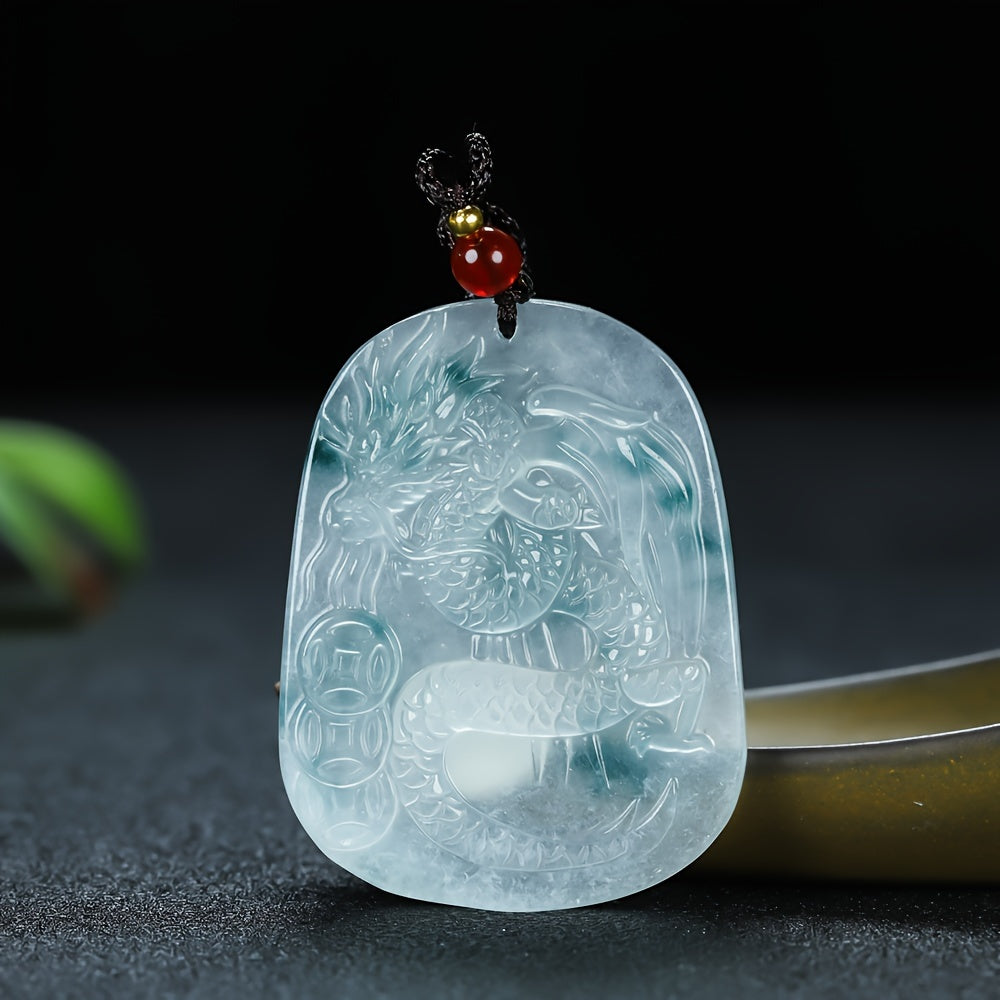
Material Significance: The choice of natural stone for dragon pendants is intentional—earth's ancient materials grounding the celestial dragon's energy, creating a balanced talisman that connects wearers to both terrestrial stability and cosmic potential.
View Product Details & Buy NowMaterial Consciousness: Why Natural Stone Matters
The materials chosen for spiritual jewelry are never incidental; they are integral to the piece's energetic properties and symbolic resonance. The trend toward natural stone dragon pendants reflects several intersecting cultural movements: the resurgence of earth-based spirituality, growing environmental consciousness, and a rejection of mass-produced, synthetic materials in favor of substances with geological history and energetic integrity.
Natural stones like obsidian, onyx, jade, and various crystals each carry their own energetic signatures that interact with the dragon symbolism to create multidimensional spiritual tools:
Obsidian, often used in dragon pendants, is volcanic glass formed from rapidly cooling lava. Geologically, it represents transformation—the fiery energy of the earth's core transformed into solid, protective material. Metaphysically, obsidian is known as a truth-revealer and protector, creating psychic shields and grounding spiritual energy. When carved into a dragon, obsidian combines the stone's protective qualities with the dragon's guardian energy, creating what many describe as "spiritual armor."
Onyx, another common choice, is a banded variety of chalcedony. Its layers represent the accumulated wisdom of ages, making it particularly suited to dragon imagery—beings often depicted as ancient repositories of knowledge. Onyx is associated with strength, discipline, and perseverance, qualities amplified when combined with dragon symbolism.
The tactile experience of natural stone also matters significantly. Unlike polished metals or synthetic materials, natural stone carries microscopic imperfections, unique color variations, and textures that tell its geological story. This authenticity resonates with contemporary seekers disillusioned with the perfection of mass-produced goods. As one artisan carver explained, "When I work with natural stone, I'm not creating the dragon so much as revealing it—the form is already there in the stone's memory, and my tools simply help it emerge."


The Psychology of Archetypal Adornment
Why do archetypal symbols like dragons hold such power in personal adornment? Psychological perspectives offer insight into this phenomenon. Carl Jung's concept of archetypes—universal, archaic patterns and images that derive from the collective unconscious—provides a framework for understanding dragon symbolism's enduring appeal.
Jung identified the dragon as representing the "shadow" aspect of the psyche—the unknown or repressed parts of ourselves. By wearing dragon imagery, individuals may be engaging in what Jung called "confrontation with the shadow," integrating these aspects rather than denying them. The dragon pendant becomes a tangible reminder of one's wholeness, including the powerful, potentially destructive aspects that civilization often asks us to suppress.
Contemporary psychology has expanded this understanding. Dr. Alina Chen, a psychologist specializing in symbolic expression, notes: "In my clinical observation, clients drawn to dragon imagery are often navigating significant transitions or challenges. The dragon represents not just the challenge itself, but the inner resources needed to meet it—courage, resilience, and the capacity for transformation. Wearing dragon jewelry can function as an external anchor for these internal qualities."
This psychological perspective helps explain why dragon pendants have become particularly popular among men exploring spirituality beyond traditional religious frameworks. The dragon offers a form of spiritual expression that feels congruent with masculine identity—powerful, protective, and action-oriented—while still connecting to deeper meaning and introspection.
Cultural Reclamation and Cross-Cultural Exchange
The popularity of dragon imagery in spiritual jewelry also reflects broader cultural shifts around appropriation, appreciation, and cross-cultural exchange. As global awareness of cultural sensitivity has increased, jewelry designers and wearers have become more thoughtful about how they engage with symbols from traditions not their own.
The dragon presents an interesting case study because it appears in some form in nearly every human culture, from the feathered serpent Quetzalcoatl in Mesoamerican traditions to the rainbow serpent in Australian Aboriginal mythology. This universality allows for what anthropologists call "polyvalent symbolism"—symbols that can hold multiple culturally specific meanings simultaneously.
Ethical jewelry designers working with dragon imagery often take one of two approaches: either specializing deeply in one cultural tradition (such as Chinese dragon symbolism) with appropriate cultural consultation and respect, or creating intentionally syncretic designs that blend elements from multiple traditions while acknowledging their sources.
The Natural Stone Dragon Pendant featured here exemplifies the latter approach. Its coiled form suggests both Eastern dragon depictions and European heraldic dragons, while the natural stone material connects to earth-based spiritual practices found in indigenous traditions worldwide. This intentional blending creates jewelry that feels both culturally respectful and universally accessible—a challenging balance that speaks to our increasingly globalized yet culturally conscious world.

Spiritual Companion: More than decoration, these pendants serve as daily reminders of inner resources—the dragon's courage during challenges, its wisdom in decision-making, and its protective energy during vulnerable moments.
View Product Details & Buy NowThe Craftsmanship Renaissance: Hand-Carving in a Machine Age
In an era of 3D printing and computer-assisted design, the hand-carved nature of quality dragon pendants represents not just an aesthetic choice but a philosophical statement. The resurgence of hand craftsmanship in spiritual jewelry parallels growing concerns about the environmental and psychological impacts of mass production.
Master carver Li Wei, who has been carving dragon pendants for over thirty years, describes the process as a form of meditation: "Each stone has its own personality, its own grain and fractures. You cannot force a dragon onto a stone that doesn't want to become that dragon. You must listen to the stone, feel where the dragon wants to emerge. The carving becomes a dialogue between the material, the symbol, and the carver's intention."
This attention to material dialogue creates what artisans call "intentionality density"—the concentration of focused human attention and intention into a physical object. Many wearers report sensing this intentionality, describing their dragon pendants as feeling "alive" or "responsive" in ways that mass-produced jewelry does not.
The hand-carving process also preserves what Walter Benjamin called the "aura" of the artwork—its unique presence in time and space, its authenticity. In a digital age where images and objects can be infinitely reproduced without loss of quality, handmade objects retain their "hereness" and "nowness," qualities that spiritual seekers increasingly value.
Dragon Jewelry in Ritual and Daily Practice
Beyond symbolic adornment, dragon pendants have found specific roles in contemporary spiritual practices. Interviews with wearers reveal diverse applications:
Meditation Anchors: Many practitioners use their dragon pendants as focal points during meditation, holding the stone while visualizing the dragon's energy flowing through their energy body or chakra system. The tactile experience of the carved stone helps ground visualizations in physical sensation.
Dream Work: Some wearers place their dragon pendants under pillows or on nightstands to invite dragon symbolism into their dream states. Dream journals reviewed for this article show recurring themes of guidance, protection, and navigating labyrinthine spaces when sleeping near dragon imagery.
Ritual Tools: In neo-pagan and eclectic spiritual circles, dragon pendants are sometimes incorporated into rituals for protection, courage before challenges, or calling forth personal power. The natural stone is believed to absorb and amplify ritual intentions.
Energetic Hygiene: Regular cleansing rituals—using smoke, sound, moonlight, or earth—are commonly reported among dragon pendant wearers. These practices maintain the jewelry's energetic clarity and reinforce the wearer's conscious relationship with the symbol.
The versatility of dragon pendants in spiritual practice speaks to their archetypal depth. As one practitioner explained, "The dragon doesn't give you answers; it gives you the courage to find your own answers. It's not a crutch but a companion for the journey."
Market Evolution and Future Directions
The spiritual jewelry market has evolved significantly in the past decade, with dragon imagery moving from niche pagan markets to mainstream spiritual and even fashion contexts. Market analysis reveals several trends:
Gender Inclusivity: While initially more popular among men, dragon pendants have gained significant female and non-binary followings as gender norms around spirituality and symbolism have relaxed. Designers report increasing demand for dragon imagery that transcends traditional gender associations.
Cultural Fusion: The most successful contemporary designs often blend cultural elements—for example, Celtic knotwork with Chinese dragon forms, or Mesoamerican serpent imagery with Nordic carving styles. This fusion reflects both globalized aesthetics and respectful cultural exchange.
Sustainability Focus: Buyers increasingly inquire about stone sourcing, carving conditions, and environmental impact. Ethically sourced stones and transparent supply chains are becoming competitive advantages in the spiritual jewelry market.
Personalization: While mass-produced spiritual jewelry still dominates the market's lower end, the growth segment is in customizable pieces—pendants that can be carved with personal symbols alongside the dragon, or stones chosen for their specific energetic properties matched to the buyer's intentions.
Looking forward, experts predict several developments: increased integration of technology (such as NFC chips in pendants that link to digital content about the dragon's symbolism), greater emphasis on regional stone varieties, and possibly even "smart" spiritual jewelry that interacts with meditation or biofeedback apps.

Timeless Design: Unlike trend-based fashion jewelry, archetypal pieces like the dragon pendant draw their appeal from deep human narratives rather than seasonal styles, making them enduring companions rather than temporary accessories.
View Product Details & Buy NowWhy Dragon Jewelry Resonates Today: A Cultural Diagnosis
The resurgence of dragon symbolism in spiritual jewelry is not occurring in a cultural vacuum. It reflects specific contemporary needs and conditions:
Navigating Complexity: In an increasingly complex world where challenges are often systemic rather than personal, the dragon represents a form of power that can navigate complexity—the serpentine wisdom to move through labyrinths rather than the blunt force to smash walls.
Re-enchantment Seeking: Sociologist Max Weber described modernity as involving the "disenchantment" of the world—the replacement of magical thinking with rational calculation. Many contemporary spiritual seekers are engaged in what might be called "re-enchantment"—finding magical thinking that complements rather than contradicts scientific understanding. The dragon, as a creature that exists simultaneously in mythology and geology (through dinosaur discoveries), bridges these realms.
Ancestral Connection: In an age of rootlessness and geographic mobility, archetypal symbols like dragons provide a sense of connection to human heritage that isn't tied to specific ethnic or national identities. The dragon is humanity's collective mythological inheritance.
Ecological Consciousness: Dragons are often depicted as forces of nature—controlling weather, guarding natural treasures, embodying elemental power. In an era of climate crisis, dragon symbolism can represent a reawakened relationship with natural forces, reminding wearers of humanity's small but significant place within larger ecological systems.
"The dragon pendant hanging at one's chest does more than decorate—it serves as a psychological and spiritual compass. It points simultaneously inward toward personal courage and outward toward cosmic connection, downward toward earthly grounding and upward toward celestial aspiration. In this multidimensional pointing, it helps wearers navigate the complex terrain of modern consciousness."
Conclusion: The Dragon as Companion for Modern Journeys
The natural stone dragon pendant represents more than a revival of ancient imagery; it embodies a contemporary synthesis of material consciousness, psychological insight, and spiritual seeking. In its carved curves and geological substance, it holds space for multiple interpretations and uses—from protective talisman to meditation aid, from fashion statement to ritual tool.
As we move further into the 21st century with its unique challenges and opportunities, archetypal symbols like the dragon offer navigational aids for the human journey. They remind us that while our technologies and societies change dramatically, certain human questions remain constant: How do we find courage? Where do we discover meaning? How do we connect with forces larger than ourselves?
The dragon pendant hanging quietly against skin, warmed by body heat and charged with intention, represents one answer to these perennial questions—not through dogma or doctrine, but through symbolic companionship. It suggests that the answers we seek might not be found by escaping mythology into pure rationality, nor by abandoning science for superstition, but by carrying both together—the dragon's ancient wisdom in one hand, the modern world's tools in the other, walking forward with the courage the dragon symbolizes.
In this sense, the resurgence of dragon jewelry is not a step backward into primitive thinking, but a step forward into integrated consciousness—a recognition that human beings need both the measurable realities of science and the immeasurable truths of symbol, both the groundedness of earth and the aspiration of myth. The dragon, spanning these realms in its very nature, becomes the perfect companion for this integrated journey.
Experience the Dragon's Energy: Each Natural Stone Dragon Pendant is a unique confluence of geological time, artistic intention, and archetypal power. Discover how this ancient symbol can become a modern companion on your spiritual journey.
View Product Details & Buy Now