




The Power of Nine: Numerology, Completion, and the Imperial Symbolism Worn Close
In the Hall of Supreme Harmony within Beijing's Forbidden City, a careful observer might count the rows of roof ornaments. They will find nine mythical creatures lining the ridge—the maximum number permitted. In the same complex, the iconic Nine-Dragon Wall stands as a testament to imperial power, its 270 tiles (9 x 30) arranged in perfect numerological harmony. Throughout Chinese civilization, from architecture to ritual to language itself, the number nine (九 jiǔ) has occupied a position of unparalleled significance. But why this particular number? And what happens when we translate this cosmological weight into a piece of jewelry meant to be worn against the skin?

The Nine Dragon Wall in Beihai Park, Beijing: A monumental expression of imperial power and numerological perfection.
I. Nine in Chinese Cosmology: The Yang Culmination
To understand nine, we must first understand the Chinese system of numerology rooted in the ancient text, the I Ching or Book of Changes. In this system, numbers are not mere quantities but carriers of intrinsic energetic qualities. Odd numbers are yang—active, masculine, celestial. Even numbers are yin—receptive, feminine, earthly.
As the largest single-digit odd number, nine represents the culmination of yang energy. It is the peak, the apex, the point of maximum expansion before the cycle returns to one. In the I Ching, the hexagram "Qian" (The Creative, Heaven) is composed of six unbroken yang lines. The ninth line of any hexagram is considered the "moving line"—the point of transformation. Thus, nine carries the dual meaning of completion and imminent change, perfection and the seed of a new beginning.
II. Homophony and Symbolic Resonance: 九 (Jiǔ) and 久 (Jiǔ)
The Chinese language, rich in homophones, adds another layer of meaning. The word for "nine" (九 jiǔ) sounds identical to the word for "long duration" or "eternity" (久 jiǔ). This phonetic link created a powerful associative bridge. The number nine became not just a symbol of imperial power, but a wish for that power—and by extension, the dynasty itself—to last forever.
This connection manifests in countless imperial constructions:
- The Nine Provinces (九州 Jiǔzhōu): The mythological division of China under Yu the Great, representing the entire civilized world under heaven's mandate.
- Nine Layers of Heaven (九重天 Jiǔchóngtiān): The celestial bureaucracy mirroring the earthly one, with the Jade Emperor at its pinnacle.
- Forbidden City's 9,999 Rooms: While the actual count differs, the legend persists that the palace complex contained 9,999 rooms—one shy of the 10,000 rooms of the heavenly palace, asserting the emperor's supreme but still subordinate position to heaven.
- Imperial Ritual: The emperor would perform the "Three Kneelings and Nine Kowtows" (三跪九叩 sānguì jiǔkòu) during sacrifices to heaven, a ritual of ultimate submission using the ultimate yang number.
III. The Nine Dragons: Multiplying the Mandate
The dragon, as the supreme imperial symbol, naturally coalesced with the supreme number. The "Nine Dragons" (九龙 Jiǔ Lóng) motif is thus a compounded symbol—a doubling down on celestial authority. It's not merely a dragon, but the complete set of dragons, representing the emperor's command over all directions, all seasons, and all elemental forces.
Scholars of iconography note that nine-dragon depictions often show the dragons in dynamic relation: one central dragon (usually the emperor) surrounded by eight others. This echoes the "Nine Palaces" (九宫 Jiǔgōng) magic square, an ancient cosmological diagram where the number 5 sits at the center, balanced by the other eight numbers around it. The arrangement symbolizes harmony, order, and the emperor's role as the stabilizing center of the universe.
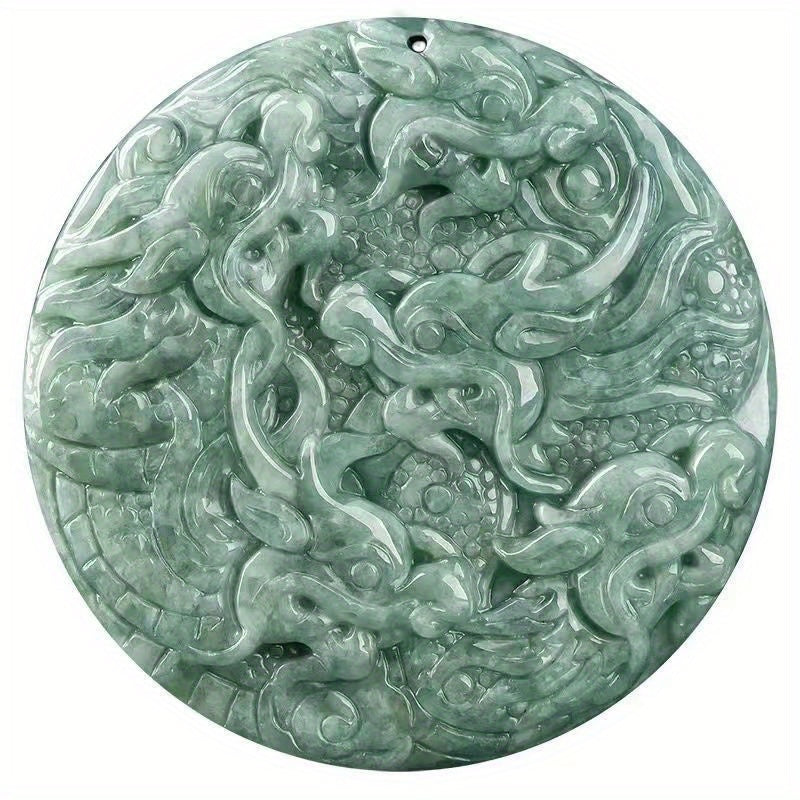
The central dragon in the pendant design echoes the imperial arrangement, symbolizing the wearer as the stable center of their personal universe.
View the Jewelry Piece →IV. The Numerology of Completion in Personal Life
What happens when this imperial, cosmological number is claimed for personal use? The symbolism undergoes a democratization of profound psychological value.
In modern life, we often experience fragmentation—our attention scattered, our goals partial, our sense of self divided between roles. The number nine, as a symbol of completion, offers a powerful antidote. A nine-dragon pendant becomes a physical reminder of wholeness. It suggests that within the wearer exists not just one strength or one aspect, but a complete set of capabilities, a full spectrum of personal power.
| Imperial Symbolism (Then) | Personal Interpretation (Now) |
|---|---|
| Command over the Nine Provinces (the world) | Command over one's personal domain: mind, emotions, choices |
| Connection to the Nine Layers of Heaven | Connection to higher purpose, intuition, and spiritual aspiration |
| The wish for dynastic eternity (久) | The wish for enduring personal integrity, legacy, and resilience |
| The balanced Nine Palaces arrangement | The pursuit of inner balance and harmony amidst life's chaos |
V. The Psychological Impact of "Complete" Symbolism
Carl Jung wrote extensively about the psychological power of mandalas—circular, often symmetrical designs representing the Self in its wholeness. The number nine, particularly when arranged in circular or balanced patterns (like the eight-around-one formation of dragons), functions as a numerical mandala. It is a symbol of individuation—the process of integrating all parts of the personality into a cohesive whole.
Wearing a symbol of completion can have subtle but real psychological effects:
- Anchoring in Wholeness: During moments of self-doubt or feeling fragmented, touching the pendant can serve as a tactile anchor to the idea of one's inherent completeness.
- Resilience Through Cyclical Thinking: Remembering that nine is both an end and a beginning helps reframe endings not as failures, but as necessary transitions in a larger cycle.
- Claiming Personal Authority: The imperial association, when internalized, becomes an assertion of self-governance—the right to be the ultimate authority in one's own life.
VI. Modern Manifestations: From Architecture to Adornment
The power of nine continues to resonate in contemporary Chinese culture. Skyscrapers avoid floor numbers containing the digit 4 (associated with death) but favor those with 9. Gifts are often given in sets of nine for auspiciousness. The "Nine Sons of the Dragon" motif appears in modern art and design, each son representing a different positive attribute like strength, wisdom, or artistic talent.
Jewelry becomes the most intimate canvas for this ancient numerology. Unlike a static wall or building, a pendant moves with the body, its meaning activated by the wearer's life. The stone, carved with nine-fold power, becomes a companion through personal journeys of completion: finishing a significant project, integrating a life lesson, achieving a hard-won state of self-acceptance.
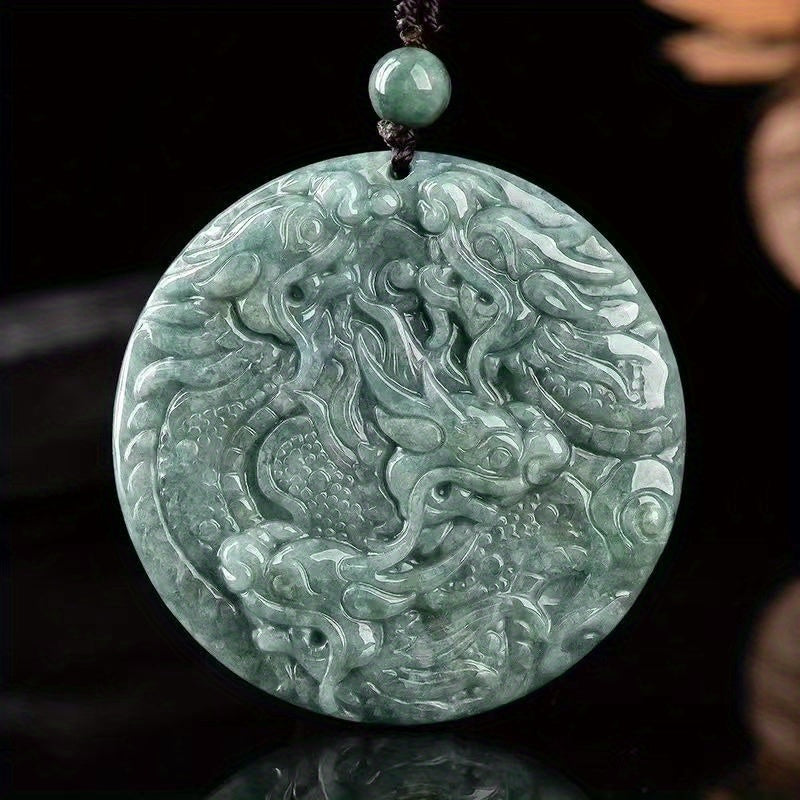
Worn close, the pendant transforms imperial cosmology into a personal cosmology—a private reminder of one's own wholeness and authority.
View the Jewelry Piece →VII. Conclusion: Carrying the Cosmos
The journey of the number nine—from cosmological principle to imperial insignia to personal talisman—reveals the enduring human need to find patterns of meaning in numbers. In a data-saturated age where numbers often represent cold metrics (likes, steps, hours worked), the Nine Dragon pendant re-enchants numerology. It reconnects the wearer to a tradition where numbers carried spiritual weight, where mathematics was a language describing the harmony of heaven and earth.
To wear the nine is to carry a miniature cosmos. It is to declare, quietly but firmly, that one's life is not a series of random events but a coherent journey toward completion. It is to align with the yang energy of action and creation, tempered by the wisdom of cycles. In the end, the power of nine worn close is not about external dominion, but about the profound, often quiet sovereignty of becoming whole.
Final Reflection: The next time you see the number nine—in a date, an address, or a piece of jewelry—pause. Remember its ancient resonance: the peak of yang, the wish for eternity, the symbol of heavenly mandate. Then consider what mandate you are living under. Is it external approval, endless productivity, or comparison? The Nine Dragon symbol invites you to replace those with a more ancient, more powerful mandate: your own completion. To wear it is not to claim imperial power over others, but to accept the celestial responsibility of becoming fully, completely, authentically yourself.
