




Carving the Guardian: How Three-Dimensional Stone Work Embodies Omni-Directional Protection
In a museum, we view sculptures from prescribed angles. The plinth elevates them, the lighting dramatizes them, and the velvet rope creates a sacred distance. We walk around them, but always aware: there is a front, a profile, a back. The artwork exists in relation to our position. Now, imagine an object meant not for a pedestal, but for the body—an object that turns with your movement, that has no designated "front," that offers its form equally from every angle. This is the realm of fully three-dimensional, double-sided carving. It is not merely a technique; it is a philosophical statement about the nature of protection, presence, and power.
The hands of a master carver engage in a dialogue with stone—a process of revelation, not imposition.
I. The Philosophy of In-the-Round: Rejecting the Hierarchy of Sides
Most relief carving operates on a hierarchy. The front face carries the primary image, the message, the identity. The sides and back are secondary, often minimally finished, merely functional. This structure mirrors a certain way of being in the world: we have a public face, a presented self, while other aspects remain private, unseen, perhaps underdeveloped.
Double-sided, fully three-dimensional carving—known as "carving in the round" or "sculpture in the round"—rejects this hierarchy. It declares that the form is complete, integral, and self-sufficient from every vantage point. There is no "wrong" side. When applied to a protective symbol like the dragon, this technical choice becomes profoundly symbolic. It suggests that true guardianship is not a shield held in one direction against a known threat. It is, instead, a cultivated state of being—a presence that is vigilant, capable, and whole in all directions.
II. The Material Dialogue: Stone as Partner, Not Canvas
Stone carving, especially in hard materials like agate or nephrite, is not a process of domination but of collaboration. The carver must "listen" to the stone. Its veins, its hardness variations, its natural flaws—these are not obstacles to be overcome, but conversations to be had.
Selection & Seeing
The master examines a raw stone, not for its blankness, but for its story. Where might a dragon's spine follow a natural vein? Where could a flaw become a highlight in the scales? The three-dimensional form is already imagined within the stone's volume.
Roughing Out
Using chisels and saws, the general form is liberated from the excess stone. This stage is aggressive yet cautious—removing bulk while preserving the integrity needed for deep, interconnected undercuts on both sides.
Modeling the Form
The carver works from all sides simultaneously. A curve on the front must flow seamlessly into a corresponding curve on the back. The depth of a claw on one side determines the thickness available for the dragon's coiled body on the other.
Detailing & Refining
With finer tools, scales, whiskers, and clouds are defined. This stage requires constant rotation—detailing the front, then the back, ensuring visual balance and tactile continuity. The piece must feel coherent in the hand, eyes closed.
Polishing & Revelation
Through graduated abrasives, the stone's inner light is awakened. The polish must be even across all surfaces, revealing the true color and translucency of the material. A perfect polish on a double-sided piece means every hidden crevice receives attention.
III. The Symbolic Anatomy of a Double-Sided Dragon
In a flat or shallow-relief dragon, power is depicted. In a fully carved dragon, power is embodied. Let's dissect the symbolic implications of this embodied form:
Omni-Directional Vigilance
The dragon's head might face one direction, but its body coils in three dimensions, suggesting awareness that extends behind, above, and below. It protects not a flank, but a sphere.
Structural Integrity
The carving must be self-supporting. No part can be too thin or weak. This mirrors the psychological integrity required for genuine resilience—strength that doesn't crumble under pressure from any angle.
Dynamic Stillness
A well-carved in-the-round piece captures dynamic tension—the dragon seems poised to move in any direction. This represents readiness, a state of dynamic equilibrium rather than passive solidity.
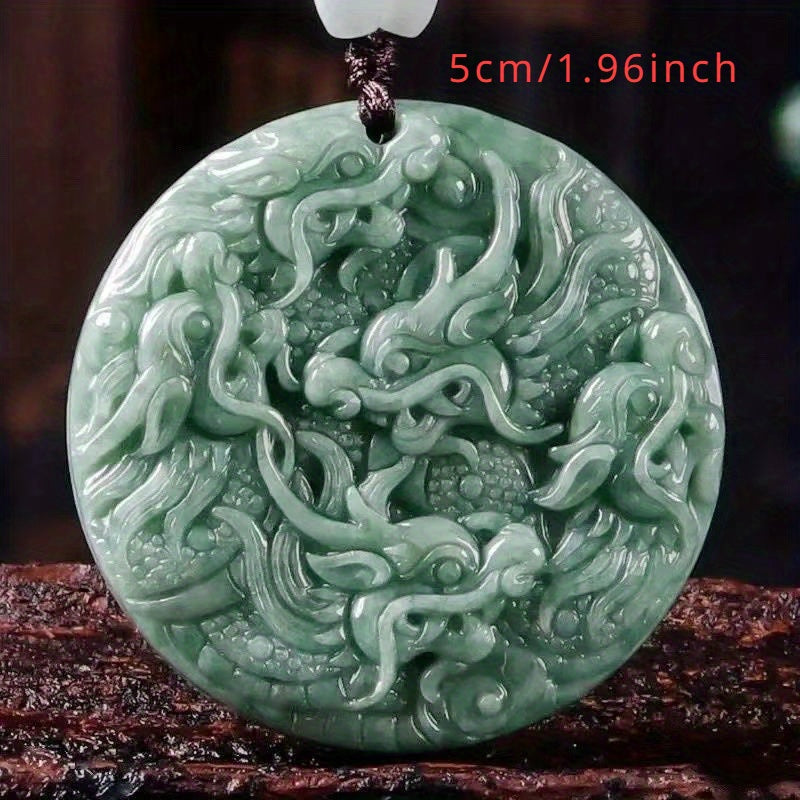
Viewing the pendant from different angles reveals new aspects of the dragon's form—a lesson in perceptual completeness.
View the Jewelry Piece →IV. The Psychology of Tactile Wholeness
The human hand is a sophisticated organ of perception. We understand the world through touch as much as sight. A double-sided carved pendant invites constant tactile engagement. Fingers trace the coils on the front, then naturally explore the mirrored topography on the back.
This haptic experience reinforces the symbol's meaning on a subconscious level:
- Confirmation of Substance: Feeling the substantial depth confirms the object's reality and weight—metaphors for substantial, grounded protection.
- Discovery of Hidden Detail: Finding intricate carving on the "unseen" side creates a moment of private discovery, reinforcing the idea that true strength has hidden depths.
- Kinesthetic Memory: The unique shape becomes mapped in muscle memory. In moments of stress, the mere thought of reaching for it can trigger a calming, centering response.
V. Historical Precedents: Jade Congs and Bi Disks
The tradition of valuing stone objects for their symbolic geometry and complete form is ancient. Neolithic Liangzhu culture (3400-2250 BCE) produced exquisite jade cong tubes: square on the outside, circular on the inside, with intricate faces carved on the corners. They were ritual objects whose meaning (likely connecting earth and heaven) was embodied in their complete, three-dimensional form. Similarly, bi disks—circular jade stones with a central hole—represent heaven and are valued for their perfect, continuous circumference.
These were not "pictures" of concepts; they were physical embodiments of cosmology. The double-sided dragon pendant continues this tradition. It is not a picture of a guardian; through the commitment of in-the-round carving, it aims to be a guardian in form.
A Neolithic Jade Cong: An ancient precedent for using complete three-dimensional stone form to embody cosmic principles.
VI. Modern Relevance: Protection in a Non-Physical Age
Today, many of our threats are non-physical: anxiety, information overload, social pressure, existential uncertainty. A medieval knight's shield is useless against these. What form, then, should modern protection take?
The double-sided carved pendant proposes an answer: protection as integrated wholeness. In a world that pulls us in multiple directions (work, family, social media, personal aspirations), the symbol of omni-directional presence reminds us to cultivate an inner center that holds. It suggests that the best defense against fragmentation is not a thicker wall, but a more cohesive self.
The pendant becomes a training tool. When you feel attacked by criticism (from the front), overwhelmed by responsibility (from above), or haunted by past regrets (from behind), touching the complete form can serve as a somatic reset: "Remember, you are not just facing this one thing. You are a complete being, capable of meeting experience from all sides."
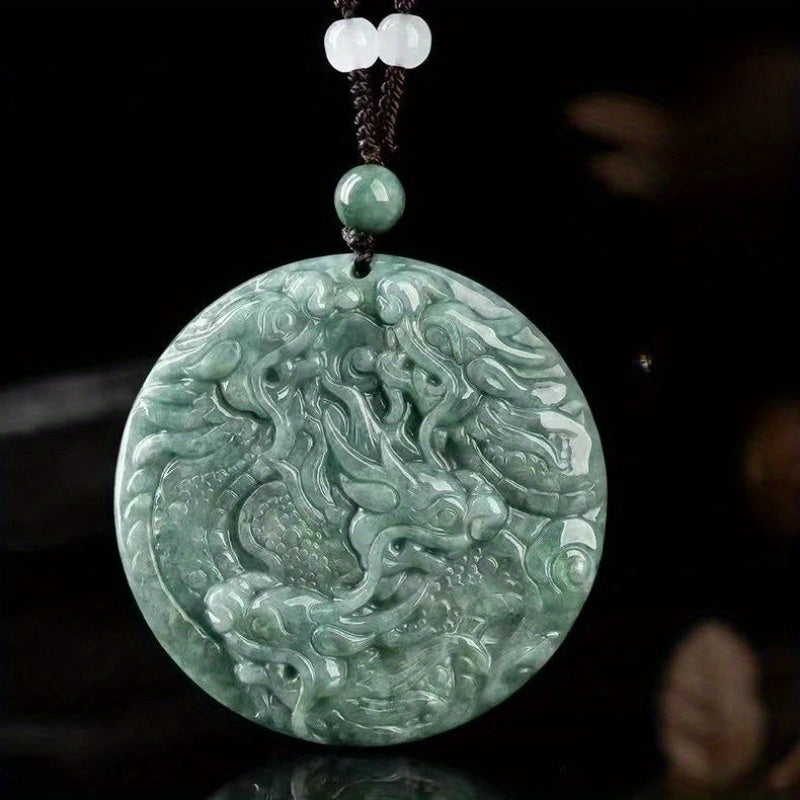
Held in the hand, the weight and completeness of the carving offer a tangible anchor in an often intangible world.
View the Jewelry Piece →VII. Conclusion: The Guardian Released from Stone
The journey from raw stone to finished pendant is a metamorphosis. The carver's patience, skill, and philosophical intent are gradually transferred into the material. When the work is done, the guardian is not placed onto the stone; it is released from within it. And because it is released in the round, it carries the memory of that wholeness in its very structure.
To wear such an object is to participate in that philosophy. You become the moving pedestal for a concept made solid. The protection it offers is not magical, but psychological and symbolic. It is a reminder, carved in enduring stone, that the most formidable protection we can cultivate is not a barrier against life, but a profound, resilient, and complete presence within it.
Final Reflection: In an age of digital images and disposable objects, the double-sided stone carving stands as an antithesis. It demands time, respect for material, and acceptance of permanent commitment (you cannot uncarve). It is slow making for fast times. It offers not a filtered image of strength, but a multifaceted, tangible experience of it. Perhaps that is the ultimate protective quality: in a world of surfaces, it teaches depth. And in a life that often feels one-sided, it insists, with quiet, stone-carved certainty, on your completeness.
