





The Weight of Your Own Attention: How to Notice When You're Leaving Yourself
It starts with a sensation so ordinary we usually miss it: the moment your attention leaves your body and goes to live somewhere else—in a screen, in a worry, in someone else's opinion of you. Here's how to notice, and what to do after you notice.
You're reading something on your phone. Your shoulders have crept up toward your ears. Your breath is shallow. You don't notice this because you're not here. You're in the article, in the argument, in someone else's curated reality.
This practice isn't about meditation. It's not about clearing your mind or achieving peace. It's much simpler: noticing where your attention lives, and inviting it back home when it's been away too long.
The Amber as Threshold Object
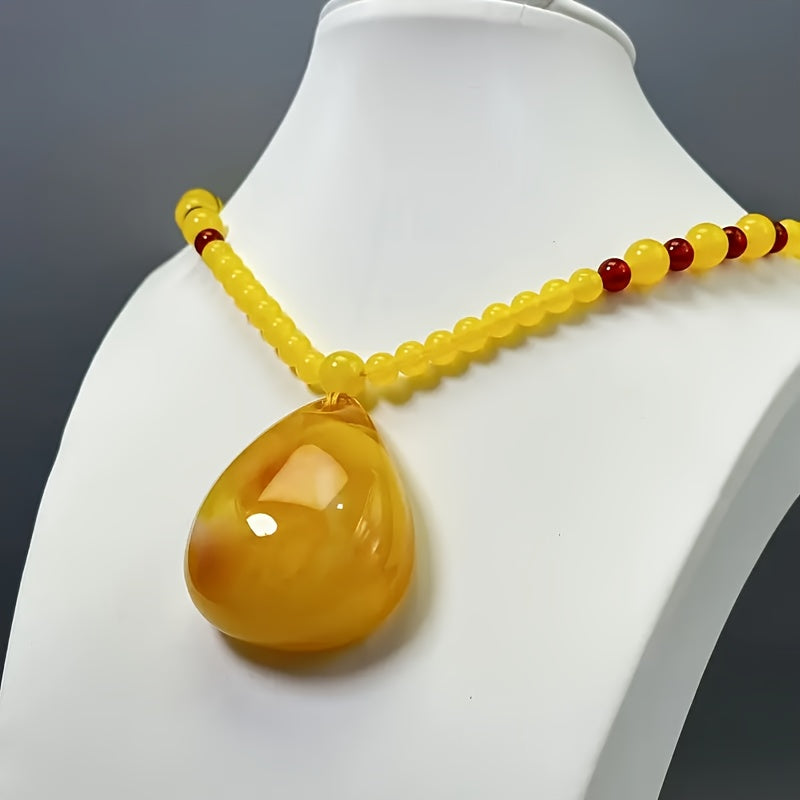
Choose one object. Something you wear daily. For this practice, we'll use an amber pendant, but it could be a ring, a bracelet, even a particular scarf. The criteria: it must make contact with your skin, and it must have a distinct texture or temperature.
Amber works particularly well because of its thermal properties. It starts cool, warms slowly, and reaches skin temperature at about the same pace as it takes to complete this practice. The material becomes a timer.
Here's the practice, broken into steps so simple they almost feel insufficient:
1. The Noticing
Sometime today, when you realize you've been scrolling or worrying or planning for longer than feels good, stop. Don't judge yourself for it. Just notice: "Ah. I've been away."
2. The Return
Place your hand on the amber pendant at your throat. If you're not wearing jewelry, place your hand on your collarbone. Feel the temperature. Is the amber cool? Warm? The same temperature as your skin?

3. The Three-Breath Pause
While keeping contact with the amber, take three breaths. Don't try to make them deep or special. Just notice the air moving in and out. On the third exhale, feel the weight of the pendant against your skin.
4. The Question (Optional)
Ask silently: "Where have I been?" Not judgmentally. Curiously. The answer might be: "In that email thread." "Worrying about tomorrow's meeting." "Comparing my life to someone's Instagram."
5. The Return (Again)
Feel the amber's texture. Smooth on one side, perhaps slightly textured where it's natural. Feel its weight—about 8 grams, the weight of two teaspoons of sugar. That's all.
Why This Works When Meditation Apps Fail
Most mindfulness practices fail because they ask too much. Twenty minutes of meditation when you're already overwhelmed. Complicated breathwork when you can barely remember to breathe.
This practice asks almost nothing. Thirty seconds. A touch. Three breaths. A question you don't have to answer.
The amber helps because it provides a physical anchor. Your attention has somewhere to go besides back into the spiral. It goes to temperature, to texture, to weight. These are simple, non-verbal facts.
One man who tried this said: "I do it during Zoom calls when I realize I haven't been listening, I've been planning what I'll say next. I touch the amber, take three breaths, and suddenly I can actually hear the other person again. Not perfectly, but better."
This isn't magic. It's physiological redirection. You're moving neural resources from your prefrontal cortex (worry, planning, comparing) to your somatosensory cortex (temperature, texture, pressure).

The Science of Simple Sensation
When you focus on a physical sensation—especially one as subtle as the warmth of amber against skin—you activate your interoceptive awareness. This is your brain's map of your internal state.
Research shows that people with good interoceptive awareness are better at emotional regulation. Not because they control their emotions, but because they notice them sooner, before they become overwhelming.
The amber practice builds this awareness through repetition. Not hours of repetition. Moments. Ten times a day, for thirty seconds each. That's five minutes total.
You're not trying to become enlightened. You're trying to remember that you have a body, and that body exists in the same room as your thoughts.
Common Moments for the Practice
• After checking your phone first thing in the morning
Before you get out of bed, touch the amber. Feel its morning coolness. Three breaths. Then get up.
• Before entering a meeting (virtual or real)
In the hallway or while waiting for the Zoom to start. Hand to pendant. Three breaths. Notice the temperature difference between your fingers and the stone.
• When someone is talking and you realize you're not listening
Instead of forcing yourself to listen better (which rarely works), touch the amber. Three breaths. Then return to the conversation.
• When anxiety feels like a buzzing in your chest
Place the amber directly over the buzzing sensation. Don't try to make it go away. Just notice: "Here is anxiety. Here is amber. They're in the same place."
• When transitioning between tasks
Hand to pendant between closing one browser tab and opening another. Three breaths. Notice: "I am ending something. I am beginning something else."
The Practice Companion

Natural Baltic amber on a 65cm chain. A tactile anchor for the simple practice of returning to your own presence.
Begin the Practice →