




In the quiet workshop of a master carver, a remarkable transformation takes place. A plain, unassuming stone becomes a portal between worlds, a physical manifestation of spiritual concepts, and a wearable piece of philosophical depth. The art of double-sided carving represents one of the most sophisticated expressions of jewelry craftsmanship, particularly when applied to spiritual symbols like the Dragon and Guanyin. This technique doesn't merely create jewelry; it forges multidimensional objects that serve as bridges between opposing energies, ancient wisdom and contemporary life, and the material and spiritual realms.
The Technical Mastery Behind Dual-Sided Carving
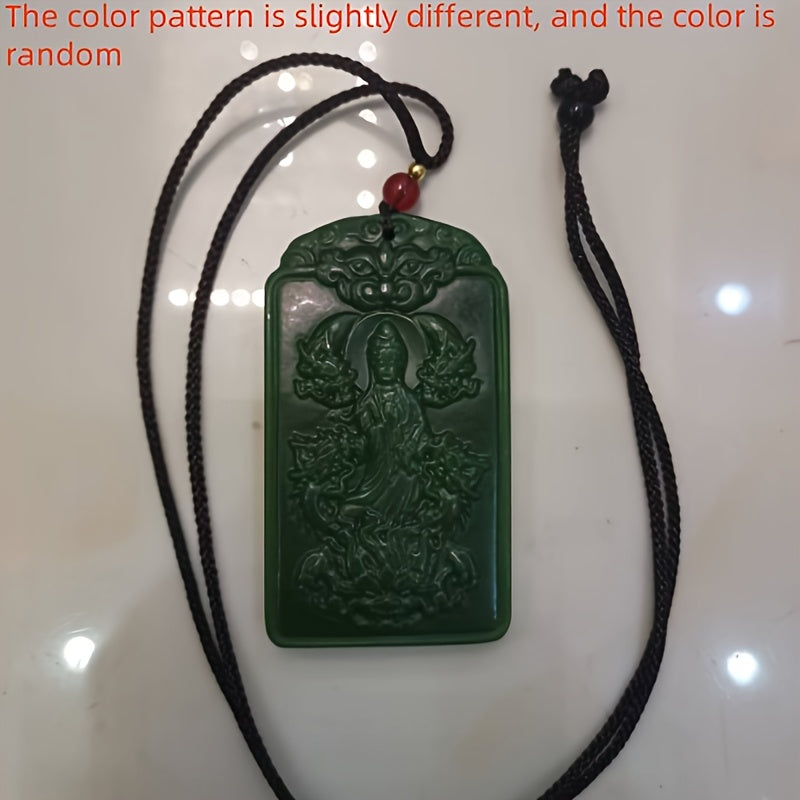
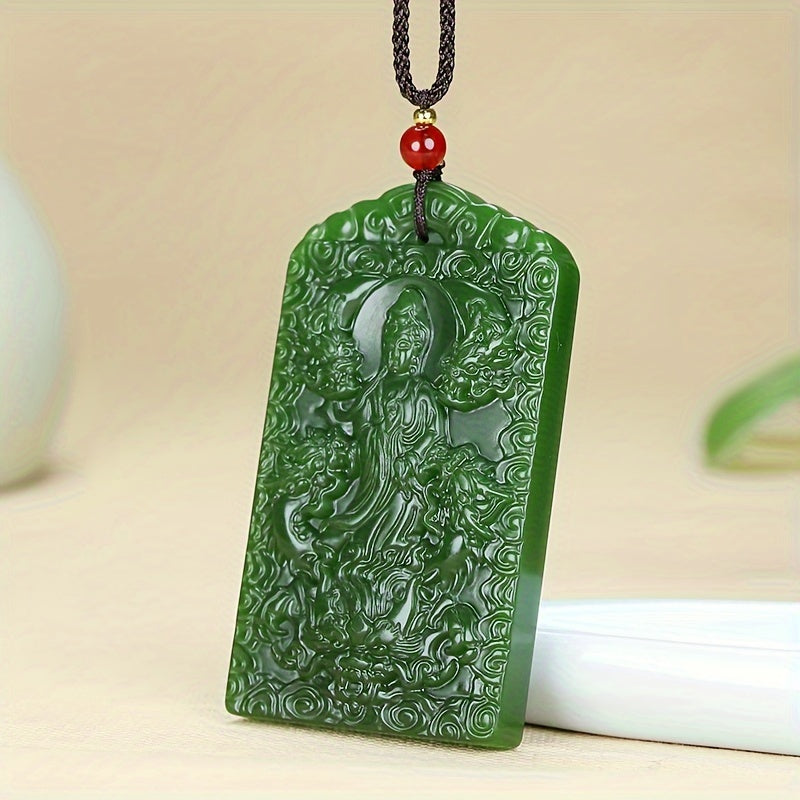
Creating a double-sided pendant like the Dragon and Guanyin piece requires exceptional technical skill and profound patience. Unlike relief carving on a single surface, the artisan must work with the three-dimensional space of the stone in a completely different way. The process begins with selecting the perfect stone—one with consistent density, no hidden fractures, and appropriate thickness. Too thin, and the carving might break through; too thick, and the pendant becomes unwieldy for wearing.
The carver must maintain perfect mental maps of both designs simultaneously, understanding how depth on one side affects the relief on the other. When carving the Dragon's scales on one face, the artisan must calculate how much material remains for Guanyin's serene features on the reverse. This requires spatial intelligence of the highest order, akin to a sculptor who can see the finished form within the raw stone before making the first cut. The tools used range from traditional hand chisels passed down through generations to modern rotary tools with diamond-tipped bits, but the fundamental skill remains human: the ability to translate vision into form through controlled removal of material.
The Dragon Side: Power in Detail
Carving the Dragon requires particular attention to dynamic composition. The serpentine body must suggest movement within the stone's static confines. Each scale, though miniature, must be individually defined to catch light and shadow. The claws convey grasping power, the eyes focused intensity. Traditional dragon symbolism includes specific elements: the deer's antlers, camel's head, demon's eyes, serpent's neck, clam's belly, carp's scales, eagle's claws, tiger's paws, and ox's ears. While not all may be present in a pendant-sized carving, the essence of each contributes to the mythological authenticity.
The Guanyin Side: Serenity in Stone
Guanyin presents a different challenge: conveying peace and compassion through stone. The features must be gentle yet distinct, the expression serene yet emotionally present. Traditional representations show Guanyin with a slight smile, downcast eyes in meditation, and sometimes holding a vase containing the nectar of compassion. The drapery of robes must flow naturally despite the stone's hardness. This side requires subtractive carving of the most delicate kind—removing just enough material to suggest softness rather than hardness, compassion rather than authority.
Historical Roots: From Imperial Seals to Personal Devotion
The tradition of double-sided carving has deep historical roots in Asian art, though its application to wearable pendants represents a modern evolution. During China's Han Dynasty (206 BCE–220 CE), officials carried double-sided seals (印玺) that featured different inscriptions or symbols on each side—one for official documents, another for personal correspondence. This practical object embodied the concept of different faces for different contexts, a metaphor for the multifaceted nature of identity and responsibility.
In Buddhist art, the concept of multiple aspects or manifestations of deities has always been present. Guanyin herself is said to have 33 different manifestations, each suited to help beings in particular circumstances. The pairing of Guanyin with the Dragon, however, has particularly interesting historical precedents. In some temple art, dragons appear as protectors of Buddhist teachings, while Guanyin represents the compassionate application of those teachings. They are not opposites but complementary forces within the same spiritual ecosystem.
Cultural Synthesis in Symbolism
The Dragon-Guanyin pairing represents a remarkable synthesis of three major streams of Chinese spiritual thought:
- Taoist Naturalism: The Dragon as embodiment of natural forces and cosmic power
- Buddhist Compassion: Guanyin as the ideal of enlightened mercy and liberation from suffering
- Confucian Social Harmony: The balance between assertive leadership (Dragon) and empathetic relationship-building (Guanyin) necessary for harmonious society
This triple heritage makes the pendant relevant across multiple dimensions of life—personal spirituality, social interaction, and engagement with the natural world.
The Philosophical Depth of Dual-Sided Design
At its core, the double-sided pendant embodies several profound philosophical principles. First is the Taoist concept of yin and yang—not as opposing forces locked in conflict, but as complementary energies that define each other through their relationship. The Dragon (yang) is powerful because it has Guanyin's compassion (yin) as its counterpoint; Guanyin's mercy is meaningful because it exists in a world that also contains the Dragon's protective strength.
Second is the Buddhist principle of non-duality, which suggests that apparent opposites are ultimately aspects of the same reality. From an enlightened perspective, there is no fundamental separation between compassion and power, peace and protection, listening and speaking. The double-sided pendant serves as a physical reminder of this non-dual understanding, encouraging wearers to transcend either/or thinking in their daily lives.
Third is the psychological concept of integration—bringing together different aspects of the self into a harmonious whole. Carl Jung's work on archetypes and shadow integration finds surprising resonance with this ancient artistic form. The Dragon might represent the assertive, confident aspects we sometimes suppress, while Guanyin represents the gentle, empathetic qualities we might neglect in competitive environments. Wearing both in balanced form supports psychological wholeness.

Modern Relevance: Why Double-Sided Symbolism Speaks to Contemporary Seekers
In today's complex world, people increasingly seek spiritual tools that acknowledge complexity rather than offering simplistic solutions. The double-sided pendant meets this need perfectly. It doesn't promise only protection or only peace; it offers the wisdom of context—knowing when each quality is needed and how to balance them. This resonates particularly with several contemporary trends:
Integrated Leadership Models: Modern leadership theory increasingly emphasizes the value of both decisive action and empathetic listening—precisely the Dragon-Guanyin balance. Business professionals, educators, and community leaders find in this pendant a symbol of the complete leadership toolkit.
Holistic Wellness Approaches: The wellness movement has evolved beyond physical health to include emotional, mental, and spiritual dimensions. A pendant that addresses multiple aspects of well-being—protection from external stress (Dragon) and cultivation of internal peace (Guanyin)—aligns with this comprehensive approach.
Cultural Hybrid Identity: For people navigating multiple cultural influences, the pendant's synthesis of different spiritual traditions mirrors their own experience of integrating diverse heritages into a coherent identity.
Gender Fluidity and Expression: The traditional gender associations of Dragon (masculine) and Guanyin (feminine) become fluid in this combined form, appealing to those who reject rigid gender binaries and embrace a spectrum of expressive possibilities.
Artistic and Aesthetic Considerations
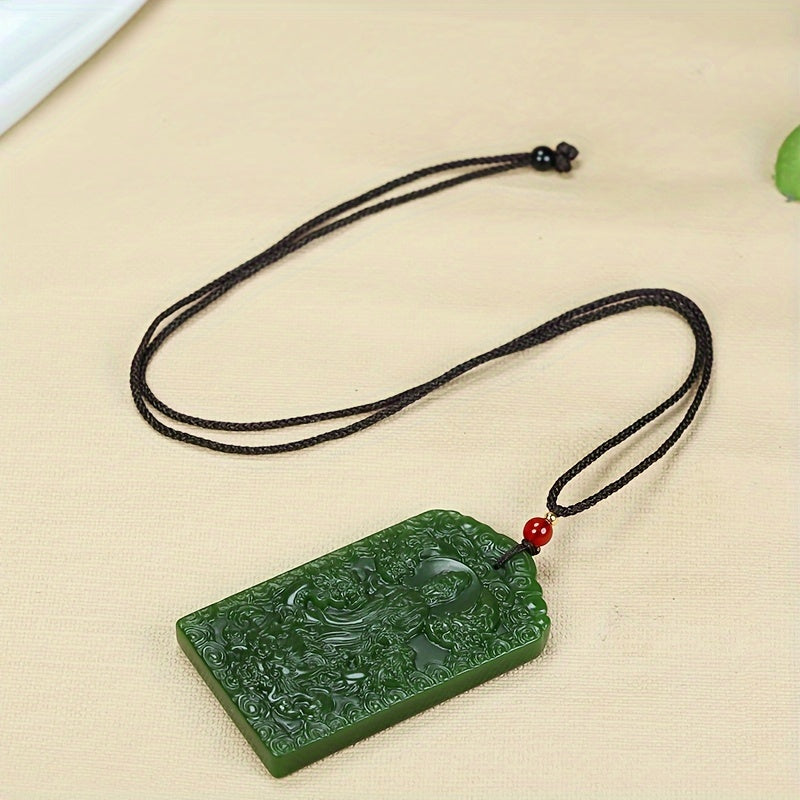
Beyond symbolism and spirituality, the double-sided pendant represents a significant aesthetic achievement. The carver must consider how the piece will look from every angle, how light will interact with both surfaces, and how the pendant will move when worn. The choice of cord—in this case, a substantial waxed cotton—complements rather than competes with the stone. The adjustable length allows for different wearing styles: shorter for a more traditional pendant presentation, longer for a contemporary layered look.
The natural variations in the stone become part of the artistic statement. No two pendants are identical because no two stones are identical. This uniqueness elevates the piece from mass-produced commodity to personal artifact. The slight imperfections in the stone—tiny mineral deposits, subtle color variations, natural texture—become virtues rather than flaws, reminding us of the organic origin of the material and the handcrafted nature of the creation process.
Expert Commentary: Master Carver Li Wei's Perspective
"When I carve a double-sided piece, I am not making two separate carvings that happen to share the same stone. I am creating a single entity that exists in dimensional harmony. The Dragon side knows it has Guanyin on its back; Guanyin knows the Dragon supports her. This awareness must be present in every stroke of the tool. The thickness where the Dragon's spine meets Guanyin's heart center is particularly important—it is the energetic bridge between them. I spend as much time contemplating that bridge as I do carving the details of scales or robes."
— Li Wei, third-generation master carver, Jingdezhen
Environmental and Ethical Dimensions
The use of natural stone raises important questions about sourcing and sustainability. Ethical carving studios prioritize several principles: stones are sourced from reputable suppliers who ensure fair labor practices; smaller pieces are often created from remnants of larger sculptures, minimizing waste; traditional carving techniques generally use less energy than industrial manufacturing processes; and the longevity of stone jewelry means it won't quickly become landfill waste like much fast-fashion jewelry.
Furthermore, the very nature of working with natural materials encourages an ethic of respect. You cannot force stone to become what it is not; you must work with its inherent qualities. This respectful engagement with material mirrors the philosophical respect for complementary opposites that the pendant symbolizes. The ethical dimension thus operates on multiple levels: respect for the material, respect for the craft tradition, respect for the cultural symbols being employed, and respect for the wearer who seeks meaningful connection rather than disposable ornament.
The Future of Symbolic Carving Art
As we look forward, several trends suggest a bright future for artisanal carving of spiritual symbols. First, the growing appreciation for slow craftsmanship in response to mass production. Second, increasing interest in spiritual practices that are portable and integrated into daily life rather than confined to specific places or times. Third, the desire for personalization and uniqueness in an age of algorithmic recommendations and standardized products.
Innovations may include combining traditional carving with modern technology (such as 3D scanning to preserve particularly successful designs), exploring new stone types from ethical sources, and creating educational materials that help wearers understand the depth of what they carry. Some studios are beginning to offer carving workshops, transforming consumers into participants in the creative process.
Exhibitions of miniature carving art are gaining popularity in galleries that traditionally focused on larger sculptures. The 2023 "Microcosms: The Art of Miniature Spiritual Carving" exhibition at the Asian Art Museum in San Francisco drew record crowds, particularly among younger visitors who appreciated both the technical skill and the philosophical content. Such recognition at institutional levels validates the artistic significance of this craft form.
Why People Choose Double-Sided Symbolic Jewelry Today
In a world dominated by mass-produced products, hand-carved double-sided pendants stand out because they offer what industrial manufacturing cannot:
Multidimensional Meaning: Unlike single-themed jewelry, double-sided pieces engage with complexity and paradox, offering richer symbolic content that grows with the wearer's understanding.
Artisanal Connection: Each piece carries the energy of the carver's focused attention and skilled hands, creating a tangible human connection absent from machine-made items.
Natural Authenticity: The stone's organic origin and unique characteristics ensure genuine uniqueness—no two pieces can ever be identical.
Energetic Depth: The combination of complementary symbols creates a more nuanced energetic field than single-symbol pieces, supporting balanced rather than one-dimensional intentions.
Timeless Design: Rooted in ancient symbolism but adaptable to contemporary style, such pieces transcend fashion cycles.
Cognitive Reminder: The physical act of turning the pendant to different sides serves as a mindfulness practice, reminding wearers to access different aspects of themselves as situations require.
Final Thoughts: More Than the Sum of Its Sides
A hand-carved double-sided pendant like the Dragon and Guanyin piece represents a remarkable convergence of technical mastery, philosophical depth, cultural continuity, and personal spirituality. It is not merely two symbols sharing a stone; it is a unified field of meaning where opposites engage in creative dialogue. The space between the carvings—the thickness of the stone itself—becomes as meaningful as the carvings, representing the potential for integration, the bridge between qualities, the fertile ground where apparent contradictions become complementary aspects of a greater whole.
In wearing or displaying such a piece, we participate in an ancient human practice: carrying sacred symbols as companions through life's journey. But we also engage with a particularly sophisticated form of this practice—one that doesn't offer simple answers but instead invites contemplative questions, that doesn't promise to make life easier but offers tools to live it more fully, that doesn't choose between power and compassion but shows us how to embody both. In this sense, the double-sided pendant becomes more than jewelry; it becomes a teacher, a companion, and a mirror reflecting back to us our own capacity for integrated being.
This article explores the rich tapestry of meaning, craft, and cultural continuity represented by double-sided symbolic carving. Each piece tells a story not just of what is carved, but of what is possible when we honor complexity and seek harmony in apparent opposition.
