





The Orchid: A Journey Through the Symbolism of Nature's Most Elegant Bloom
From a symbol of virility in ancient Greece to an emblem of luxury in the Victorian era, the orchid's journey through human culture is as intricate and beautiful as the flower itself.
Few flowers captivate the human imagination quite like the orchid. With its exotic shapes, vibrant colors, and often intoxicating fragrance, it has been a source of fascination for millennia. But beyond its physical beauty, the orchid carries a profound weight of symbolic meaning, representing a complex tapestry of ideas from love and luxury to strength and spiritual enlightenment. This article explores the rich history and enduring allure of the orchid, revealing how this delicate blossom became a powerful symbol etched into our collective consciousness and, ultimately, into our art and jewelry.
Ancient Roots: Greece, China, and the Aztecs
The story of the orchid's symbolism begins in the ancient world. In Ancient Greece, the name "orchid" is derived from the Greek word "orchis," which means "testicle." This rather direct name reflects the shape of the plant's tuberous root, which the Greeks believed was a powerful aphrodisiac and a symbol of virility and masculinity. The flower was associated with fertility and was used in rituals to determine the gender of an unborn child; larger tubers were thought to indicate a male child, while smaller ones indicated a female. This early association with potency and procreation laid a foundational layer of meaning for the flower.
Half a world away in Ancient China, the orchid held a completely different, yet equally profound, significance. Known as "Lan," the orchid was one of the "Four Gentlemen" in Chinese art, alongside the plum blossom, the chrysanthemum, and the bamboo. These plants represent the four seasons and, more importantly, the ideal qualities of a noble scholar. The orchid, growing in seclusion in deep valleys, symbolized refinement, elegance, humility, and the beauty of a scholar's moral character. It was a symbol of perfection and integrity, often used in poetry and paintings to represent a person of high moral standing.
Similarly, the Aztecs in Mesoamerica held the orchid in high regard. They believed that the vanilla orchid, from which they created a prized flavoring, was a gift from the god Quetzalcoatl. The flower's strength and beauty were seen as a manifestation of divine power, and it was used in rituals and as a symbol of strength.
The Victorian Language of Flowers: An Emblem of Luxury and Love
While admired for centuries, the orchid's popularity exploded in the 19th century, particularly during the Victorian era. This was the age of "Floriography," the art of communicating through flowers. Every bloom, color, and arrangement had a specific meaning, allowing people to express sentiments that were often too forward to speak aloud. The orchid, with its exotic origins in Asia and South America and its complex, almost otherworldly structure, became a symbol of luxury, refinement, and opulence.
Owning an orchid in Victorian England was a status symbol. They were difficult to cultivate, requiring specific humidity and light conditions, making them an expensive and rare commodity. Only the wealthiest households could afford these "hothouse flowers." As a result, giving someone an orchid was a grand, dramatic gesture. It conveyed a message of "You are as exquisite and rare as this flower," signifying deep admiration and love. The intricate beauty of the bloom also spoke to a sophisticated and refined taste. Different colors carried nuanced messages: a white orchid spoke of innocence and beauty, while a pink one conveyed affection and grace. This period solidified the orchid's modern association with love, romance, and luxury.

Strength in Delicacy: The Modern Symbol of Resilience
In the 20th and 21st centuries, a new layer of meaning has been added to the orchid's symbolism: that of strength and resilience. This interpretation stems from the flower's remarkable ability to thrive in some of the harshest environments on Earth. Epiphytic orchids grow on other plants, deriving moisture and nutrients from the air and rain, clinging to tree branches high in the rainforest canopy where soil is scarce. They are survivors, adaptable and tenacious.
This quality has made the orchid a powerful metaphor for the human spirit. It represents the ability to find beauty and grace even in difficult circumstances, to persevere through adversity, and to bloom with strength. In the context of personal growth and mental health, the orchid is seen as a symbol of hope and the capacity to flourish despite challenges. This modern interpretation beautifully complements its older meanings, creating a more holistic symbol: a flower that is not only beautiful and luxurious but also incredibly strong and resilient. This duality—delicate appearance and robust nature—is what makes the orchid so endlessly fascinating and relatable.
The Orchid in Jewelry and Art: A Wearable Masterpiece
Given its rich tapestry of meanings, it is no surprise that the orchid has been a perennial favorite subject for artists, designers, and jewelers. From intricate paintings by Georgia O'Keeffe to the Art Nouveau jewelry of René Lalique, the orchid's unique form has inspired countless works of art. In jewelry, the orchid motif is a classic. A piece of orchid jewelry is more than just a decorative accessory; it is a statement.
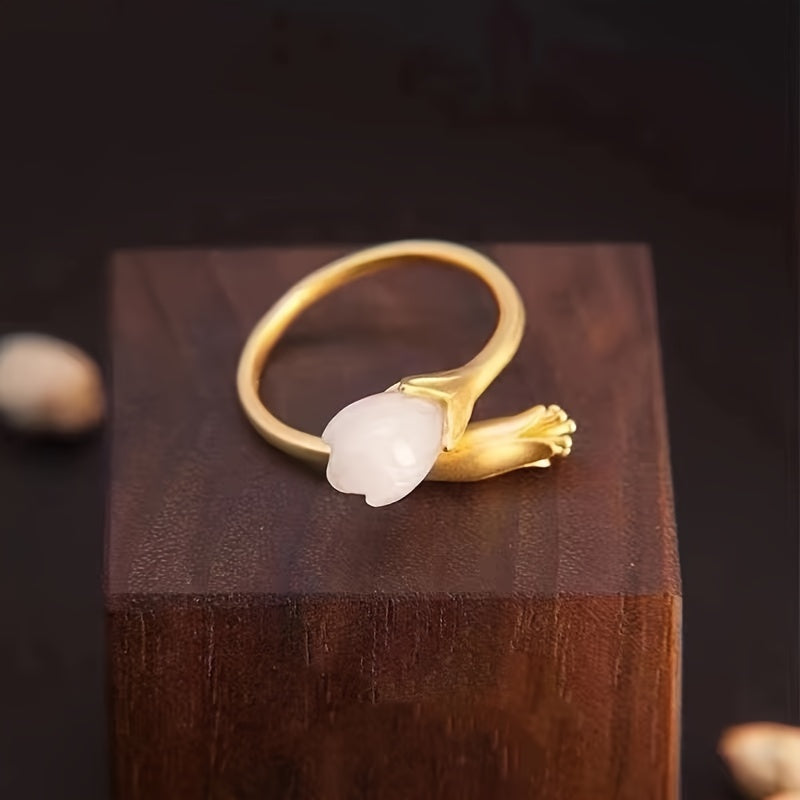
Wearing an orchid ring, pendant, or brooch is a way to carry its powerful symbolism with you. It can represent a declaration of love, a celebration of luxury and sophistication, or a personal reminder of your own inner strength and resilience. The design of the jewelry itself can emphasize different aspects of the symbol. A ring crafted from a pure, white stone like the one pictured, set in elegant silver, highlights the themes of purity, wisdom, and spiritual blossoming. The hand-carved detail speaks to the artistry of nature and the skill of the artisan, making the piece a wearable work of art that connects the wearer to the flower's profound history and enduring beauty. It is a way to adorn oneself not just with beauty, but with meaning.
