

The Unspoken Language of “Peace”: How a Simple Bead Became a Modern Touchstone
You see it on a bumper sticker, etched into a park bench, hashtagged under a sunset. Peace. The word itself can start to feel smooth from overhandling, its edges worn down by overuse. It becomes a concept, an aspiration, a political stance—anything but a felt state.
But then there’s the moment you’re fumbling with an earring back. Your fingers are slightly cold from the morning air. They brush against a small, spherical stone before guiding the wire through your ear. For a second, your attention narrows to that point of contact: the cool, dense surface of the bead, the slight resistance as it settles. There’s no grand thought. Just a brief, physical registration. Oh. This.
That’s where it lives now, for some people. Not in the slogan, but in the stone. Not in the declaration, but in the daily, almost missed, touch.
When Reaction Replaces Perception
The modern itch isn’t usually a lack of information. It’s a surplus of reaction. A notification triggers a swipe. A headline sparks an opinion. A subtle tension in your shoulder—maybe from hunching, maybe from an unresolved conversation—immediately gets diagnosed, labeled, turned into a problem to be solved. We’re fluent in the language of response.
Peace, in this economy, gets marketed as the solution. The endpoint. The calm after you’ve solved the problem, silenced the noise, achieved the goal. It becomes another item on the checklist, forever deferred. What if it’s not an end state, but a mode of perception? Not something you achieve, but a way you briefly inhabit?
Some people notice it first as a physical absence of scramble. It’s the two seconds after you hang up the phone, before you pick up the next task, when your gaze just lands on the dust motes in a sunbeam. Nothing is being solved. You’re just there. That’s the territory the peace bead quietly maps—not the treaty, but the temporary ceasefire within your own attention.
The Bead as a Pause Button for the Fingers
Historically, beads have always been tools for the hand as much as for the eye. Rosaries, prayer malas, worry beads—their function is kinetic. They give the fingers a simple, repetitive task to anchor a restless mind. The rhythm of thumb against surface creates a tiny, somatic ritual.
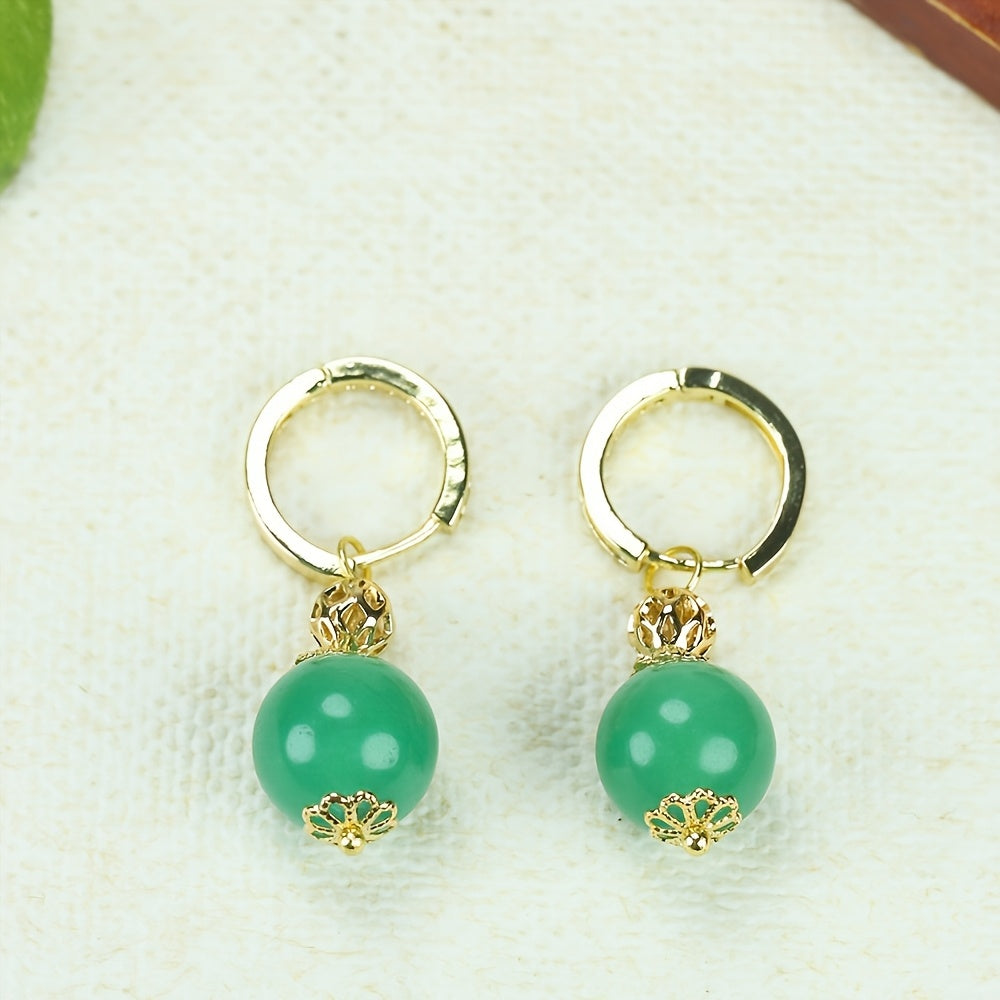
The modern “peace bead” earring works similarly, but passively. You might not actively roll it between your fingers. Instead, you feel it throughout the day. When you tuck your hair behind your ear, your knuckle grazes its coolness. When you turn your head quickly, you register its gentle, pendulous weight—a 1cm reminder of mass and gravity. It inserts a series of micro-pauses into your somatic awareness.
This is the shift: from symbolic meaning (a bead representing peace) to somatic function (a bead creating a moment of sensory awareness). The meaning isn’t explained; it’s accessed through the body first. The mind can follow, or not.
Jade’s Whisper: A Stone That Doesn’t Shout
Why apple green jade? Its symbolism in East Asian culture is vast—virtue, grace, protection. But set aside the library of meanings for a moment. Consider its material personality.
Jade, especially this softer green hue, doesn’t sparkle. It glows. It absorbs and softens light rather than fracturing it into brilliance. Its coolness to the touch is immediate, but it warms slowly against the skin, taking on your temperature patiently. It has a quiet density. It feels… composed.
In a world of high-shine finishes and loud declarations, jade offers a different quality of presence. It’s a stone that embodies stillness. Wearing it isn’t about projecting an image of serenity; it’s about carrying a small, tangible piece of that composed, quiet quality with you. It’s less a symbol you show the world, and more a texture you privately know.
The Gold Hoop: The Circle That Holds the Question
The bead hangs from a retro gold hoop. The circle is an ancient, complete shape. It suggests continuity, wholeness. But here, it’s a stage, not the star. Its job is to cradle the bead, to let it move freely, to frame that specific, cool point of green against the warmth of the metal and the skin.
This is the design’s quiet intelligence. The gold provides a context of timelessness and warmth—a “retro” feel that speaks of cycles, not linear progress. The jade bead introduces a note of earthy, cool contemplation. Together, they create a visual and tactile dialogue: the enduring loop of time and the specific, precious moment of awareness. One doesn’t dominate the other. They’re in conversation.
You might find your finger tracing the hoop’s smooth curve, a different sensation entirely from the bead’s compact surface. It’s a journey that ends where it begins, a breath. The bead is the pause within that breath.
A Companion for the Unremarkable Day
This object isn’t meant for the grand ceremony or the profound breakthrough. It’s for the Tuesday. For the commute where you choose to look out the window instead of at your phone. For the difficult conversation where you feel your pulse jump, and your hand rises almost unconsciously to your ear, finding that cool, solid bead—a touchstone that says nothing, but simply is.
Its power is in its redundancy. Day after day, the same simple gesture of putting it on. The same slight weight. The same coolness giving way to warmth. In that repetition, it becomes less a symbol of peace and more an integrated part of your sensory landscape—a familiar landmark in the terrain of your own awareness.
So the question it poses isn’t “Do you believe in peace?” It’s more mundane, more physical: “Can you feel this small, cool stone right now?” And in the moment you honestly check in with that sensation, for just a second, the word and the feeling occupy the same space. No translation needed.