




The Amber Threshold: How a Tear-Shaped Stone Became a Symbol for Holding Space in a Fractured World
It started with a hesitation. Someone noticing how their hand kept reaching for something solid during video calls. Not for protection, exactly. More like a reminder that the screen wasn't the only reality in the room.
Some people notice it first in their hands. The way fingers search for an edge, a texture, something that doesn't give way. On days when notifications pile up like leaves against a door, there's a particular quality to that search. It's not about finding an answer. It's about remembering that the body exists in three dimensions.
The teardrop shape appears across cultures—Mesopotamian cylinder seals, Egyptian pectorals, Byzantine reliquaries. But we've misunderstood its grammar. We read it as sorrow, as release. What if we've been reading it backward?
The Container, Not the Content
In thirteenth-century Persian poetry, the tear was sometimes called "the cup that holds what the heart cannot name." Not the emotion itself, but the vessel that makes emotion bearable by giving it boundaries. A tear has edges. It falls, yes, but first it forms. It holds.
When you look at Baltic amber under magnification, you see something strange: tiny bubbles of ancient atmosphere, fragments of vegetation, sometimes even insects suspended in mid-movement. Fifty million years of forest sunlight, captured not as energy but as solidified attention. The stone remembers what it witnessed.
This isn't symbolism in the decorative sense. It's physics. Amber is one of the few organic gems that warms to skin temperature almost immediately. It doesn't stay cool like crystal or metal. It meets you halfway. That warmth arrives slowly, a gradual recognition between body and object.
The Misreading of Liquid States
We live in a culture that privileges flow. Liquid modernity, fluid identities, streaming content. Everything must move, adapt, transform. The teardrop—in its frozen amber form—asks a different question: What if some things need to solidify to be seen clearly?
There's a practice among some amber workers in the Baltic region. They don't polish stones to perfect spheres. They look for the natural tear shape that sometimes forms as resin drips down pine bark. That form is preserved because it tells the truth of the material's origin: gravity acting on viscosity over unimaginable time.
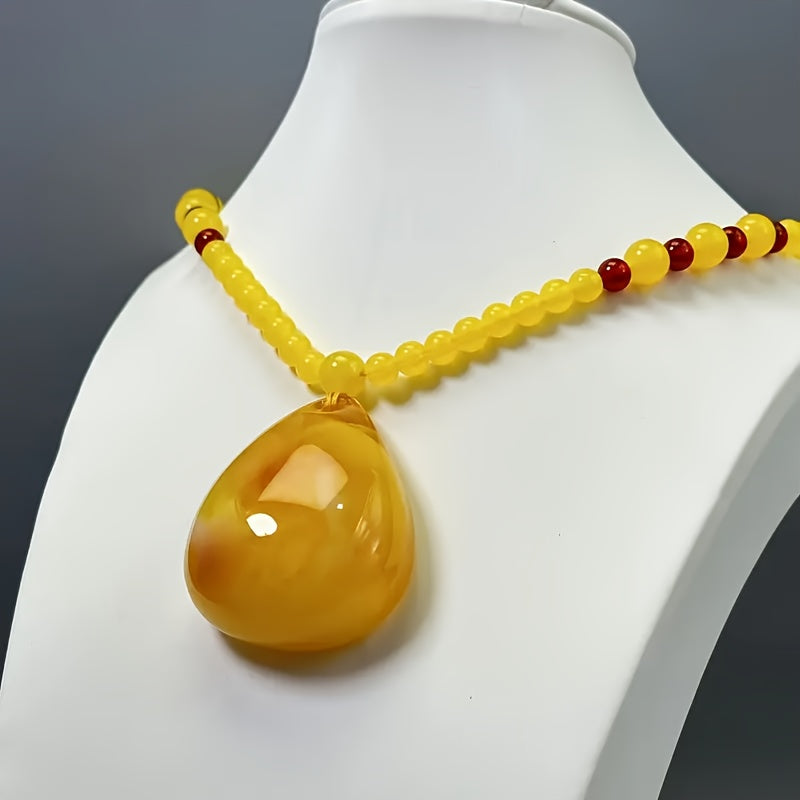
When you wear a teardrop pendant, you're not wearing a symbol of sadness. You're wearing a record of transition. Liquid becoming solid. Ephemeral becoming permanent enough to hold.
Some people notice it during difficult conversations. Not that the pendant magically makes things easier. But its weight—about 8 grams, the weight of two teaspoons of sugar—becomes a tangible counterweight to words that threaten to float away, to meanings that evaporate before they can be understood.
The Threshold Function
In architectural anthropology, a threshold isn't just a doorway. It's a psychological space between realms. Amber functioned this way in multiple traditions: placed at borders, worn by travelers, given to newborns. Not as magical protection, but as a material reminder of continuity.
When ancient Greek physicians prescribed amber for "melancholic humors," they weren't suggesting the stone absorbed sadness. They observed something more subtle: patients who held amber pieces reported feeling "more contained." The emotion didn't disappear. It found edges.
This is what we've lost in modern symbolic literacy. We want symbols to do things: protect, attract, transform. We've forgotten that some symbols simply accompany. They don't change the weather; they help you remember you have a coat.

Modern Translation: The Unspoken Need for Boundaries
We talk about boundaries as psychological concepts. We read articles about saying no, about guarding our energy. But the body often understands what the mind theorizes. Sometimes a physical object can hold a boundary more gently than a mental rule.
There's a particular moment that repeats: you're scrolling through something that makes your chest feel tight. Your breath shallow. Without thinking, your hand goes to the pendant at your collar. The amber is warm from your skin. The teardrop shape fits perfectly in the space between thumb and forefinger.
Nothing dramatic happens. The screen doesn't change. The world doesn't transform. But for three breaths, your attention has somewhere to go besides the digital vortex. The stone becomes a quiet alternative to reaction.
This isn't about escaping reality. It's about having a choice of where to place your attention within reality. The amber doesn't promise peace. It simply offers a different texture than the one provoking anxiety.
The Personal Archaeology of Meaning
Amber contains fossils, yes. But it also contains something less visible: traces of the wearer's own history. Over months, the surface develops tiny micro-scratches that catch light differently. The warmth of your skin slowly deepens the color at the points of contact.
One woman noticed something after wearing the same amber pendant for two years. During a particularly difficult week, she found herself holding it while waiting for test results. The action was automatic. Later, she realized: "I wasn't praying. I wasn't even hoping. I was just reminding myself that I was still here, in this body, in this room."
The teardrop shape had become something unexpected: not a container for her fear, but evidence of her presence beside the fear.
This is where sacred symbology becomes personal. Not through belief systems, but through repeated physical encounter. The meaning isn't decoded; it's accumulated through use.

The Amber Threshold Necklace

A natural Baltic amber teardrop on a 65cm chain. For days when thoughts scatter and hands search for something that remembers sunlight.
View the Amber Threshold Necklace →