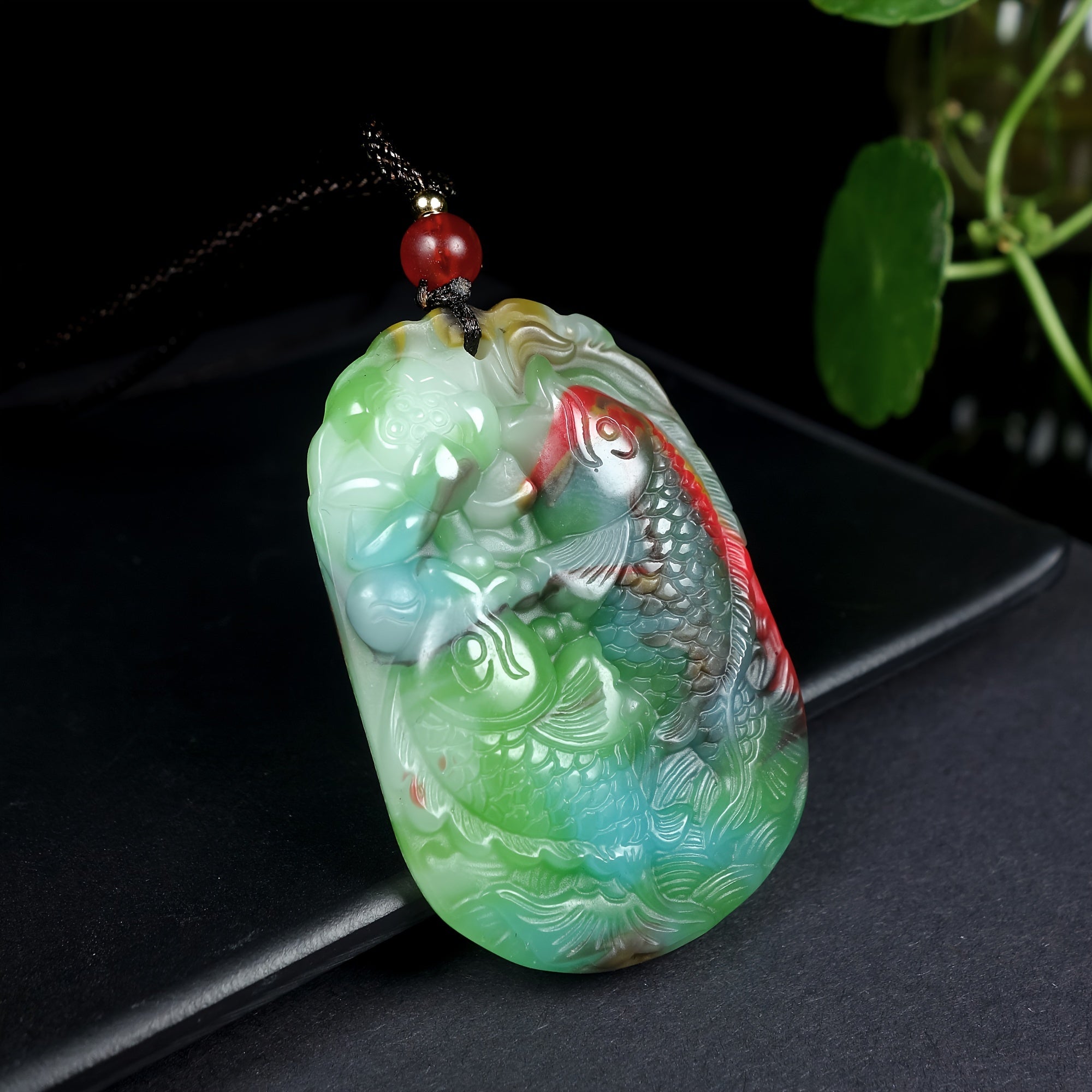


The Fish That Never Swims
You know the moment. It's Tuesday morning, maybe Wednesday. You're standing at your kitchen counter, waiting for the coffee to brew. Your hand reaches for your neck, not out of anxiety exactly, but something like it—a search for texture, for something solid in a morning that feels both familiar and strangely empty.
Your fingers find the stone fish. It's cool at first, having rested against your skin all night. The uneven surface catches on your fingerprint in a way that's become familiar over weeks. You don't think "good fortune" in that moment. You don't think "abundance" or "prosperity." You think: stone. Cool. Here.
Some people notice this shift after wearing something for a month. The symbol stops meaning what the culture says it means, and starts meaning what Tuesday mornings mean. What subway rides mean. What that quiet space between meetings means.
The fish—nian you yu—has traveled through markets for centuries. You've seen it in restaurants, on red envelopes during Lunar New Year. It means surplus, having more than enough. But somewhere between the historical marketplace and your kitchen counter, something changes. The symbol stops pointing outward toward some future abundance, and starts pointing inward toward the abundance of this particular moment.
You might find yourself touching it during video calls. Not when you're speaking, but in those seconds when someone else is talking and you're meant to be listening, but your mind is somewhere else entirely. The weight of it—just heavy enough to notice, not heavy enough to be burdensome—pulls you back. Not to the conversation necessarily, but to your own body. To the fact that you have a body at all, sitting in a chair, participating in this strange ritual of digital connection.
Historical fish symbols swam in different waters. In Buddhist art, they represented freedom from samsara. In Chinese tradition, paired fish meant marital harmony. In early Christian communities, the fish was a secret sign of belonging. But here, in your life, the fish doesn't swim toward any of these meanings. It simply hangs there, a slight weight against your sternum, reminding you that you're breathing.
Over days, you start to notice the temperature changes. How it warms to your skin within minutes of putting it on. How it feels cool again after you've been outside in winter air. The stone has its own thermal rhythm, a slow conversation with your body that has nothing to do with fortune and everything to do with presence.
Sometimes, when you're walking somewhere and your mind is replaying yesterday's conversation or worrying about tomorrow's deadline, your hand will go to the fish unconsciously. The texture interrupts the thought pattern. Not with a message, but with a sensation. Rough stone. Smooth chain. The slight resistance as it catches on your sweater.
This is where symbols stop being symbols and start being companions. They don't teach. They don't guide. They simply exist alongside you, marking time not in years but in mornings, in commutes, in quiet moments before sleep.
The fish that never swims isn't stuck. It's choosing a different kind of movement—the slow accumulation of meaning through use, through touch, through the quiet repetition of daily life.
The Object in Question
If this reflection resonates, you might find the physical companion that inspired it.