




The Unclosed Circle: How an Ancient Taoist Symbol Became Misread as Mere Boho Aesthetic
You notice it first in the morning, when your fingers brush against the cool metal while reaching for something else—a coffee cup, a set of keys. The curve of the silver isn't quite closed. There's a deliberate gap, maybe three millimeters wide, where the circle refuses to complete itself. For a moment, your thumb rests in that space, and you wonder: Is this a mistake, or an invitation?
In the hurried taxonomy of modern jewelry shopping, this form often gets labeled "boho," "organic," or "artisan." The algorithm shows you similar pieces: open circles in hammered brass, uneven hoops, asymmetrical designs. The language around them speaks of "free spirits" and "natural beauty." But the classification feels thin, like trying to describe a river by calling it "wet."
What gets lost in this quick categorization is the specific gravity of the symbol itself—a weight that has traveled through centuries, not just through Pinterest boards.
The Uncarved Block in an Over-Carved World
Around the 4th century BCE, the Taoist philosopher Zhuangzi wrote about the concept of pu (樸)—the "uncarved block." It was an image of potential in its purest form: wood that had not yet been shaped into a specific tool, a stone not yet chiseled into sculpture. The value lay precisely in what it wasn't: not a finished product, but a repository of all possible products. It represented a state of being that was whole, not because it was complete, but because it was undivided from its own nature.
Centuries later, this idea would manifest visually in Chinese brush painting as the "open circle" or "incomplete circle." Artists like Liang Kai, in his famous painting "The Poet Li Bai," would use a single, flowing brushstroke to create a circle that deliberately didn't meet at the ends. This wasn't a lack of skill; it was a philosophical statement. The gap was where the viewer's mind entered the painting. It was an acknowledgment that perfection, in the sense of sealed-off completeness, was a kind of death. Life, by contrast, breathes through openings.
The symbol traveled. It appeared in Zen enso circles in Japan, where the single, fluid stroke represented enlightenment, the universe, and the void—all at once. The beauty of the enso was often in its imperfection: the shaky line, the uneven thickness, the opening that refused to close. Monks would practice drawing it for years, understanding that the form was less about creating a perfect circle and more about capturing a moment of mind that accepted both the circle and the not-circle.
The Modern Misreading: When Continuity Becomes Ornament
Fast forward to the early 21st century. The open circle reappears, but its context has shifted. It's no longer in meditation halls or philosophy texts, but on fashion runways and in boutique jewelry cases. The semantic shift is subtle but profound: from a symbol of continuity without confinement to an aesthetic of casual elegance.
This happens gradually, through a series of quiet translations:
First translation: The spiritual practice becomes a design element. The enso circle, once drawn as a meditation, is now laser-cut from brass and sold as a wall decoration. The gap remains, but the intention behind it changes. It's no longer an invitation to contemplate emptiness; it's a stylish alternative to a full circle.
Second translation: The philosophical concept becomes a personality trait. "Boho-chic" emerges as a style category, and the open circle gets folded into its visual vocabulary. Now it signals not a state of mind, but a type of person: someone "free-spirited," "creative," "unconventional." The symbol is drained of its specific history and becomes a generic marker of a certain lifestyle aesthetic.
Third translation: The active contemplation becomes passive adornment. This is the most significant shift. When you wear an open circle earring today, few people ask, "What does that opening mean?" They're more likely to say, "That's pretty." The symbol ceases to be a question and becomes merely an answer to the question of what looks good with jeans and a white shirt.
This isn't necessarily a loss. Symbols migrate; that's what they do. A cross can be both a religious symbol and a fashion pendant. A lotus can be both a Buddhist emblem and a tattoo design. But something specific happens when the migration erases the journey: the symbol becomes lighter, easier to wear, but also easier to discard. It joins the cycle of trends rather than the continuum of meaning.
The Body's Understanding: Wearing the Gap
And yet—the body often understands what the mind overlooks.
When you wear earrings with an unclosed circle, you experience the symbol in a way that no blog post or historical analysis can replicate. There's the physical sensation: the way the open end sometimes catches on a strand of hair, requiring a gentle untangling. The way, when you take them off at night, they don't lay flat on the dresser but rest at an angle, the gap making them unstable. The way, in moments of distraction, your finger finds that opening and traces its shape, as if checking that the possibility is still there.
These are micro-moments of re-engagement with the symbol's original function. The catch on the hair is a small friction, a reminder that this isn't a seamless, thoughtless ornament. The instability on the dresser echoes the philosophical instability of the form—it refuses to be a closed system. The finger tracing the gap is a quiet, tactile contemplation of what's not there.
Some people notice that they touch these earrings more often than closed hoops. It's not conscious; the hand just goes there. What is it seeking? Perhaps it's checking that the opening remains—that the symbol hasn't somehow "healed" itself into a conventional circle. Or perhaps the touch is a way of participating in the symbol's meaning: by touching the absence, we acknowledge the presence of possibility.

This physical relationship creates a different kind of understanding than intellectual knowledge. You might never read Zhuangzi or study Zen painting, but your body learns something through daily wear: that completeness isn't always about closure; that an ending can be more like a comma than a period; that some forms are designed not to contain, but to connect.
Green Jade's Particular Silence
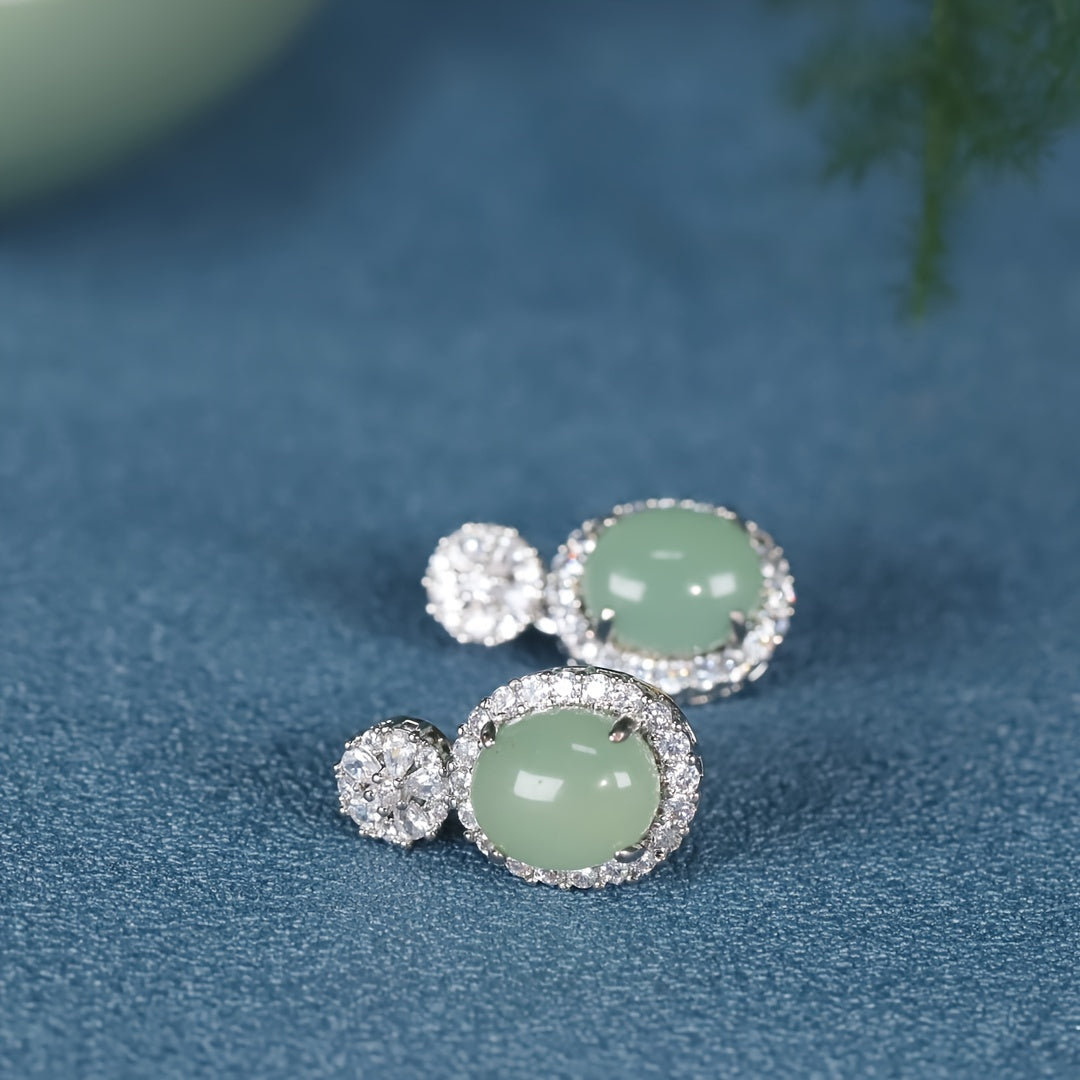
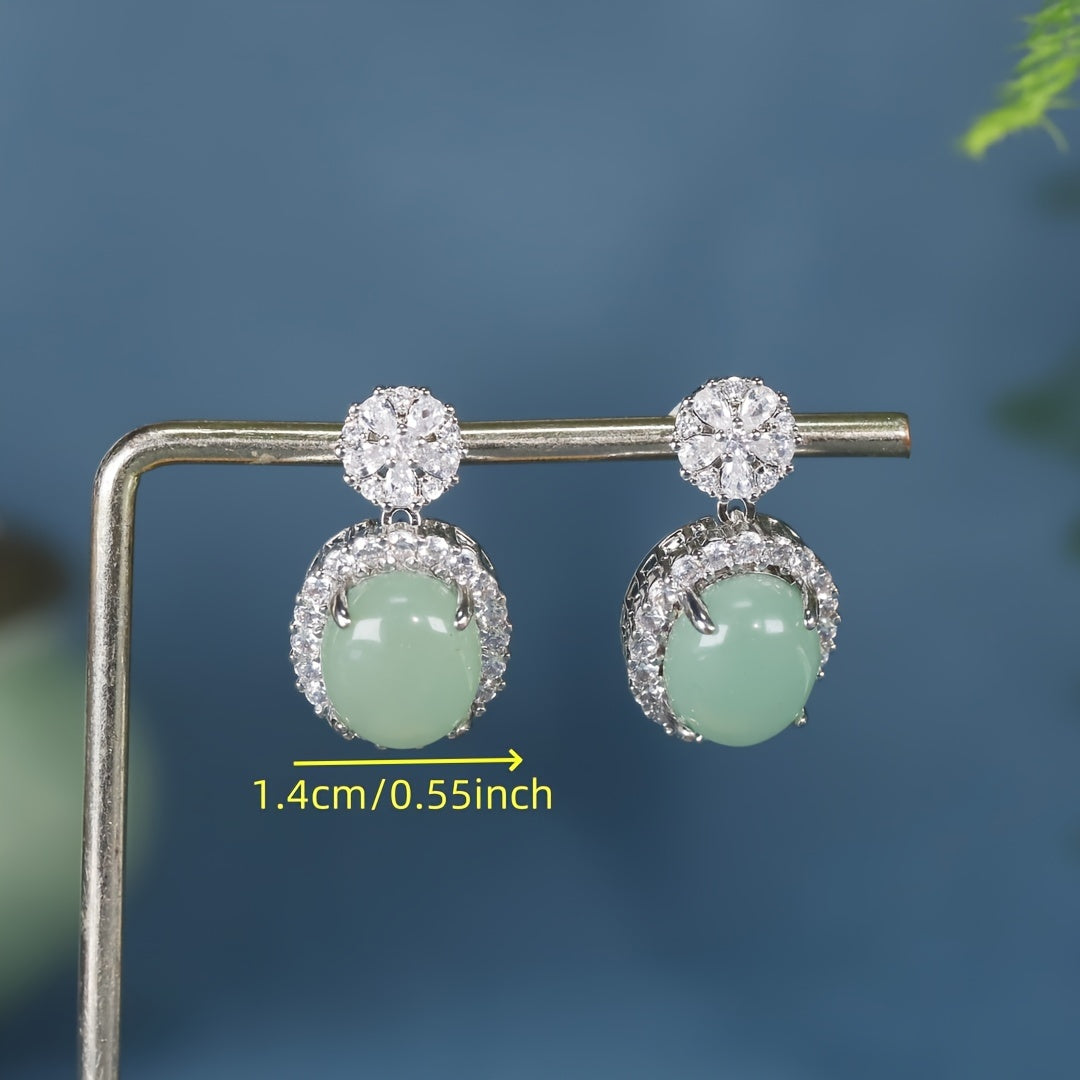
The stone matters here. Green jade carries its own history—of riverbeds, of tectonic pressure, of being shaped by water over millennia before human hands ever touched it. In Chinese culture, jade represents virtue not through flashiness, but through its quiet, enduring qualities: its coolness to the touch, its toughness despite appearing gentle, its ability to be polished to a soft glow rather than a hard shine.
When jade is paired with the open circle form, the combination creates a layered conversation. The jade speaks of time on a geological scale; the open circle speaks of philosophical continuity. The jade is solid, dense, earthly; the circle's gap is empty, light, conceptual. Together, they embody a particular kind of balance: the weight of tradition held lightly by the openness of interpretation.
This is why vintage-inspired designs that use this combination often feel different from purely trendy versions. The vintage element isn't just about an "old-looking" patina on the silver; it's about invoking a longer conversation with the symbol. It suggests that this form has been around, has meant different things to different people, and will continue to evolve.
When you choose earrings like these, you're not just choosing a shape or a stone. You're choosing to wear a symbol that has survived multiple translations—from philosophy to art to spirituality to fashion—and has emerged with its essential question intact: What do we do with the space between endings and beginnings?
The Practical Question: How to Wear a Symbol That Resists Definition
Some people hesitate before wearing openly symbolic jewelry. There's a concern: "Do I need to understand all this history to wear it properly?" Or worse: "Will people think I'm making a statement I don't intend?"
These questions come from a good place—a respect for meaning. But they also come from a modern anxiety about "getting it right." We live in a culture of explainers, of TED talks that promise to demystify everything in eighteen minutes. We expect symbols to have clear, concise meanings that we can learn and then correctly perform.
The open circle resists this entirely. Its meaning is precisely in its resistance to a single meaning. The gap is literally an opening for interpretation. To wear it "correctly" is, in a sense, to wear it with an awareness that it means different things at different times.
In the morning, it might be a reminder that the day doesn't need to be perfectly planned to be meaningful. During a difficult conversation, you might touch it and remember that understanding doesn't require complete agreement—sometimes a little space between positions is where progress happens. At night, taking it off, you might notice how the incomplete circle looks against the wood of your dresser and think about all the things in your life that are beautifully, necessarily unfinished.
The wearing becomes a practice in itself—not of displaying knowledge, but of remaining open to multiple understandings. Some days the earrings feel light and playful; other days they feel weighted with history. Both experiences are "correct," because the symbol contains both possibilities.
When the Symbol Returns to Itself
There's a moment that sometimes happens after wearing such pieces for months or years. The initial fascination with the "meaning" fades. You stop thinking about Taoism or Zen or boho aesthetics. The earrings just become... your earrings. You know their particular weight, how they catch the light at certain angles, which tops they work with.
This might seem like a diminishment—the profound becoming ordinary. But in the logic of the open circle, it might be something else: the symbol completing its journey back to the uncarved block.
When Zhuangzi wrote about the uncarved block, he wasn't describing something rare and special. He was describing the natural state of things before we impose our categories and judgments on them. A block of wood is just a block of wood until we decide it should become a chair or a table. In its "uncarved" state, it contains all possibilities without being limited to any one.
Similarly, when the open circle earrings become simply "your earrings," they return to a kind of symbolic uncarved state. They're no longer "that Taoist symbol" or "that boho piece." They're just this particular arrangement of silver and stone that you choose to wear. And in that simplicity, they actually become more available for meaning, not less. Now they can mean whatever you need them to mean on a given day, because you're not filtering your experience through someone else's interpretation.
This is the quiet revenge of the open circle against its own misreading. However much the fashion world tries to pin it down as a mere aesthetic, the form itself resists final definition. The gap remains. And in that gap, there's room for the wearer to discover that some of the most meaningful things we own are those that refuse to tell us exactly what they mean.
So when your fingers brush against that cool metal in the morning, and you feel the space where the circle doesn't close, you might pause for a second. Not to recall philosophical texts, but to notice what that openness feels like today. Is it inviting? Unsettling? Full of potential? Simply interesting to touch?
The answer changes. And the symbol is designed for that.
