





The Unchanted Wood: How Sandalwood Was Misread as Merely Fragrant

Some people notice it first in hotel lobbies. That familiar scent—warm, woody, slightly sweet—coming from discreet diffusers or candles labeled "spa scent" or "meditation fragrance." The association is immediate: relaxation, luxury, perhaps a vague spirituality. Cleanliness. Calm.
What rarely occurs in that moment is that this scent once traveled with monks across Himalayan passes. That it was carved into beads not for decoration, but because the texture provided something for restless fingers during long hours of sitting. That for centuries, this wood wasn't chosen for how it smelled in a room, but for how it accompanied a person through transitions too subtle for words.
1. The Modern Reality: When Scent Becomes Commodity
Walk into any home goods store today and you'll find sandalwood essential oils, incense cones, scented candles, and room sprays. The marketing language is consistent: "calming," "grounding," "spiritual." The price points vary wildly—from mass-produced synthetic approximations to genuine, sustainably sourced oils costing hundreds of dollars per milliliter.
What's interesting isn't the commercial success, but the semantic shift. Sandalwood has become an effect to be purchased. A mood-altering substance. An ambiance creator. Its value is measured in its ability to produce a specific psychological state or aesthetic environment.
This represents a fundamental misunderstanding of the wood's historical role. For at least three millennia, sandalwood wasn't primarily valued for what it did to people or spaces, but for what it was alongside them. A companion material. A witness substance. Something that existed in parallel to human experience rather than acting upon it.
2. Seeing is Not Passive: The Original Relationship
Examine historical records from South Indian temple archives (5th-8th century CE). Sandalwood appears not in lists of ritual implements, but in inventories of "companion objects." A carved sandalwood box for holding personal items during pilgrimage. Sandalwood beads for travelers. Small carved tokens given to children entering monastic education.
The common thread isn't ritual use, but transitional companionship. Sandalwood accompanied people through changes: geographical changes (travel), social changes (pilgrimage status), developmental changes (child to student).
The scent was incidental—or rather, it was a byproduct of the material's physical properties. The wood's density made it durable for travel. Its fine grain allowed detailed carving that could hold personal symbols. Its natural oils prevented insect damage during long journeys. The fragrance was simply what happened when you worked with or wore this particular wood.
3. Myth and Symbolic Layer: The Threshold Guardian
In Tamil Siddha tradition (circa 10th century), there's a story about a sandalwood tree that grows at the crossing point between three villages. The tree isn't claimed by any village, but travelers from all three stop there to rest. Over generations, people begin leaving small carvings hanging from its branches—not as offerings to gods, but as markers of passage. "I was here during this transition." "I carried this worry across this threshold."
The story contains several layers of meaning that modern fragrance marketing misses entirely:
- Neutral ground: The tree belongs to no one, yet accompanies everyone
- Transition marker: It exists at crossing points, not destinations
- Collective witness: Multiple generations add their markings
- Non-petitionary: The carvings aren't requests; they're acknowledgments
This is sandalwood's original symbolic function: a threshold guardian. Not a guardian that protects or prevents, but one that witnesses passage. The material itself—durable yet aromatic, substantial yet workable—embodies the qualities needed for threshold existence.
4. Modern Mental Dilemma: The Commodification of Experience
Why does this misreading matter? Because it reflects a larger pattern: our tendency to commodify experiences that were once relational.
Consider the difference:
Historical relationship: A pilgrim carries a sandalwood token during a three-month walking journey. The wood becomes smooth from handling. It absorbs sweat, rain, campfire smoke. The scent mingles with the smell of dust, other travelers, roadside flowers. The token becomes a physical record of the journey—not through intentional symbolism, but through actual physical interaction.
Modern relationship: Someone buys "sandalwood serenity" room spray to create a calming atmosphere before meditation. The scent is uniform, consistent, designed to produce a specific effect. The relationship is transactional: payment for psychological state change.
The modern version isn't wrong—it's simply a different thing entirely. But when we mistake the second for the first, we lose something important: the possibility of companionship that doesn't promise results.
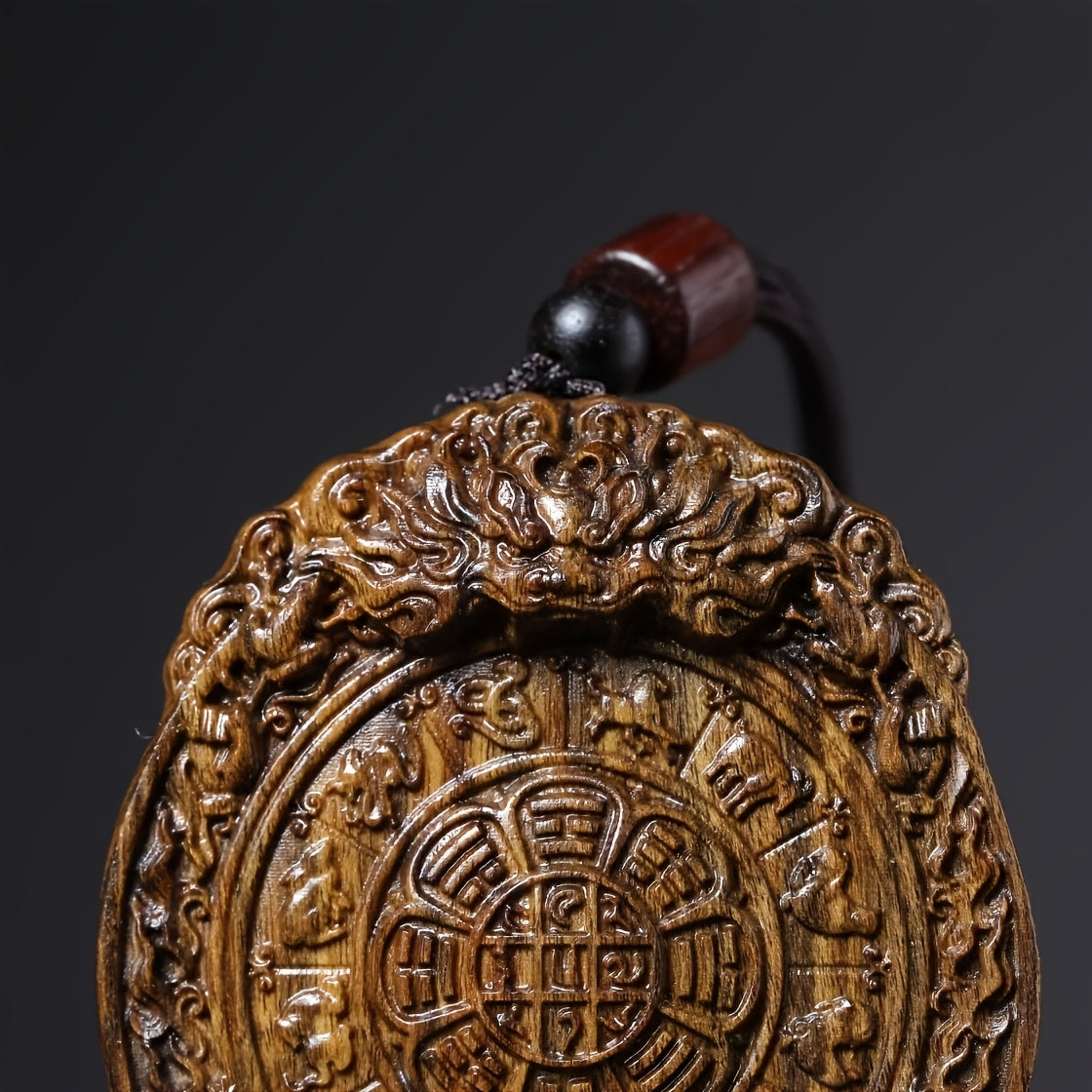
Explore the sandalwood medallion as a contemporary companion object
View the Jewelry Piece →5. Non-reactive Observation: Relearning How to See
If we want to recover sandalwood's original role—or at least understand what was lost—we need to practice a different kind of observation. Not looking for what something does, but noticing what it is alongside us.
Try this with any natural material:
- Hold it without intention. Don't try to relax or receive anything.
- Notice its temperature against your skin. Does it feel cool, warm, neutral?
- Notice its weight. Not in grams, but in presence. Does it feel substantial, light, balanced?
- Notice its texture without evaluating. Rough, smooth, porous, dense—simply observe.
- Breathe normally. If there's scent, notice it as you would notice birdsong outside a window—present but not summoned.
This practice isn't about sandalwood specifically. It's about recovering a mode of relationship that modern consumerism has trained out of us: the ability to be with something without requiring it to perform.
6. The Role of the Object: Jewelry as Physical Companion
This brings us to contemporary jewelry made from sandalwood. When crafted with understanding of the material's history—not as mystical substance, but as companion material—it can serve a unique function.
A sandalwood pendant worn daily becomes:
- A tactile record of days lived (developing patina from skin contact)
- A subtle scent marker that appears unexpectedly (in warmth, during movement)
- A weight presence that's noticeable but not demanding
- A textural reminder through touch (fingers finding familiar carving)
These aren't magical properties. They're simple physical realities. But in their simplicity, they create something modern life often lacks: continuity of presence.
7. Daily Life as Practice: The Unchanted Ritual
The word "enchanted" comes from Latin incantare—to sing spells upon. An enchanted object is one that has been sung over, spell-bound, given magical properties.
Sandalwood, in its original context, was unchanted. No spells were sung over it. No magical properties were claimed. Its power—if we must use that word—lay in its quiet endurance, its capacity to witness without commentary, its physical suitability for human companionship.
We can recover this today through simple daily practices:
Morning dressing: Putting on a sandalwood piece not as adornment, but as choosing a companion for the day.
Transition moments: Touching it when moving between tasks or environments, creating a tactile bridge.
Evening removal: Noticing its temperature (warmer from body heat), its scent (subtly released), acknowledging the day lived together.

8. Why Awareness is Not Slow
There's a common misconception that this kind of relationship requires slowness, meditation, special quiet time. But sandalwood's historical use suggests otherwise.
Pilgrims weren't meditating all day. They were walking difficult terrain, navigating social interactions, managing practical concerns. The sandalwood token was a companion through all of it—the difficult and mundane as well as the contemplative.
The awareness it fostered wasn't a special state, but a continuous thread. A touchpoint. A place to return amidst fragmentation.
In modern terms: you don't need to slow down your entire life. You simply need one point of continuity—one companion who doesn't care how fast you're moving, who simply remains present through the changes of pace.
9. Returning to the Symbolic Core
So what does sandalwood symbolize, if not relaxation or spirituality?
Based on its historical usage across multiple cultures:
- Threshold existence: Being present at transitions without rushing to resolution
- Quiet endurance: Presence maintained through changing conditions
- Companionship without demand: Relationship that asks nothing but mutual existence
- Physical memory: The capacity of materials to record lived experience through subtle changes
These aren't glamorous symbols. They won't sell essential oils. But they might offer something more valuable: a model for how to be with ourselves and our experiences without constant evaluation, improvement, or consumption.
10. Seeker's Dialogue: Living With the Unchanted
Some people hesitate before choosing sandalwood jewelry. The hesitation often takes this form: "But what does it mean?"
This question assumes that meaning must precede relationship. That we need to understand before we can engage.
Sandalwood's history suggests the opposite: meaning emerges through relationship. Through daily wearing. Through noticing when the scent appears. Through the gradual development of patina. Through the weight becoming familiar.
The wood doesn't have a meaning to impart. It has a companionship to offer. The meaning—if there is one—is what grows in the space between wearer and worn.
Perhaps this is the most radical recovery available to us today: not learning what symbols mean, but learning how to live with objects that don't mean anything specific, yet mean everything through the simple fact of shared time.
The unchanted wood waits. Not with answers. Not with promises. Simply with the possibility of quiet companionship through whatever transitions we're navigating—whether we notice its presence or not.
