





The Unspoken Ritual: Integrating a Mala into the Rhythm of an Ordinary Day
It happens at 3:17 PM. Your focus has dissolved into a faint static. The browser has twelve tabs open, each a monument to unfinished thought. Your lower back is tight from the chair. A low-grade anxiety about an upcoming deadline hums in the background. This isn't a crisis; this is daily friction—the mundane, cumulative grinding down of presence that defines so much of contemporary work and life. This is the exact moment when grand spiritual ideas feel distant, and complex rituals feel impossible. And it is the perfect moment for an unspoken ritual.
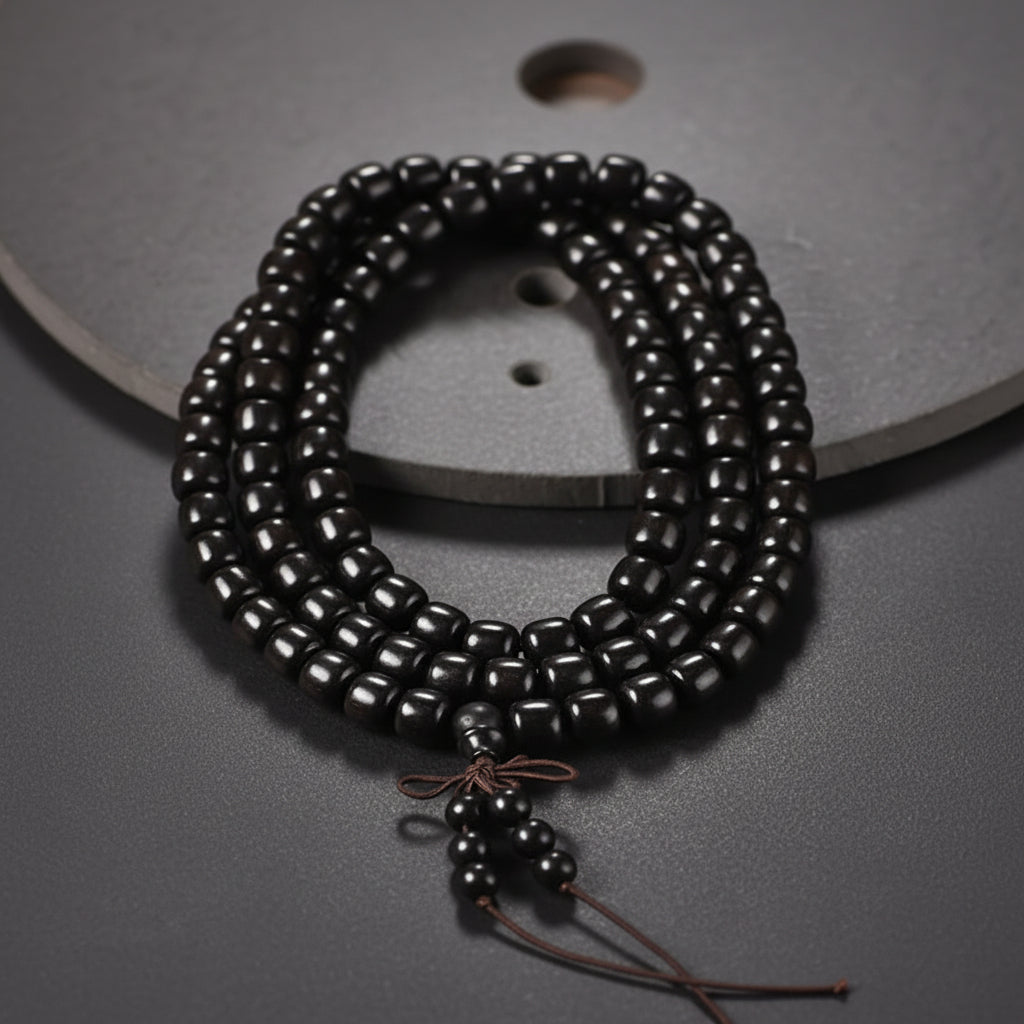
This ritual requires no special clothing, no sacred space, no prior knowledge. It has only one participant and one prop: you, and a string of 108 beads. The goal is not enlightenment or mystical union. The goal is simple: to re-calibrate perception from scattered to gathered, from frantic to rhythmic, from lost in thought to anchored in sensation. This is the practice of using a mala not as a religious object, but as a tactile reset button embedded in your day.
Seeing is Not Passive: The Mala as a Perceptual Tool
We often think of seeing as something that happens to us. Light hits our retina, and we perceive. But conscious seeing—observation—is an active skill. It requires directing and sustaining attention. In a state of friction or overwhelm, our attention is like a spotlight swinging wildly. The mala offers a gentle way to train that spotlight.
Each bead is a discrete, tangible object for attention to land on. Moving from bead to bead is not mindless fidgeting; it is a deliberate, kinesthetic practice of moving attention with intention. You are teaching your mind to follow a single, simple point of focus through space and time. This is a foundational skill for everything from deep work to calm conversation.
The Core Practice: Breath-Bead Synchrony (Without Mantra)
You don't need a Sanskrit mantra. Your breath is the most ancient rhythm you own. Here is the fundamental, adaptable practice:
The Reset Cycle:
- Pause: Stop what you are doing. Put down your phone. Sit back, or simply still your hands.
- Hold: Take the mala in your preferred hand. Feel its weight. Notice the scent if it arises.
- Anchor: With your thumb, gently pull the first bead toward you.
- Breathe & Move: Inhale naturally. As you exhale, allow your thumb to move to the next bead. Don't rush. Let the bead's movement be guided by the completion of your out-breath.
- Continue: Follow this rhythm: Exhale, move bead. Inhale, pause. Exhale, move bead. Your focus is on the twin sensations of the breath leaving your body and the smooth texture under your thumb.
- Complete or Pause: You don't need to finish the full 108. Even 5, 10, or 27 beads can create a perceptual shift. Stop when you feel a sense of gathered presence.
That's it. The entire practice is this loop of sensation and breath. When your mind wanders (it will), just gently return to the feel of the bead and the sound of your exhale. This is the unspoken ritual in its purest form.
Where to Weave It In: Scenarios for Daily Friction
The power of this practice is in its deployability. Here are specific moments where it can serve as a functional tool:
- The Pre-Meeting Reset: In the three minutes before a video call or important meeting, instead of checking email, do one slow round of 10 beads. It grounds you in your body, not in your agenda.
- The Commute Transition: On the train or bus, or after parking your car. Use the mala to consciously mark the transition between "travel mode" and "home mode" or "work mode." It creates a psychological airlock.
- The Creative Block Breaker: When stuck on a problem, switch from cognitive wrestling to tactile rhythm. Often, the solution arises in the space created by this shift in attention.
- The Anxiety Diffuser: In moments of rising anxiety, the combination of rhythmic breathing and focused touch provides a dual anchor that can interrupt the panic loop more effectively than pure thought.
- The Sleep Preparatory: Sitting on the edge of the bed, doing a slow round of beads while breathing deeply tells your nervous system it's time to downshift.
Beyond the Hand: The Wrist as a Constant Cue
Wearing the mala as a bracelet transforms it from a practice tool you take out to a perceptual cue you carry. Throughout the day, your wrist will brush against it. That subtle touch is a micro-reminder: "You are here. You have a body. You can choose where to place your attention."
In a moment of stress, simply moving your other hand to hold the beads on your wrist can be enough to trigger a deeper, calmer breathing pattern. It becomes a non-verbal, always-available shorthand for the reset practice.
The Role of the Object: Why Physicality Matters
Why not just count breaths in your head? The physical object is crucial. It provides external structure for an internal process. When your mind is chaotic, an internal instruction ("focus on your breath") can get lost. An external, tangible sequence (these beads, in this order) is easier to follow. It also engages your sense of touch, which is a powerful pathway into the present moment, often more accessible than trying to control thought directly.
The sandalwood adds another layer. Its scent, activated by warmth, creates a subtle sensory envelope that further distinguishes this ritual space from your ordinary mental space.
Daily Life as Practice: Erasing the Division
The ultimate aim is to erase the hard line between "practice time" and "life time." The unspoken ritual isn't something you do instead of living your life; it's a quality of attention you bring to living your life.
After consistent use, you may find that the mindful, gathered quality you cultivate during your bead practice begins to bleed into other activities. You might notice yourself moving more deliberately, listening more fully, or pausing before reacting. The mala practice becomes a training ground for a mode of being that you can then access even when the beads are out of sight.
Why This Awareness is Not Slow
This practice takes time—maybe two to five minutes a session. But it saves time. It saves the hours lost to distracted, low-quality work. It saves the emotional energy drained by unmanaged anxiety. It saves the relational damage caused by reactive responses. By investing minutes in deliberate re-centering, you reclaim the quality of the hours that follow. This is not slow living; it is efficient perception.
Troubleshooting the Friction: Common Hesitations
"I feel silly / I don't know what I'm doing." This is normal. There is no "right" way, only a sincere way. The practice is between you and your own attention. No one is grading you.
"I keep forgetting to do it." Link it to an existing habit. "After I pour my coffee, I will do one round of beads." Or wear it as a bracelet for constant visual/tactile cues.
"My mind won't stop racing." Perfect. The practice isn't to stop thoughts, but to give your attention another place to go. Each time you notice a thought and return to the bead, you've done a repetition of the most important mental muscle exercise there is.
Returning to the Ritual Core
At its core, this unspoken ritual is an act of kindness and agency. It is a small, private way of saying to yourself: "This moment of friction does not have to own me. I can step to the side of the mental stream and find a point of stillness within it." The beads are just the vehicle. The destination is a more responsive, less reactive you—one conscious bead, one conscious breath, at a time.
Make this practice tangible with the 108-Bead Black Sandalwood Mala—designed for the hand, the wrist, and the spaces between tasks.
View the Jewelry Piece →