




Exploring the profound intersection of ancient Christian symbolism, natural mineral energies, and modern spiritual expression through the lens of handmade cross jewelry that bridges tradition and contemporary consciousness.
Introduction: When Symbols Breathe
In the realm of spiritual expression, symbols serve as bridges between the visible and invisible, the temporal and eternal, the human and divine. Among these, the cross stands as one of humanity's most potent and enduring symbols—a geometric intersection that has carried meanings of sacrifice, redemption, hope, and transcendence across millennia. Yet, when such ancient symbols are crafted from natural materials like stone, wood, or mineral, something remarkable occurs: the symbol becomes "living." It breathes with the earth's own history, carries the memory of geological time, and resonates with vibrational energies that pre-date human civilization.
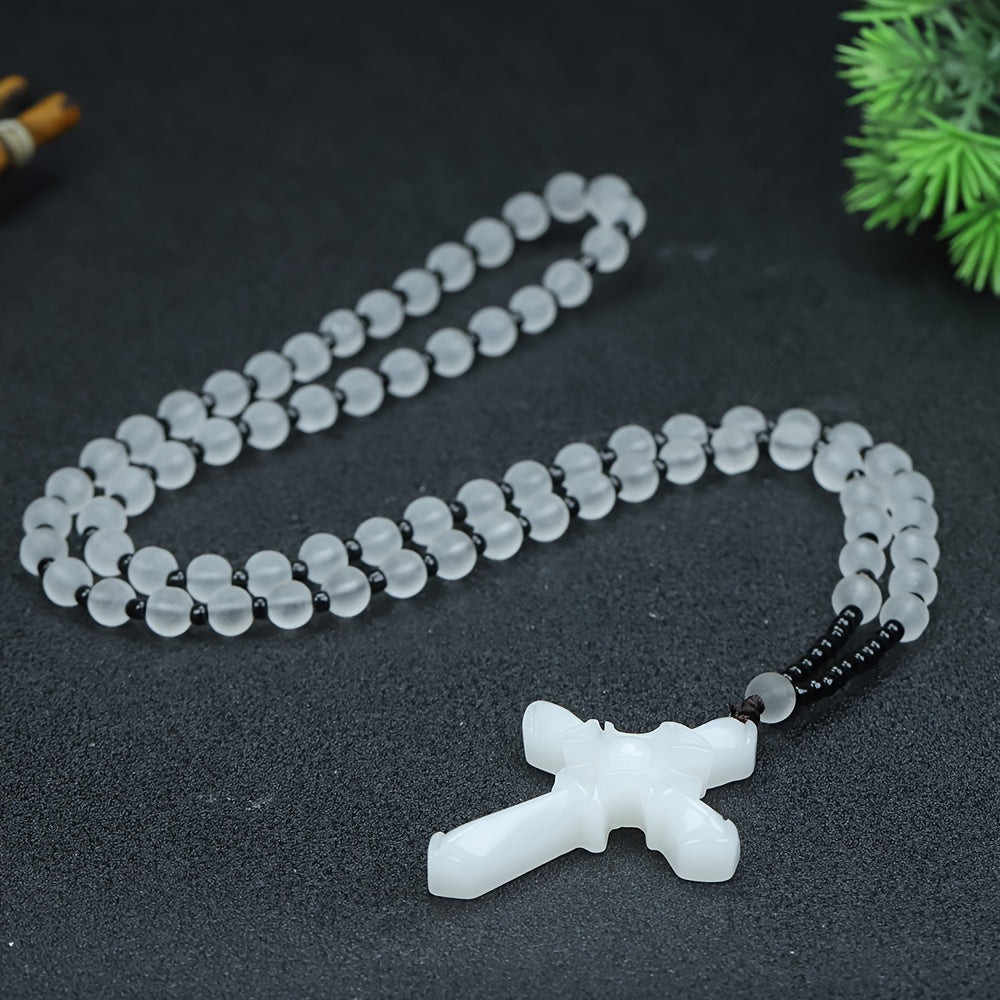
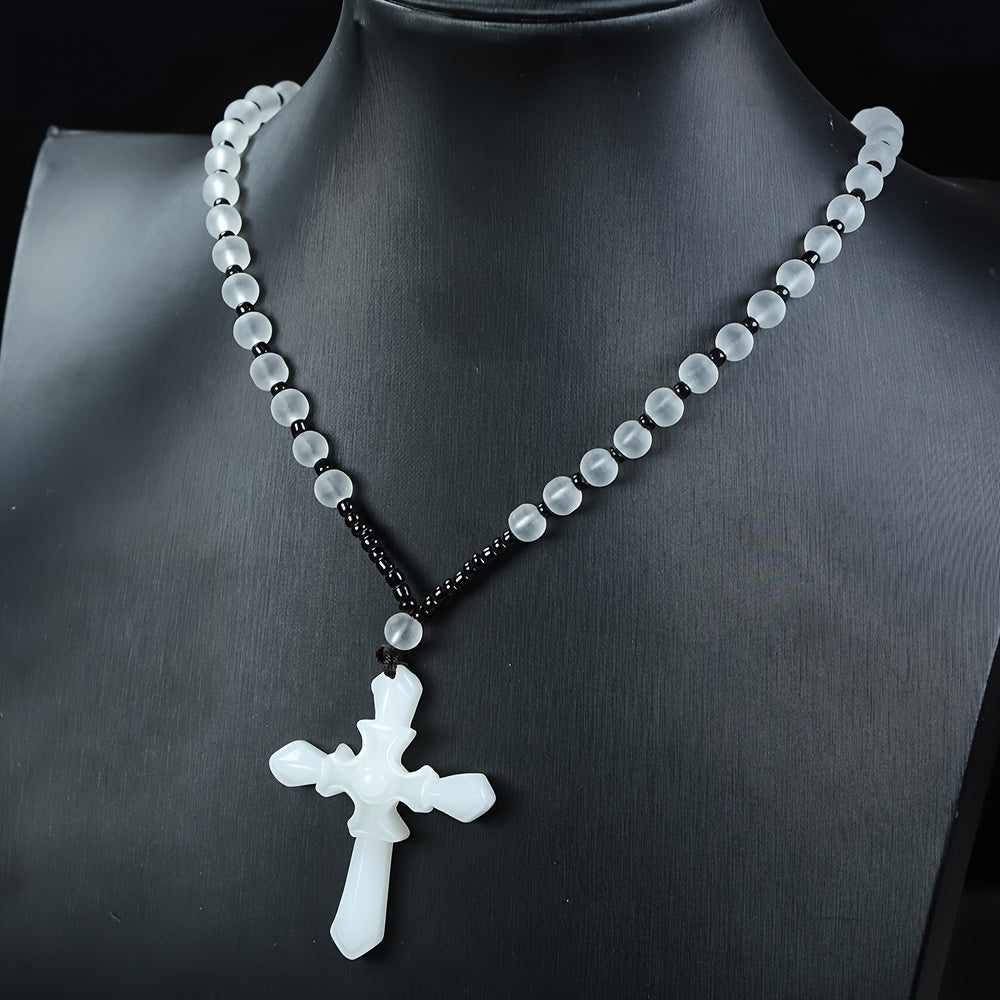
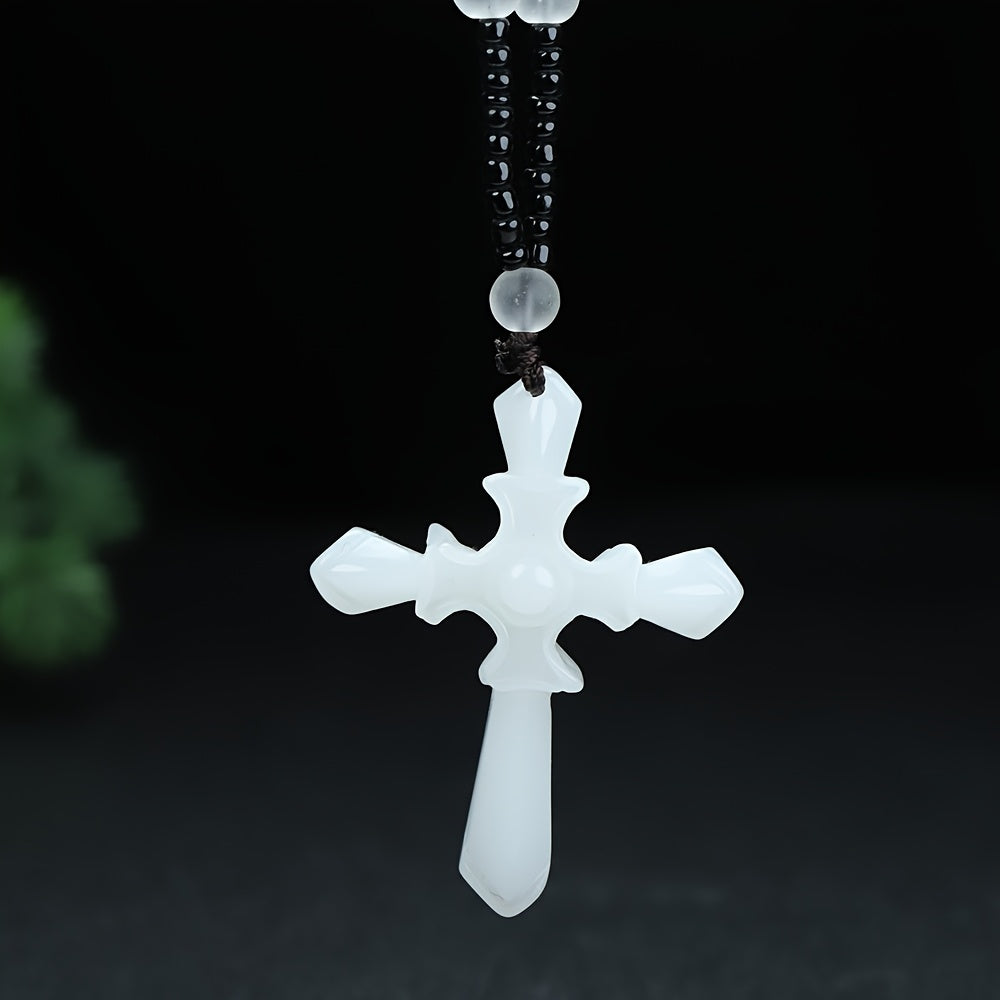
This transformation of religious symbolism through natural materials represents a significant development in contemporary spiritual practice. As modern seekers increasingly value authenticity, sustainability, and holistic approaches to faith, religious jewelry crafted from natural stones offers a bridge between traditional devotion and contemporary values. The Easter cross pendant featured here—with its green and white stones suspended from a black beaded chain—exemplifies this synthesis. It honors Christian tradition while embracing the earth-conscious, energy-aware spirituality characteristic of our time.
"The most profound religious art doesn't merely represent the divine; it participates in divine creativity. When we craft crosses from natural stones, we're not just shaping symbols—we're collaborating with earth's own artistry, allowing geological time to speak through liturgical form. The cross becomes not just a sign pointing to something else, but a meeting point where heaven's geometry and earth's substance embrace."
Historical Background: The Cross Through Material History
Early Christian Material Choices
The earliest Christian crosses were simple, often crafted from whatever materials were available—wood from local trees, stones from nearby quarries, or even etched into walls with whatever tools were at hand. This material immediacy reflected both the humility of early Christian communities and their understanding of incarnation—the belief that divine spirit could inhabit ordinary matter. As Christianity developed, cross materials became more elaborate: gold and jewels for royalty and churches, silver for clergy, simpler materials for common people. Yet throughout this development, a thread remained: the material of the cross mattered, speaking to both the theology of incarnation and the social location of the wearer.
During the medieval period, pilgrim crosses crafted from stones collected at holy sites became popular. These "contact relics" carried the spiritual energy of sacred places, blurring the line between symbol and sacrament. The tradition of crafting crosses from natural materials thus has deep historical roots, though its contemporary revival represents both continuity and transformation—honoring ancient practice while infusing it with modern ecological and energetic consciousness.
The Reformation and Material Simplicity
The Protestant Reformation brought significant changes to Christian material culture, with many reformers advocating for simpler, less ornate religious objects that wouldn't distract from spiritual focus. This led to crosses crafted from humble, natural materials—plain wood, unpolished stone, simple metal. This aesthetic of simplicity, while theologically motivated, accidentally preserved a connection to natural materials that more elaborate Baroque and Rococo styles sometimes obscured.
Today's natural stone cross jewelry inherits this Reformation value of simplicity and authenticity while adding contemporary understandings of mineral energies and sustainable sourcing. The pendulum has swung full circle: from early Christian simplicity to medieval elaboration, through Reformation austerity, to contemporary synthesis that values both natural authenticity and intentional craft.
Material, Energy, and Symbolism: A Triadic Relationship
Stone as Theological Language
In biblical and Christian tradition, stones carry rich symbolic meanings. Christ is called the "cornerstone" (Ephesians 2:20), Peter's name means "rock" with Jesus declaring "on this rock I will build my church" (Matthew 16:18), and believers are described as "living stones" being built into a spiritual house (1 Peter 2:5). The use of actual stones in cross jewelry thus resonates with deep biblical imagery, creating layers of meaning beyond the cross shape itself.
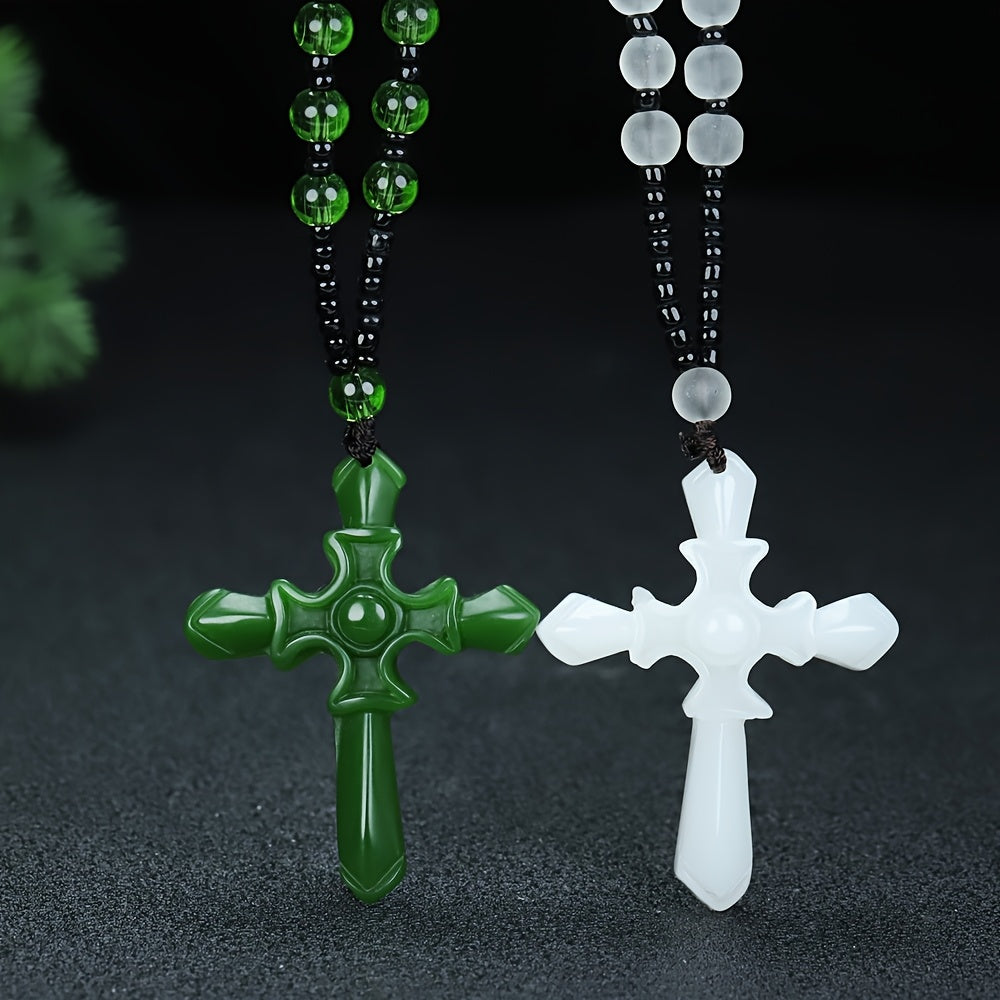
The specific stones used in this Easter cross pendant—green and white—carry additional symbolic weight. Green echoes the "green pastures" of Psalm 23 and the new life of resurrection, while white reflects the "white robes" of Revelation given to those who have washed their robes in the blood of the Lamb. When these stones are natural rather than dyed or synthetic, they carry the authenticity of creation itself, becoming what theologian Matthew Fox might call "original blessings"—unmediated expressions of divine creativity.
Energetic Resonance with Liturgical Themes
Beyond traditional symbolism, natural stones carry vibrational energies that can align with liturgical themes. Green stones like serpentine or jade resonate with heart chakra energy—promoting compassion, healing, and emotional balance—which aligns perfectly with Easter themes of forgiveness and renewal. White stones like howlite or white jade connect to crown chakra energy—facilitating spiritual connection and clarity—which resonates with resurrection themes of illumination and transcendence.
This energetic dimension doesn't replace traditional Christian theology but adds another layer of spiritual engagement. For wearers who understand both Christian symbolism and crystal energies, the cross becomes a multidimensional spiritual tool: theologically meaningful, historically connected, and energetically active. This represents what might be called "integrative spirituality"—honoring traditional religious frameworks while incorporating insights from other wisdom traditions, in this case the understanding of stones as carriers of specific vibrational qualities.
Artistic & Aesthetic Interpretation: Design as Theological Expression
The Cross Form: Geometry of Meaning
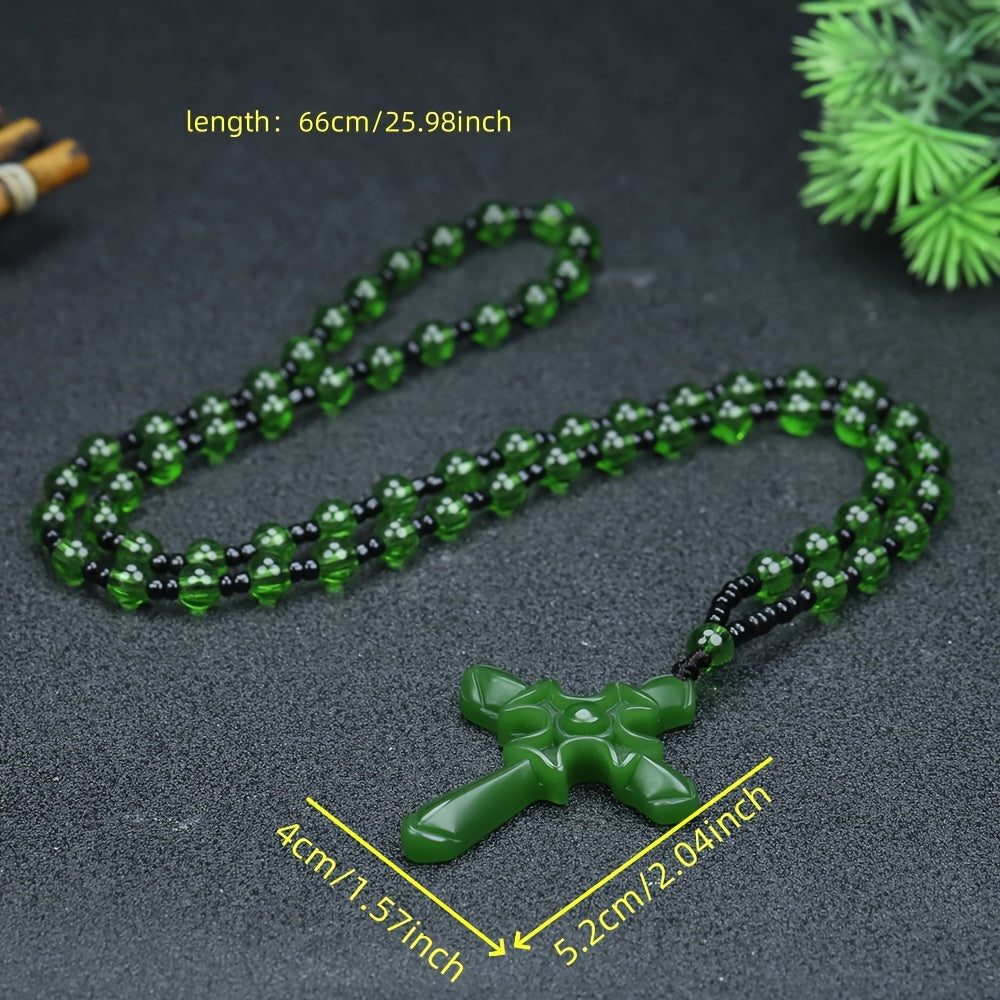
The cross is fundamentally a geometric intersection, and its proportions carry symbolic weight. The vertical beam traditionally represents the connection between divine and human realms, while the horizontal beam represents connection across human community. In well-designed cross jewelry, these proportions are carefully considered. The featured pendant maintains classic Latin cross proportions while allowing space for the green and white stones to create visual interest at the intersection point—the symbolic meeting place of heaven and earth, spirit and matter.
This attention to proportion reflects an understanding that sacred geometry matters in religious art. The cross isn't just a random shape but a specific geometric configuration that has carried meaning for centuries. When crafted with intention, these proportions create visual harmony that resonates at unconscious levels, making the cross not just recognizable but aesthetically satisfying in ways that reinforce its spiritual significance.
Color as Liturgical Language
The green and white color scheme of this pendant isn't merely decorative—it's liturgical. In Christian liturgical tradition, specific colors mark specific seasons and meanings. White is used for festivals of Christ (including Easter), representing joy, purity, and resurrection. Green is used for Ordinary Time, representing growth, hope, and the work of the Holy Spirit in everyday life. By combining these colors on a single cross, the pendant visually represents the integration of festival celebration with everyday spirituality.
This color theology extends beyond traditional liturgy to include color psychology and energy medicine understandings. Green is universally recognized as calming, balancing, and renewing—qualities that support the heart-centered aspects of Christian practice. White represents clarity, illumination, and new beginnings—resonating with Easter's themes of resurrection light. The aesthetic thus works on multiple levels: traditional liturgical, psychological, and energetic.
Emotional & Social Significance: Wearing Faith in Contemporary Society
Personal Devotion in Public Space
Wearing religious jewelry in contemporary pluralistic societies represents a complex negotiation between personal faith and public presentation. A natural stone cross necklace offers particular advantages in this negotiation. Its beauty as jewelry makes it socially acceptable in diverse settings, while its materials signal values of authenticity, sustainability, and earth-connection that resonate beyond specifically Christian circles. This allows wearers to express faith in ways that invite conversation rather than confrontation.
The natural materials also provide what sociologists call "plausibility structures"—tangible supports for belief in a secular age. When faith feels abstract or challenged by modern worldviews, holding or wearing a physical object crafted from earth's own materials can ground belief in sensory experience. The stones' natural variations serve as daily reminders of creation's diversity and beauty, reinforcing theological concepts of God as creator through direct experience rather than just abstract belief.
Interfaith and Interspiritual Bridges
Interestingly, natural stone cross jewelry often appeals beyond traditional Christian circles to those with more eclectic spiritualities. The combination of Christian symbolism with crystal energy concepts creates a bridge between traditional religion and contemporary spirituality movements. This represents what theologian John Thatamanil calls "the interreligious"—not just tolerance between religions but creative intersections that generate new forms of spiritual practice.
For interfaith families or individuals with complex spiritual identities, such jewelry can honor Christian heritage while embracing broader spiritual values. The natural stones make the cross accessible to those who might resist more traditional religious jewelry, creating possibilities for shared spiritual expression across religious differences. This social function—building bridges rather than boundaries—represents an important contemporary adaptation of ancient symbols.
Market Perspective: The Growing Niche for Meaningful Religious Jewelry
From Mass-Production to Meaningful Craft
The religious jewelry market has traditionally been divided between mass-produced inexpensive items and high-end precious metal/jewel pieces. The emerging market for handcrafted natural stone religious jewelry represents a significant third way: items that are affordable yet artisanal, accessible yet meaningful. This reflects broader consumer trends toward conscious consumption—purchasing decisions based on values like sustainability, authenticity, and story rather than just price or brand.
This market shift has theological implications. When religious objects are mass-produced in factories far removed from any spiritual intention, they risk becoming what sociologist George Ritzer calls "McDonaldized"—efficient, predictable, but devoid of deeper meaning. Handcrafted natural stone jewelry reintroduces what Walter Benjamin called "aura"—the unique presence and history of an artwork that cannot be replicated. For religious objects, this aura includes not just the maker's intention but the stone's geological history and the wearer's personal relationship with the piece.
Demographic Shifts and Spiritual Consumption
Market research indicates growing interest in religious and spiritual products among millennials and Gen Z, particularly when these products align with values like sustainability, authenticity, and inclusivity. Natural stone cross jewelry appeals precisely to these values. Its materials are earth-friendly (especially when ethically sourced), its making is transparent (often with stories about artisans and sourcing), and its symbolism can be interpreted inclusively (honoring Christian tradition while being accessible to those with eclectic spiritualities).
This represents a significant opportunity for religious artisans and small businesses. Rather than competing with mass-produced religious goods on price, they compete on values—offering not just products but meaningful experiences, not just symbols but spiritual tools. The success of such businesses suggests a growing market for what might be called "slow spirituality"—intentional, meaningful, relationship-based spiritual practice supported by intentionally crafted objects.
Expert Commentary: Multidisciplinary Perspectives
Theological Perspective
Dr. Sarah Jenkins, professor of theology and material culture: "The shift toward natural materials in religious jewelry represents what I call an 'incarnational turn' in contemporary spirituality. Incarnation theology teaches that divine spirit takes material form. When we craft crosses from natural stones, we're participating in this incarnational principle—allowing divine meaning to take form in earth's own substances. This is particularly meaningful in an age of ecological crisis, as it reconnects Christian practice with creation care in tangible ways."
Art Historical Perspective
Dr. Marcus Chen, art historian specializing in religious objects: "Throughout Christian art history, materials have always carried theological meaning. Gold represented divine light, precious stones represented heavenly Jerusalem, wood represented Christ's humanity. Contemporary natural stone crosses continue this tradition but with different material meanings: sustainability, authenticity, earth-connection. What's fascinating is how these contemporary values align surprisingly well with early Christian material choices—simple, local, meaningful rather than ostentatious."
Psychological Perspective
Dr. Elena Rodriguez, psychologist studying material religion: "Our research shows that religious objects crafted from natural materials have different psychological effects than mass-produced versions. The natural variations in stone create what we call 'perceptual richness'—ongoing visual interest that encourages repeated engagement. This makes the object more effective as a focus for meditation or prayer. The tactile qualities of natural stone also provide sensory grounding that can reduce anxiety during spiritual practice."
Technical Craftsmanship: From Stone to Sacred Symbol
The Art of Stone Selection and Matching
Crafting a cross pendant from natural stones begins with careful material selection. Unlike synthetic materials that offer uniformity, natural stones present unique challenges and opportunities. The artisan must select stones with complementary colors, compatible hardness for combined setting, and appropriate sizes for the cross proportions. For the green and white cross, this might involve selecting stones from different sources that nonetheless harmonize in both appearance and energetic quality.
This selection process requires both aesthetic sensitivity and technical knowledge. The stones must not only look good together but work together physically—similar enough in hardness that one won't wear down faster than the other, compatible in their response to cutting and polishing. This technical challenge mirrors the theological challenge of Christian incarnation: how divine meaning takes particular material form without being limited by that form.
Setting and Finishing with Intention
The setting of stones into cross form represents another layer of craftsmanship with spiritual dimensions. How the stones meet at the cross center—the intersection point—requires particular attention. This meeting point symbolizes the crux of Christian faith (literally, "crux" means cross): the intersection of divine and human in Christ. A well-crafted setting makes this intersection visually and energetically meaningful.
The finishing process—polishing, smoothing edges, ensuring secure setting—has both practical and spiritual dimensions. Practically, it ensures durability and comfort. Spiritually, it represents the refinement of faith through practice, the smoothing of rough edges through spiritual discipline. Many artisans report praying or maintaining spiritual focus during this finishing work, infusing the object with intention beyond mere technical skill.
Environmental Sustainability: Faith and Ecology Intersect
Ethical Stone Sourcing as Stewardship
The use of natural stones in religious jewelry raises important questions about environmental ethics and Christian stewardship. Ethical artisans address these questions through careful sourcing: selecting stones from suppliers who practice responsible mining, avoid environmental damage, and ensure fair labor practices. This transforms the purchase of religious jewelry into an act of environmental stewardship—supporting sustainable practices through consumer choice.
This represents a concrete application of creation theology—the understanding that caring for earth is part of religious responsibility. When a cross is crafted from ethically sourced stones, it carries not just theological meaning but ecological witness. This is particularly significant given growing Christian engagement with environmental issues, from Catholic teachings on "integral ecology" to evangelical creation care movements.
Longevity and Anti-Consumerism
Well-crafted natural stone jewelry offers exceptional longevity compared to mass-produced fashion jewelry. A cross pendant like the featured piece, with proper care, can last generations—becoming an heirloom that carries family faith stories across time. This longevity represents an alternative to disposable consumer culture, aligning with Christian values of simplicity, stewardship, and intergenerational connection.
This anti-consumerist dimension has theological resonance. In a culture of constant consumption, choosing a durable, meaningful religious object represents what theologian William Cavanaugh calls "theopolitical" resistance—small acts that challenge dominant economic systems through alternative values. The cross, symbol of counter-cultural sacrifice, becomes through its materiality a counter-cultural statement against throwaway consumerism.
Fashion Trends: Religious Symbolism in Contemporary Style
The Modest Fashion Movement
The growing modest fashion movement has created renewed interest in religious jewelry as both faith expression and style statement. Natural stone cross necklaces fit perfectly within this trend—offering coverage (the cross rests near the heart), modesty (the materials are elegant but not flashy), and meaning beyond mere fashion. This represents a significant shift from previous decades when religious jewelry was often either hidden or ostentatious, with little middle ground.
This trend reflects broader cultural movements toward authenticity and values-based consumption. In fashion as in other areas, consumers increasingly seek products that express who they are and what they value. For many, this includes religious identity—not as separate from fashion identity but integrated with it. Natural stone crosses offer this integration: beautiful enough for fashion consciousness, meaningful enough for spiritual identity.
Gender-Neutral Spiritual Accessories
Contemporary fashion shows increasing fluidity in gender expression, with accessories playing important roles in this fluidity. Natural stone cross necklaces often transcend traditional gender categories—their simplicity and natural materials making them appealing across gender identities. This represents an important development in religious jewelry, which has often been highly gendered (delicate crosses for women, bold ones for men).
This gender neutrality aligns with theological understandings of baptismal equality—the idea that in Christ "there is neither male nor female" (Galatians 3:28). By creating crosses that appeal across gender lines, artisans give material form to this theological principle, creating inclusive religious objects that welcome diverse expressions of faith and identity.
Social Impact: Jewelry as Community Builder
Creating Conversations About Faith
Wearing distinctive religious jewelry often sparks conversations about faith, spirituality, and meaning. Natural stone crosses, with their beauty and uniqueness, particularly invite such conversations. Unlike more common cross designs that might go unnoticed, the combination of traditional symbol with natural materials often prompts questions: "What stone is that?" "What does the green represent?" "Where is it from?"
These conversations create opportunities for what missiologists call "faith sharing"—not in aggressive evangelism but in natural relationship. The jewelry becomes what anthropologist James Bielo calls "material witness"—not preaching but simply being present as beautiful object that invites curiosity. In increasingly secular societies where religious conversation can be challenging, such material witnesses create gentle openings for meaningful exchange.
Supporting Artisan Communities
The market for handcrafted natural stone religious jewelry supports networks of artisans, many in developing regions where traditional crafts provide important livelihoods. When consumers choose such jewelry over mass-produced alternatives, they support these artisan communities, often with fair trade principles that ensure living wages and dignified working conditions.
This economic impact has spiritual dimensions. Supporting artisans aligns with biblical teachings about fair wages (James 5:4) and valuing craftsmanship (Exodus 31:1-5). It transforms jewelry purchase from mere transaction to relationship—connecting wearer with maker, consumer with producer, in ways that honor human dignity and creative gift. This represents what theologian Kathryn Tanner calls "theological economics"—economic practices shaped by theological values rather than market values alone.
Future Outlook: The Evolution of Religious Material Culture
Digital Integration and Physical Presence
As religious practice increasingly incorporates digital elements, physical religious objects take on new importance as anchors of tangible presence. Natural stone crosses represent what might be called "analog spirituality"—grounding digital faith experiences in physical reality. Future developments might include thoughtful integration of digital and physical: crosses with QR codes linking to prayers or scriptures, or companion apps that tell the stone's geological and spiritual story.
The challenge will be maintaining the simplicity and authenticity that make natural stone crosses meaningful while incorporating helpful technology. Done well, such integration could deepen rather than distract from spiritual practice, creating multidimensional religious objects for multidimensional spiritual lives.
Expanding Interfaith Material Dialogues
The success of natural stone Christian jewelry suggests possibilities for similar approaches in other religious traditions: natural stone Star of David pendants, Hamsa hands, Om symbols, or Buddhist prayer beads. This could foster what scholar Catherine Cornille calls "interreligious empathy"—understanding other faiths through engagement with their material culture.
Such expansion would enrich both religious jewelry markets and interfaith understanding. By approaching different religious symbols with shared values of natural materials, ethical sourcing, and artisanal craft, we create common ground across religious differences. The materials become conversation starters not just about specific faiths but about shared human values of beauty, meaning, and earth-connection.
Exhibitions and Related Events: Sacred Craft in Cultural Context
Museum Exhibitions on Material Faith
Major museums have mounted exhibitions exploring the intersection of faith and material culture, such as the Victoria & Albert Museum's "Strange and Sacred" or the Museum of Fine Arts Boston's "Sacred Landscapes." These exhibitions often include contemporary religious jewelry alongside historical pieces, demonstrating continuity and innovation in sacred craft.
A natural stone cross pendant would fit perfectly in such contexts, illustrating how traditional symbols adapt to contemporary material sensibilities. Such exhibitions validate religious craft as significant cultural expression, positioning it within broader narratives of human creativity and meaning-making rather than marginalizing it as merely devotional or commercial.
Sacred Craft Fairs and Religious Art Shows
The growing "sacred craft" movement has spawned fairs, shows, and online markets specifically for religious and spiritual handmade goods. These events bring together artisans, religious communities, and spiritual seekers, creating spaces where faith and craft intersect in celebration rather than commerce alone.
At such events, natural stone crosses find appreciative audiences who understand both their spiritual significance and craft excellence. These gatherings serve as important incubators for the values represented by such jewelry—intentional making, meaningful materials, spiritual depth. They represent alternatives to impersonal religious goods retail, creating communities around shared values of beauty, meaning, and sacred intention.
Conclusion: The Cross That Grows
The natural stone Easter cross pendant represents more than a beautiful object—it embodies a particular approach to faith in contemporary world. In choosing to wear or gift such a piece, we participate in values that matter deeply today: authenticity over pretense, sustainability over disposability, meaning over mere fashion, integration over separation of sacred and secular.
This cross invites us to consider how ancient symbols can speak anew through earth's own language of stone and mineral. It reminds us that faith, like stone, is formed under pressure, polished through friction, and made beautiful through time and intention. The green stone speaks of continual renewal—faith that grows rather than stagnates. The white stone speaks of clarity—faith that illuminates rather than obscures. Together on the cross form, they tell a story of intersection: where divine meets human, tradition meets innovation, symbol meets substance.
As we navigate complex spiritual landscapes, such tangible anchors matter. The natural stone cross becomes not just personal adornment but spiritual companion—a small piece of earth's eternity worn close to the heart, whispering of deeper realities, grounding lofty beliefs in tangible beauty, and reminding us that the most enduring symbols are those that, like the stones themselves, carry the memory of deep time while speaking to present moment.
Carry a piece of this meaningful synthesis with you:
View Product Details & Buy Now