





The Ear as a Threshold: A Practice in Asymmetrical Listening
When perception becomes one-sided. A simple exercise using the gentle sway of a drop earring to recalibrate attention, to practice hearing the world—and your own thoughts—with deliberate, rotational focus.
The Friction: When Listening Becomes Half-Hearted
It happens in the middle of a conversation. You're nodding, making eye contact, but part of your mind is already drafting a response, or thinking about your next meeting, or replaying something that happened earlier. You're hearing, but you're not listening. The words enter one ear and seem to exit the other without ever fully landing.
Or it happens when you're alone with your thoughts. You're trying to focus on a task, but your attention is pulled in multiple directions—by notifications, by ambient noise, by an underlying anxiety. You can't hear your own thinking because the signal is lost in the noise.
This is the daily friction: perception becomes scattered, diluted, or prematurely editorialized. We hear through a filter of preparation, judgment, or distraction. True listening—receptive, open, patient—becomes a rare event rather than a default state.
The problem isn't that we don't want to listen. It's that our perceptual habits have adapted to a world of constant input. We've learned to skim, to multitask, to prioritize efficiency over depth. Listening deeply feels slow, inefficient, even risky. What if we hear something that requires us to change our mind? What if we hear our own doubts clearly?
So we settle for half-listening. And in doing so, we miss layers—in others' words, in situations, in ourselves. The friction is the gap between what we could perceive and what we actually allow in.
The Anchor: A Weight That Swings
The practice begins with a simple physical fact: when you wear a drop earring with a little weight to it, and you turn your head, the earring swings. It lags behind your movement for a fraction of a second, then catches up. This creates a gentle tug on your earlobe—a brief, tactile reminder of the motion you just made.
This sensation is the anchor. It's not meant to be dramatic or distracting. It's meant to be subtle—a whisper from your own body, saying, You just moved. Did you notice?
Most of the time, we move through the world without registering these micro-movements. We turn to look at someone, we glance at a screen, we shift in our chair. The motion is automatic, unconscious. The swinging earring makes it slightly less automatic. It adds a tiny moment of feedback.
Here's how to work with this anchor:
Step 1: Notice the swing. When you feel the gentle pull of the earring as you turn your head, let that sensation be a cue. Instead of ignoring it, pause for just a second. Let the swing complete its arc. Feel the weight return to stillness.
Step 2: Connect swing to source. Ask yourself: What prompted that head turn? Was it a sound? A person speaking? A thought? Trace the motion back to its origin.
Step 3: Reset attention. In that moment of tracing, your scattered attention has just been gathered to a single point—the physical sensation and its cause. From that gathered point, you can choose where to direct your attention next, with more intention.
This isn't about stopping your thoughts. It's about creating a small, rhythmic interruption in the flow of automatic reaction, creating space for a more chosen response.
The Practice: Asymmetrical Listening
Now we apply the anchor to listening. This practice is called asymmetrical listening because it uses the physical asymmetry of wearing a single drop earring (or focusing on one ear when wearing both) to train attention.
Exercise: The One-Eared Conversation
1. Choose a context: A low-stakes conversation—perhaps with a colleague, a friend, or during a family meal.
2. Set your anchor: Wear the drop earring(s). At the start of the conversation, take a moment to feel the weight on your earlobe(s).
3. Focus on one "ear side": As the other person speaks, consciously direct your attention to listening through the ear wearing the drop. Imagine the sound waves entering that ear specifically. Feel the weight of the earring as you keep your head still to listen.
4. When you feel the swing: If you start to turn your head away (to look at something else, to prepare your response), the earring will swing. Let that swing be a gentle signal: Ah, I'm leaving the conversation. Gently bring your attention back to the speaker, and to the feeling of listening through that anchored ear.
5. Notice the difference: Does the voice sound different when you listen with this deliberate focus? Do you catch more nuance? Do you find yourself formulating responses less urgently?
The goal is not to maintain perfect focus, but to notice when you drift, and to have a gentle, physical way to return. The earring is not a magic tool; it's a training wheel for attention. Over time, the mere thought of the earring can become the cue to listen more deeply, even when you're not wearing it.
This practice works because it gives the abstract act of "listening" a physical location and sensation. It grounds perception in the body. It makes listening something you do with a specific part of yourself, rather than a passive reception that happens somewhere in your head.
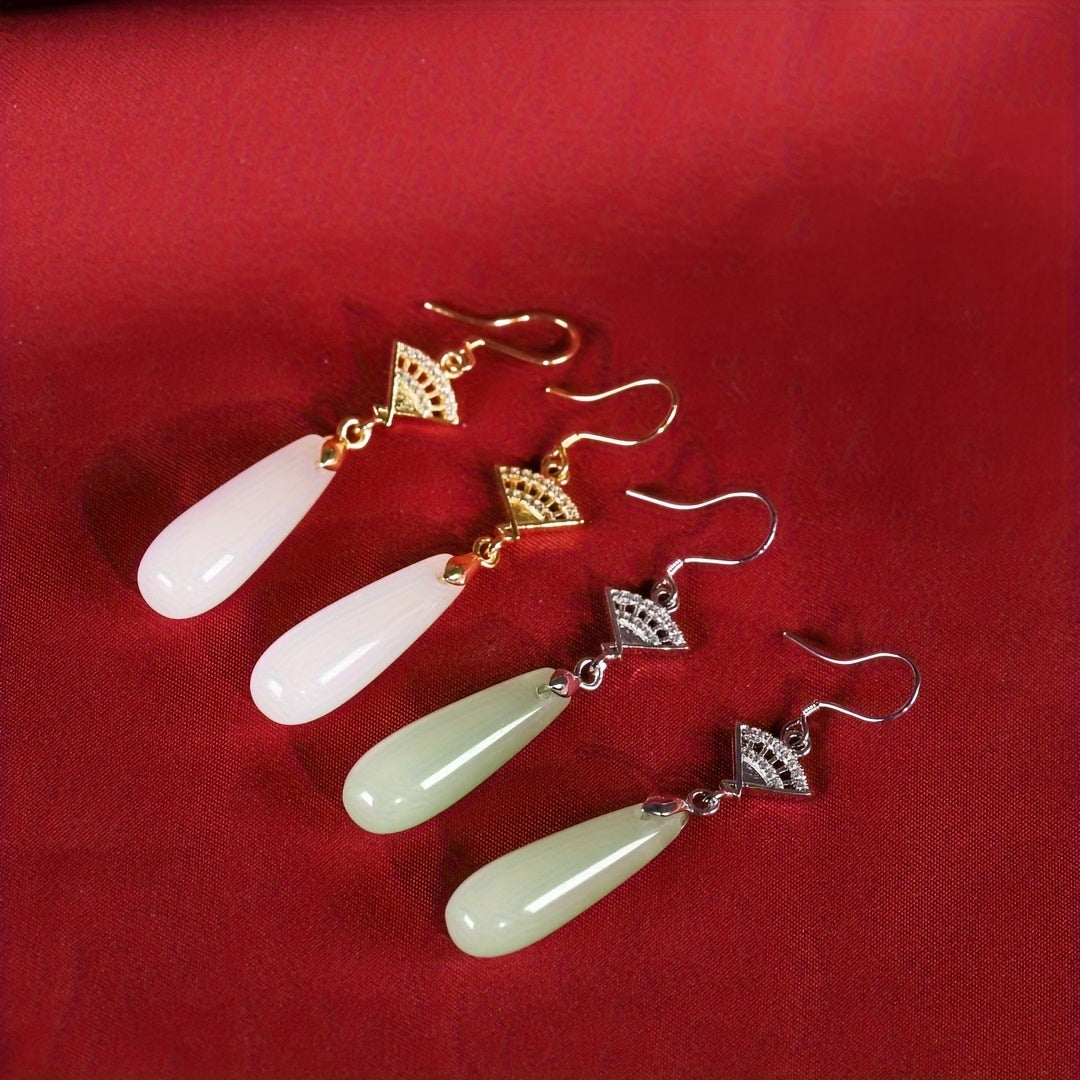
Use the Red Agate Drop Earrings as an anchor for deeper listening.
View the Jewelry Piece →