





Noticing the Inner Flame: A Practice of Identifying Your Own Unseen Strength
A simple, daily exercise to move from reacting to perceiving your own resilience. Using a symbolic object as a physical anchor, learn to recognize your quiet, formidable nature.
Where in your daily life do you most easily lose touch with your own resilience?
Not in the big crises—those often summon strength we didn't know we had. But in the small, cumulative frictions: the third interruption in an hour, the passive-aggressive email, the task that should be simple but keeps hitting snags, the feeling of being pulled in too many directions at once.
These moments don't break us. They scatter us. They don't destroy our strength; they make us forget we have it. We react rather than respond. We become fragmented rather than centered. The inner flame—that steady core of resilience—doesn't go out. We just lose sight of its light.
This article offers a practice. Not a grand spiritual discipline, not a life-changing revelation, but a simple, repeatable method for noticing when you've lost touch with your inner strength and gently returning to it. It uses a physical object—the dragon pendant—as an anchor, but the practice works with any small, meaningful item you can carry or wear.
The goal isn't to become invincible. It's to become noticing. To recognize the subtle shift from centered presence to reactive fragmentation. And to have a reliable way back.
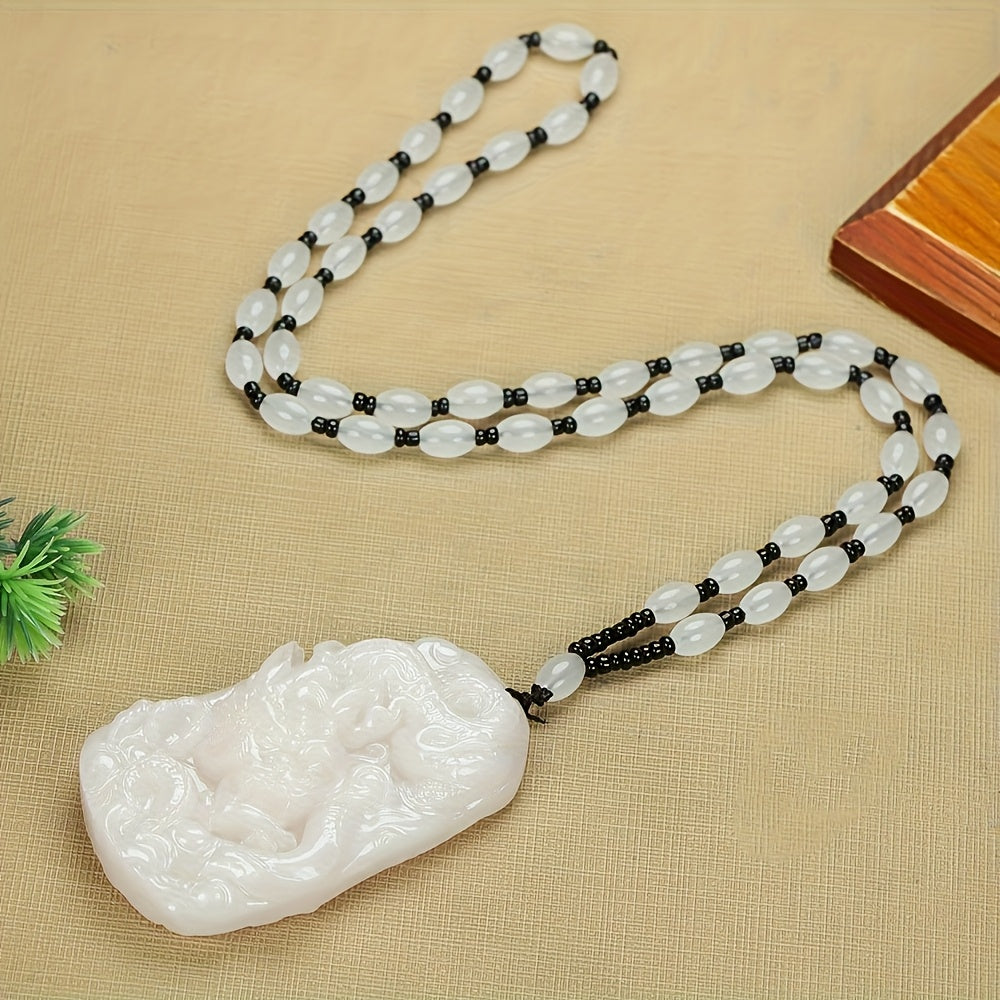
A physical anchor for an internal practice: the pendant serves as a tactile reminder to return to centered awareness.
The Problem: How We Lose Ourselves in Daily Friction
Before we can practice returning to our center, we need to understand how we leave it. Modern life is engineered for distraction, not depth. Consider these common friction points:
You're writing an email while half-listening to a meeting while checking notifications. Your attention is split, not multiplied. Each fragment gets less than full presence. The inner flame isn't extinguished—it's divided into weaker sparks.
Someone sends a curt message. You feel a surge of defensiveness. Before you're aware of it, you've crafted a equally curt reply. The reaction happened to you, not through you. The inner flame was obscured by the flash of reactive heat.
Too many demands, not enough time. Instead of prioritizing, you freeze or flit between tasks without completing any. The inner flame feels distant, like a light at the end of a long tunnel you don't have energy to walk through.
Scrolling through others' curated achievements, you measure your raw reality against their highlight reels. Your own strengths feel inadequate. The inner flame is overshadowed by others' apparent brightness.
These aren't moral failings. They're perceptual habits. We've trained ourselves to notice external stimuli more than internal states. The phone buzzes—we notice. The inbox pings—we notice. But the subtle shift from centered presence to fragmented reaction? That often goes unnoticed until we're deep in the fragmentation.
First Awareness Exercise: For the next hour, notice each time you switch tasks or contexts. Don't judge it or try to change it. Just notice: "Ah, I'm switching from writing to checking messages." "Ah, I'm moving from focused work to social interaction." This simple noticing is the foundation of the practice.
The Anchor: Why Physical Objects Help
Our minds are slippery. Thoughts drift. Intentions fade. This is why spiritual traditions use physical anchors: prayer beads, meditation cushions, altars, mandalas. The physical object provides a stable reference point in an unstable mental landscape.
The dragon pendant serves this function. But it's not magical. Its effectiveness comes from three properties:
Tactile Presence: You can feel it. Its weight against your skin, its texture under your fingers. This physical sensation provides an immediate, non-conceptual anchor to the present moment. When your mind is spinning in future worries or past regrets, the physical sensation says: "Here. Now. This."
Symbolic Resonance: It means something to you. The dragon represents inner strength, sovereignty, contained power. This isn't arbitrary symbolism; it's a semantic shortcut. When you see or feel the dragon, it evokes the concept of inner strength without needing to articulate it intellectually.
Consistency: It's always the same. While your mental state changes—calm, anxious, focused, scattered—the pendant remains constant. Its unchanging nature provides a reference point against which you can notice your own changing states.
Together, these properties create what we might call a "perceptual checkpoint". The pendant isn't telling you what to feel or think. It's offering a moment to check: "What am I feeling? What am I thinking? Am I centered or scattered?"
You don't need this specific pendant for this practice. Any small object can serve if it has these three qualities: 1) It's physically noticeable (you can feel or see it easily), 2) It has personal meaning (not necessarily deep, just meaningful to you), 3) It's consistently present (you wear or carry it regularly). A ring, a bracelet, a smooth stone in your pocket—all can work.
The dragon pendant is particularly suited because its symbolism (strength, sovereignty) aligns with the practice's goal (remembering inner resilience). But the practice is portable. The principles matter more than the specific object.
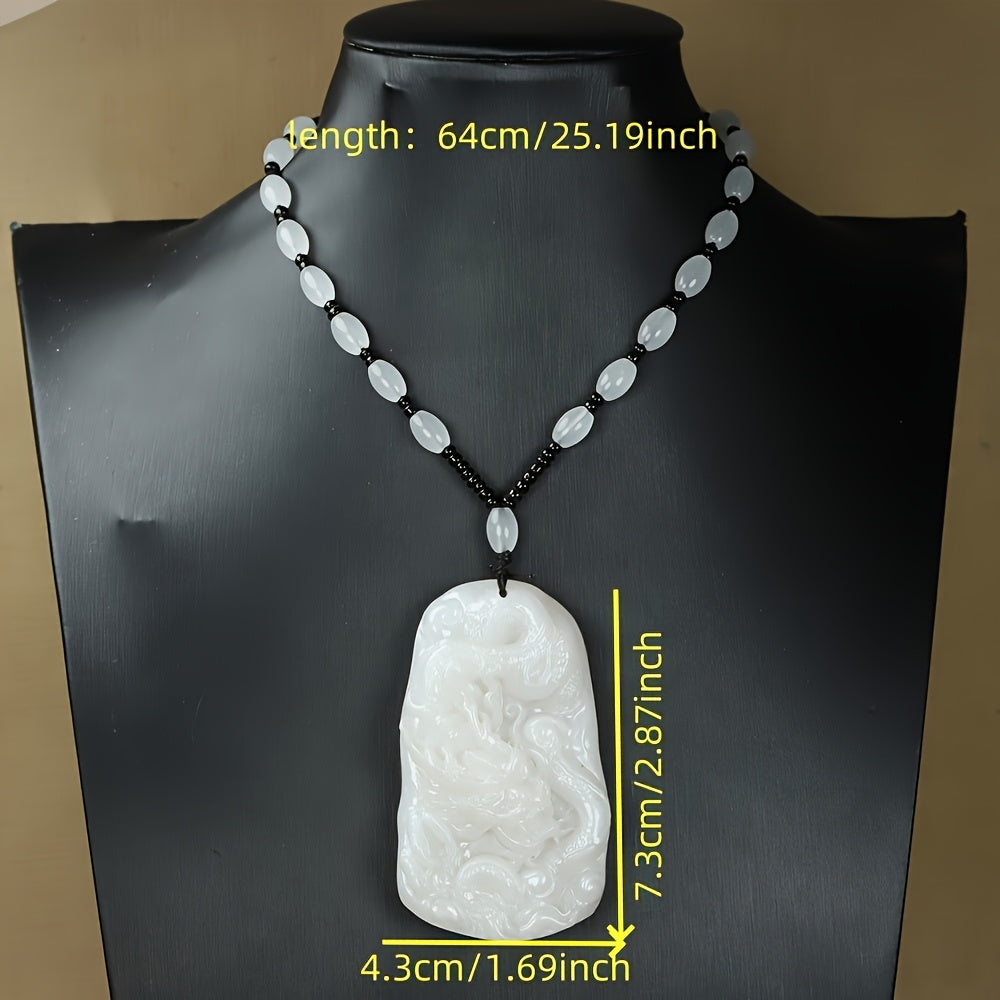
Tactile anchoring: the physical sensation of the object brings awareness back to the present moment.
The Core Practice: Three-Breath Return
Here is the central exercise. It takes less than 30 seconds. You can do it anywhere, anytime you notice the pendant (or your chosen anchor).
Three-Breath Return Practice
You see or feel the pendant (or your anchor object). Instead of ignoring it or treating it as mere decoration, pause. This is the trigger. The object says: "Check in."
What this looks like: You're typing an email, feel the pendant against your chest, and instead of continuing to type, you pause for one second. That's it. You've completed Step 1.
While keeping slight awareness of the pendant, bring attention to the sensations in your feet. Feel the contact with the floor or ground. Then take three slow, natural breaths. Not deep or forced—just normal breaths you pay attention to.
Why this works: The feet anchor you physically (grounding). The breath anchors you temporally (present moment). Together, they pull awareness out of mental abstraction and into bodily presence.
As you exhale the third breath, ask silently: "How is my inner flame right now?"
Don't analyze. Don't judge. Just notice what answer arises. It might be an image (a strong flame, a flickering one, a banked fire), a word ("steady," "scattered," "quiet"), a sensation (warmth in chest, tension in shoulders), or simply "I don't know." All answers are valid.
The key: The question isn't about fixing or changing. It's about noticing. You're taking a reading, not prescribing treatment.
Return to what you were doing. But carry with you the subtle awareness of having checked in. You might notice you're slightly more centered, slightly less reactive. Or you might not notice any change. Both are fine.
Important: This isn't a "reset button" that magically fixes everything. It's a gentle interruption of autopilot. Sometimes that's enough to change your course. Sometimes it just creates a moment of awareness amidst the chaos. Both have value.
That's the entire practice. 20-30 seconds. Repeat whenever you notice the anchor. The goal isn't to do it "right" or achieve a certain state. The goal is to interrupt automaticity with awareness.
Practice Note: Start small. Don't try to do this every time you notice the pendant. That's overwhelming. Begin with once a day. Maybe when you put it on in the morning. Or when you feel it during your afternoon slump. One conscious Three-Breath Return is more valuable than ten rushed, guilt-driven ones.
The practice grows naturally. As you experience its benefits (even subtle ones), you'll find yourself doing it more often. But let that happen organically. Forced discipline often backfires. Gentle invitation works better.
Integration: Weaving the Practice into Daily Life
The Three-Breath Return is the core technique. But practices need contexts to live in. Here are ways to integrate it into common daily scenarios:
Morning Preparation: As you put on the pendant, do one Three-Breath Return. Set an intention: "Today, I'll check in with my inner flame whenever I feel overwhelmed." Don't commit to doing it constantly—just plant the seed of possibility.
Transition Moments: Use the practice when moving between contexts: before checking email, after a meeting, when switching tasks. These liminal spaces are perfect for brief re-centering.
Trigger Response: When you feel a strong emotional reaction (irritation, anxiety, excitement), feel for the pendant. Let it remind you: "Before reacting, check in." Then do the Three-Breath Return. You may still react, but now it's a choice, not a reflex.
Evening Reflection: As you remove the pendant, do one final Three-Breath Return. Ask: "How was my inner flame today? When did I remember it? When did I forget?" No judgment—just curious noticing.
The UV-reactive quality of the pendant adds an interesting dimension to this practice. Under normal light, the dragon is visible but subtle—like our everyday awareness of inner strength. Under UV light, it reveals hidden colors—like those moments when we suddenly recognize depths of resilience we didn't know we had.
You might create a special practice around this: Once a week, in a dark room with a UV light (or in sunlight, which contains UV), look at the pendant's transformation. As the hidden colors emerge, ask: "What hidden strengths in me are waiting for the right conditions to become visible?"
Weekly UV Reflection
When: Once a week, preferably when you have 10 minutes of quiet.
What: Look at the pendant under UV light (a small UV flashlight works). Watch the colors emerge.
Reflect: "Just as this pendant has colors invisible in ordinary light, what strengths or resources do I have that aren't visible in my ordinary state? What conditions would make them visible?"
Important: This isn't about "unlocking hidden powers." It's about acknowledging that your current perception of yourself is always partial. There's always more than you can see right now.
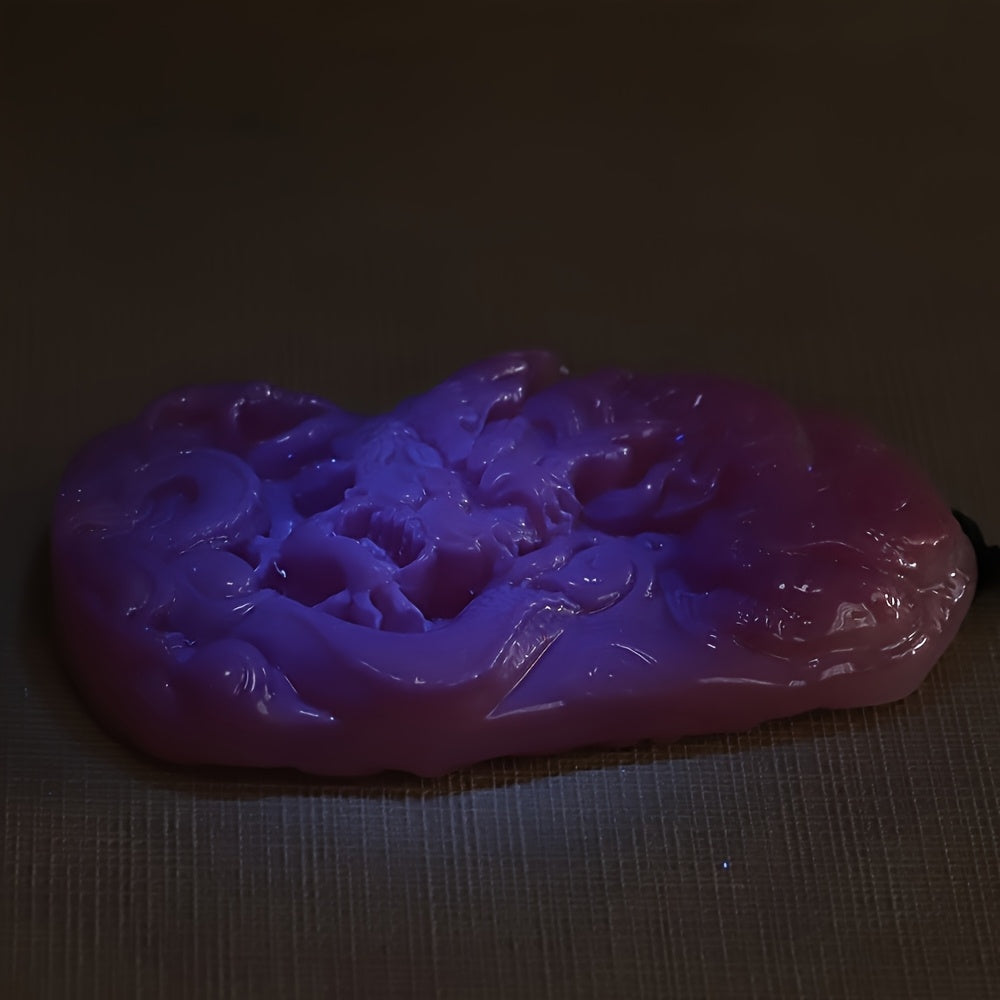
Texture as mindfulness tool: the detailed carving provides rich sensory input for anchoring awareness.
Troubleshooting: Common Challenges & Adaptations
Every practice encounters obstacles. Here are common ones with this practice, and gentle adaptations:
This is normal, not failure. The practice includes forgetting. Each time you remember ("Oh right, I meant to check in"), that's a success—you remembered! Gently do a Three-Breath Return in that moment of remembering. Over time, the remembering happens more often.
All new practices feel artificial at first. That's how learning works. Acknowledge the feeling ("This feels silly") and do it anyway. Or adapt: Instead of the full practice, just pause when you notice the pendant and take one conscious breath. Build from there.
The goal isn't to feel different. The goal is to notice how you already feel. Sometimes the only "effect" is that you noticed you were scattered. That noticing is the practice. The feeling of centeredness may come later, or not at all. The noticing is enough.
That's exactly when the practice is most needed. But start smaller: Just notice the pendant. Don't do the full practice. Just think "pendant" when you feel it. That micro-pause is a beginning. On less busy days, you can do more.
The Golden Rule of Practice: Be kinder to yourself than you think you need to be. If you do one Three-Breath Return today, that's a complete success. If you forget entirely but remember tomorrow, that's also success. The practice is about gentle return, not perfect consistency.
This isn't a performance. It's a relationship—with yourself, mediated by a physical object. Like any relationship, it has good days and forgetful days. The commitment is to keep returning, not to never wander.
Beyond the Pendant: Transferring the Skill
After several weeks of practicing with the pendant, you might notice something interesting: you start checking in even when not wearing it. The mental habit begins to transfer. The pendant trained your attention; now your attention can operate independently.
This is the ultimate goal: not to be dependent on the object, but to have internalized the skill it helped develop. The pendant becomes like training wheels—useful for learning, then set aside when balance is found.
Phase 1: Object-Dependent You need to see/feel the pendant to remember to check in. This is fine. This is where everyone starts.
Phase 2: Trigger Generalization Other things start triggering the check-in: feeling stressed, hearing a certain tone of voice, transitioning between tasks. The habit is spreading.
Phase 3: Integrated Awareness Checking in becomes a background process, like breathing. You're often aware of your inner state without needing to deliberately "check." The practice has become a natural way of being.
Phase 4: Optional Object You can wear the pendant or not. It's a pleasant reminder, not a necessary crutch. The skill lives in you, not in the object.
This progression happens naturally, over weeks or months. Don't rush it. Enjoy Phase 1. The object is your companion in learning. When you naturally move to Phase 2, that's a sign the practice is working—not that you've "graduated" from needing the object.
Transfer Exercise: Once a day, try doing a Three-Breath Return without touching or looking at the pendant. Just decide to do it. Notice if it feels different. If it's harder, that's information—the object is still helpful. If it's easier, that's also information—the skill is integrating. Neither is better or worse.
The Science Behind the Practice
While this practice comes from experiential wisdom, it aligns with what we know from neuroscience and psychology:
Neuroplasticity: Repeatedly pausing to check in strengthens neural pathways associated with self-awareness and emotional regulation. The brain literally rewires itself through this consistent practice.
Interoception: Noticing bodily sensations (feet on ground, breath rhythm) improves interoceptive awareness—the ability to perceive internal states. This is linked to better emotional regulation and decision-making.
Cognitive De-fusion: The pause creates space between stimulus and response, allowing you to choose rather than react. This is a core skill in Acceptance and Commitment Therapy and other evidence-based approaches.
Anchor Effects: Physical objects can serve as "cognitive anchors" that trigger desired mental states through associative learning. This is why athletes have lucky charms and why religious traditions use ritual objects.
The practice works not because of magical properties in the pendant, but because of how human attention and neuroplasticity work. The pendant is a tool that leverages these natural processes. You could achieve similar results with other methods. But for many people, a physical object makes the practice more accessible, concrete, and sustainable.
Conclusion: The Flame That Never Goes Out
We began with a question: Where in daily life do you lose touch with your resilience? We end with a practice: a simple method for returning to awareness of that resilience.
The dragon pendant, in this context, isn't a symbol of mythical power you lack. It's a mirror for the quiet, formidable nature you already have but often forget. The inner flame isn't something you need to create; it's something you need to remember noticing.
This practice won't eliminate stress, solve all problems, or make you invincible. It will do something more sustainable: it will help you navigate stress with more awareness. It won't give you strength you don't have; it will help you recognize the strength you already possess.
Final Invitation: For the next week, try this: Each morning when you put on the pendant (or any anchor object), say to yourself: "This reminds me to notice my inner flame." Then go about your day. Whenever you happen to notice the pendant, pause for just one breath. That's it. One breath. Notice if anything shifts, even slightly.
That's enough to begin. A single conscious breath, prompted by a physical anchor, repeated whenever you happen to remember.
The inner flame doesn't need to be stoked constantly. It just needs to be noticed occasionally. Noticed, it tends to burn more steadily. Forgotten, it still burns—we just don't benefit from its light.
The pendant's square frame contains the dragon. Your practice contains your awareness. Both are gentle containers, not rigid prisons. Both allow what's within to exist, to be seen, to serve its purpose.
Wear the practice lightly. Return to it gently. Notice what you notice. The flame was always there. Now you have a way to remember it's there.
This article is part of DARHAI's Practice & Daily Perception series, offering verifiable exercises for psychological growth. These practices are invitations, not prescriptions. Their value comes from consistent, gentle application.
