

The Weather of Decision
Sunday at 3 PM, you sit at your desk, the spreadsheet glowing cold on the screen. It's raining outside—that fine, persistent rain that blurs all the sounds of the world. Your fingers hover above the keyboard. The job offer has been sitting in your inbox for four days. The deadline to respond is tomorrow at 9 AM.
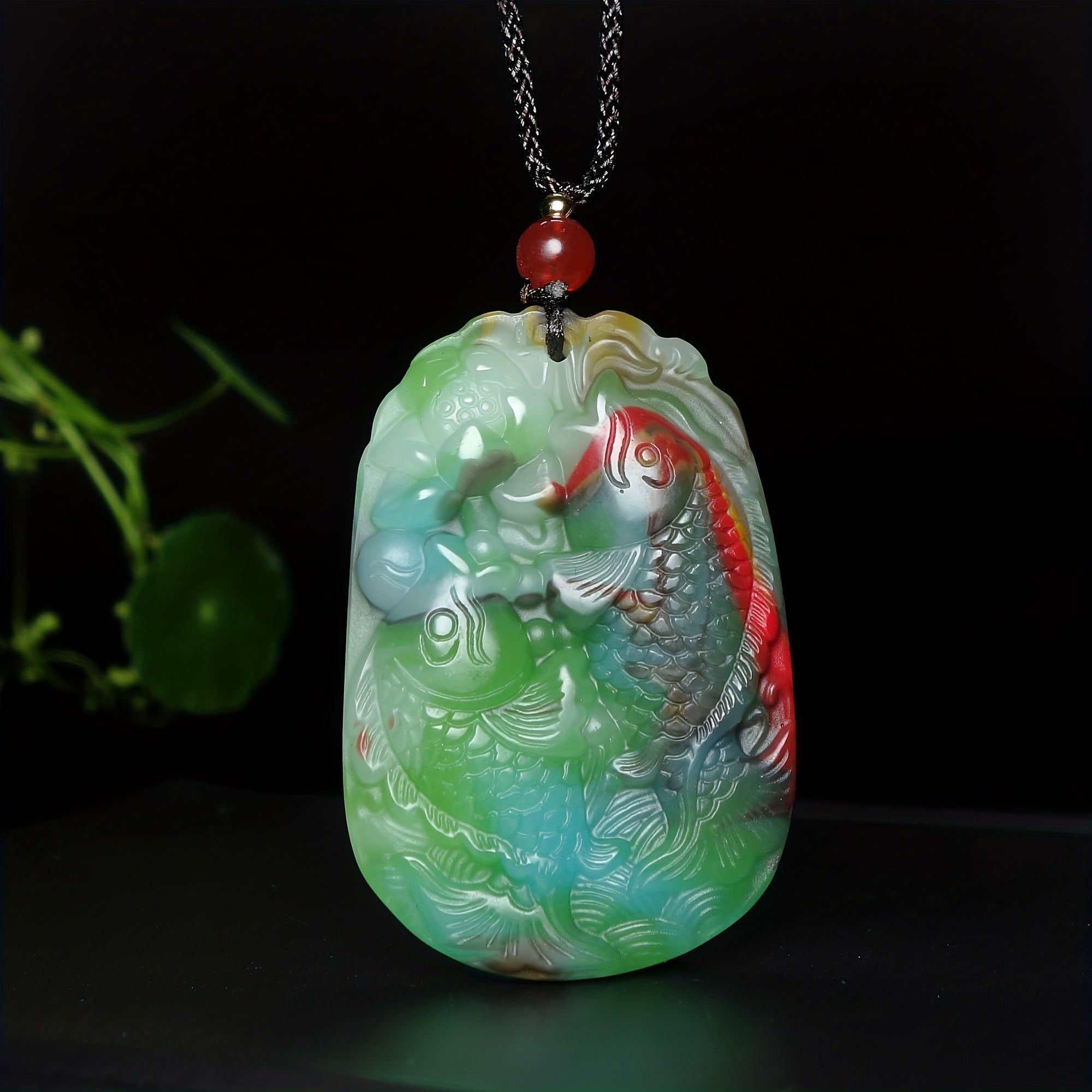
You reach for your coffee mug and find it empty, just a brown ring at the bottom. In that motion, your hand brushes against the stone at your neck—the fish pendant you've been wearing for eight months. It's warm, almost skin temperature. There's one spot along the edge that's particularly smooth, where your thumb most often finds it when you're thinking.
Some people notice that significant decisions seem to have their own seasons. Not calendar seasons, but internal ones. Some days, your mind is clear like glass after rain; other days, it's dense and blurred like this afternoon's downpour. That career decision has been waiting—waiting for its weather.
You might find that days marked as "good for signing contracts" or "favorable for investments" often feel out of sync with your internal rhythm. You wake up on a morning declared "auspicious" and feel a slight, persistent tightness in your stomach. You find surprising clarity about a financial plan on an afternoon supposedly "unfavorable for decisions."
The stone turns in your hand. It doesn't offer answers. It's simply there, as a thermometer, recording your body's tension or ease. Today, it feels slightly heavier than usual—or perhaps you're simply more tired.
Traditional wisdom about choosing dates often rests on celestial patterns, seasonal shifts, numerical cycles. But there's another, more personal cycle: the ebb and flow of your attention through a day, the current of your energy through a week, the contraction and expansion of your courage under pressure. This cycle isn't written on any calendar, but it exists as truly as your breathing rhythm.
The Body's Forecast
Tuesday, 10:30 AM. You've just emerged from an exhausting meeting. The air conditioning vent hums persistently; the room is too cold, goosebumps on your forearms. Your phone screen lights up: a reminder about an investment opportunity. You need to decide today whether to join this funding round.
Your hand goes to your suit's inner pocket, fingertips finding a folded paper—the financial projection you printed out. The edges are already slightly worn. You take it out but don't unfold it. You just hold it, feeling its weight, its presence.
That's when you realize: your body has already decided before your mind. That meeting drained today's decision-making energy. Your thoughts are still processing, but your body has raised the white flag. It's speaking through stiff shoulders, dry eyes, a slight discomfort in your stomach.
Some people learn to listen to this physical weather. They know that financial commitments made in the cold of exhaustion often carry a flavor of desperation—not clarity about opportunity, but a desire to end the decision process. They also know that ideas emerging during well-rested, physically warm moments often align more closely with their true inclinations.
You might find that wearing something with weight—like that stone pendant—helps you notice this state earlier. When your hand goes to it unconsciously during a meeting, it reminds you: your body is here. It's experiencing this moment. Its sensations are part of the data, a row in your decision matrix often overlooked.
Historically, there was a forgotten practice: physical fasting before significant decisions. Not for religious reasons, but to clear sensory noise, allowing subtler signals to surface. In a modern context, this might mean: the day before a major career decision, avoid blue light from screens, eat simple food, sleep early—letting the body quiet before the mind.
The stone pendant can serve as an anchor in this process. Its weight remains constant, but your perception of that weight changes. In anxiety, it feels like lead; in calm, almost feather-light. What changes isn't the stone, but your sensitivity to your own state.
The Private Rhythm of Financial Flow
The month-end bank statement lies spread on the dining table. The numbers themselves are neutral, but the light in which you read them, the temperature of the room, the quality of your sleep that night—these color the numbers. The same deposit record feels entirely different viewed on a sunny Saturday morning versus a rainy night after overtime.
You lean back in your chair, the pendant slipping from your collar, hanging and swaying slightly. You notice its swing has a rhythm, slowly synchronizing with your breathing. A small moment of synchronicity—the chance harmony between an object's movement and life's rhythm.
Financial decisions are often presented as purely rational calculations: yield rates, risk coefficients, time value. But the person performing these calculations exists in specific days, with specific bodies, in specific moods. That "specificity" is the private rhythm. It doesn't negate reason; it provides the soil for reason.
Some people develop the habit of observing this rhythm. They notice they're often most financially insightful on Wednesday afternoons, perhaps because Wednesday is the week's midpoint—not Monday's beginning anxiety nor Friday's ending fatigue. They discover they shouldn't handle tax documents immediately after a long flight, as jet lag muddles internal clarity.
You might start recording: not writing "made investment decision today" in a journal, but writing "rainy today, old knee injury aching slightly, drank three coffees, decided to invest in Project X at 3 PM." Over time, patterns might emerge. Perhaps you're more risk-averse when physically uncomfortable, more willing to explore new directions when well-rested.
The fish-shaped pendant can serve as a physical cue for this recording. Its fish form comes from the cultural image of "nian you yu"—not as a guarantee of wealth, but as a symbol of flow. Water flows, fish swim within it, finding positions best suited for breathing, feeding, surviving. Finance, too, is a flow, and you're finding your position for survival within it.
This observation isn't for control, but for understanding. With understanding, you can choose to respect your own rhythm: scheduling important financial meetings during your typically clear hours, allowing yourself a night's sleep before major commitments, permitting postponement when your body resists—even if the calendar says today is "auspicious."
Tactile Memory of Career Transitions
You stand by the photocopier, waiting for the resignation letter to print. The machine hums rhythmically, warm air carrying the scent of ozone. Your palms are sweating, but your fingertips are cold. Your left hand searches unconsciously for the pendant—finds it, grips it, the stone's coolness transmitting through skin.
This tactile moment will be remembered. Not as a "lucky moment," but as a coordinate point. On some future uncertain day, when you encounter difficulties in the new job, you might grip this pendant again, recalling this afternoon: the photocopier's hum, sweaty palms, the stone's coolness, and the decision to press "print."
Career choices are often narrated afterward as clear stories: I did A, which led to B, achieving C. But in the moment of happening, they're a series of bodily sensations: stomach tightening or relaxing, shoulders heavy or light, breathing shallow or deep. These sensations don't determine the choice, but they provide its background music.
Some people keep small objects from their career journey: the first business card, notes from the first presentation, a printout of an important email. These aren't souvenirs but carriers of tactile memory. When needing to make new decisions, touching these objects can evoke the physical sensations of that time, offering continuity—reminding you that you've made choices in similar uncertainty before, and survived.
You might discover that wearing the same piece of jewelry through a career transition gives it a special weight. Not physical weight, but memory weight. It becomes a fixed point in your professional journey, remaining constant as you change jobs, cities, roles. Its constancy highlights your changes, letting you see movement against stillness.
The fish pendant, with its reference to "abundance through surplus," becomes interesting here. In career context, surplus might mean: having enough clarity to make a decision, enough courage to act on it, enough resilience to endure its consequences. The fish doesn't guarantee you'll catch anything; it simply continues swimming in the current you're navigating.
The False Binary of Timing
We're often presented with a binary: "good days for business decisions" versus "bad days." But lived experience suggests something more nuanced. There are days when your analytical mind is sharp but your intuition is muffled. Days when you feel emotionally clear but physically drained. Days when external circumstances align perfectly while internal resistance builds.
Friday evening, 6 PM. You're reviewing a contract for a partnership that could reshape your business. Logically, everything checks out. The numbers work. The terms are fair. But as you read Clause 7 for the third time, your hand goes to the pendant at your neck. It feels cooler than it should, considering it's been against your skin all day.
This coolness isn't an omen. It's data. Perhaps the room's temperature dropped as evening fell. Perhaps your circulation is slightly off from sitting too long. Perhaps it's completely random. But noticing it creates a pause—a wedge of awareness between the logical assessment and the signing of the document.
Some people develop their own calendar of personal readiness. They might notice they make their clearest strategic decisions in the quiet hour after everyone else has left the office. Or that they should never make hiring decisions before 10 AM. Or that major purchases feel right only after they've slept on the decision for exactly three nights.
This personal calendar often contradicts traditional wisdom. The day marked as "excellent for career advancement" might find you with a migraine. The "unfavorable for financial moves" day might bring unexpected clarity about an investment. The stone pendant serves not as a lucky charm aligning you with external timing, but as a reminder to check your internal timing.
The practice becomes: before checking any external calendar for business decisions, first check your internal weather. How does your body feel? Where is your energy? What's the quality of your attention today? This doesn't replace rational analysis; it precedes it. You bring your whole self to the decision, not just your calculating mind.
Over time, you might notice that the best decisions—the ones that feel integrated, that you don't second-guess—often happen when there's alignment. Not alignment with stars or dates, but alignment between your logical assessment, your intuitive sense, and your physical state. The stone, cool or warm, heavy or light, becomes a simple tool for sensing one part of that alignment.
A Different Kind of Business Companion
In a world that often reduces career and finance to metrics, projections, and optimized strategies, the stone fish pendant offers a different kind of companionship. It doesn't promise better deals or guaranteed successes. It doesn't align you with cosmic forces for profit.
What it does is simpler: it grounds decisions in the physical reality of the person making them. You, with your tired eyes on a Tuesday afternoon. You, with your hopeful excitement about a new venture. You, with your cautious skepticism about an investment opportunity.
The pendant becomes a touchpoint—literally. When your mind is spinning with projections and scenarios, your fingers finding the stone's texture can momentarily anchor you in your body. That anchoring creates space. Space to breathe. Space to remember that behind every financial model is a human being who slept well or poorly last night, who feels confident or uncertain today, who carries hopes and fears into every decision.
Some might ask: but does this actually lead to better financial outcomes? That's the wrong question. The right question might be: does this lead to more integrated decisions? Decisions you can live with, regardless of outcome? Decisions that feel true to who you are in that moment?
The fish shape, drawn from centuries of cultural meaning about abundance and flow, becomes quietly subversive in this context. It's not about attracting abundance; it's about recognizing the abundance already present in your capacity to pay attention, to sense your own state, to make choices with awareness rather than reactivity.
In the end, the "lucky days for business decisions" aren't found on any calendar. They're the days when you're most present to yourself. The days when you can distinguish between fear and genuine caution, between excitement and true alignment, between external pressure and internal knowing. The stone pendant doesn't create those days; it simply reminds you to look for them.
The Decision Companion
For those who make decisions with their whole selves, not just their calculating minds.