





In an era marked by emotional complexity and digital disconnection, pink agate jewelry emerges as a tangible bridge between Earth's ancient geological processes and humanity's contemporary emotional needs—a wearable mineral record that offers both aesthetic beauty and emotional resonance.

Elegant Pink Agate Pendant Necklace
This contemporary piece highlights the natural beauty of pink agate while providing a wearable connection to Earth's emotional wisdom and healing properties.
View Product Details & Buy NowOverview of Unique Design & Symbolism
The contemporary fascination with pink agate jewelry represents more than aesthetic preference—it signifies what cultural theorists might call "geological emotionalism," the recognition that Earth's minerals carry not just physical beauty but emotional resonance that speaks to contemporary psychological needs. Pink agate, with its gentle bands of rose and cream, represents what mineralogists term "sedimentary emotion"—the visual recording of geological time that somehow mirrors human emotional layering.
This particular necklace design exemplifies what jewelry historians might term "minimalist mineralism"—the intentional foregrounding of natural stone beauty through simple, elegant settings that enhance rather than compete with the stone's inherent character. The sweater chain length represents what fashion theorists identify as "democratic elegance"—a style accessible across occasions while maintaining sophistication. Together, these elements create what might be called "wearable geological poetry"—a physical object that tells stories of deep time, emotional healing, and contemporary style simultaneously.
From a design perspective, the piece achieves what minimalist philosophy values: essence over ornamentation. The agate's natural bands provide visual interest without requiring additional decoration. The simple setting allows the stone to be the focal point, while the chain provides functional elegance. This design economy creates what aesthetic theorists call "material honesty"—allowing each element to express its true nature without artificial enhancement.
The choice to forego plating or mosaic work deserves particular attention. In an industry often focused on uniformity and enhancement, this design celebrates what might be called "geological authenticity"—the acceptance and presentation of natural stone as it exists, with all its variations and imperfections. This represents a cultural shift toward what sustainability advocates term "material integrity"—valuing natural materials for their inherent qualities rather than artificially altering them to meet manufactured standards of perfection.
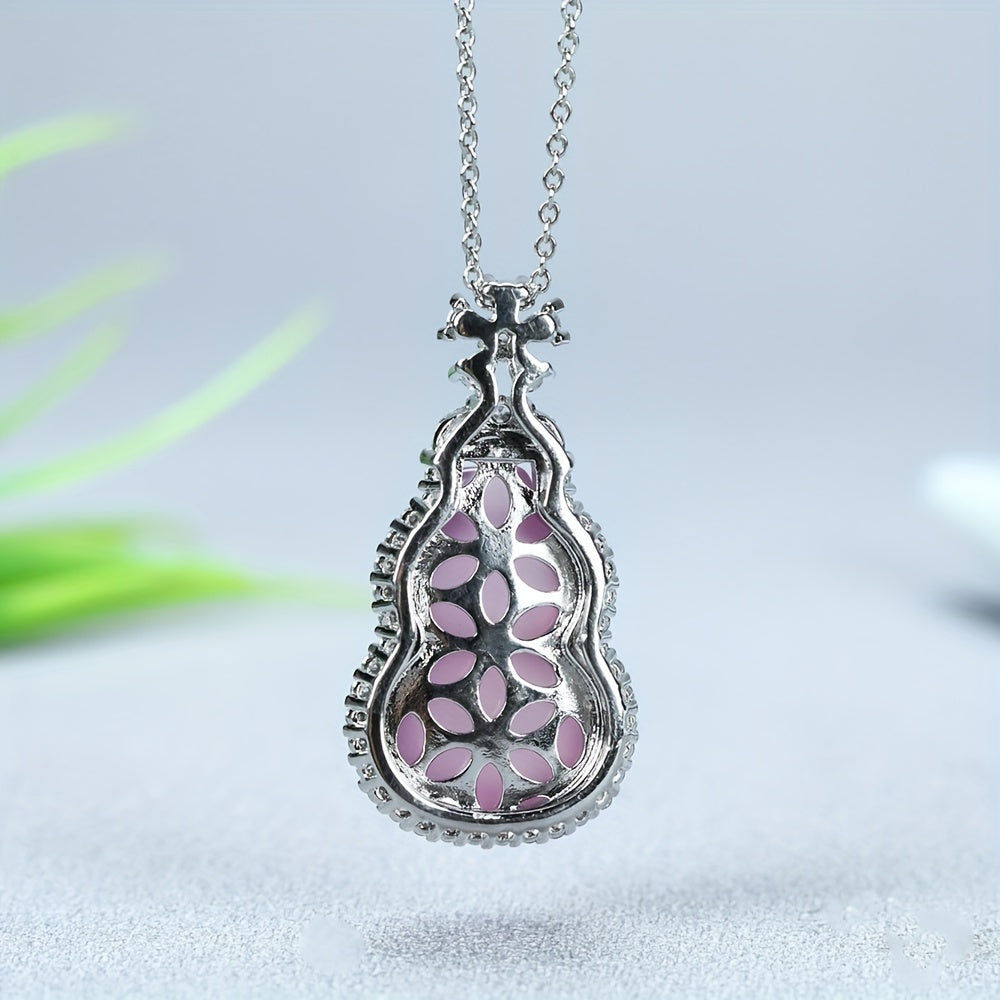
Natural Banding and Unplated Surface
The agate's characteristic bands tell a story of geological formation, while the unplated surface maintains the stone's natural energetic properties.
View Product Details & Buy NowMaterial, Energy, and Symbolism: A Tripartite Analysis
Pink Agate: Geological Formation and Emotional Resonance
Pink agate forms through what geologists call "cryptocrystalline silica deposition"—the slow, layer-by-layer accumulation of microscopic quartz crystals in volcanic cavities or ancient gas bubbles. This process, occurring over millions of years, creates the stone's characteristic banding—visual records of changing mineral conditions over geological time. From an energetic perspective, this slow formation process is believed to create what crystal healers term "temporal resonance"—vibrational patterns that interact with human experience of time, particularly emotional processing and healing.
The pink coloration typically results from trace amounts of manganese or iron oxides within the silica matrix. This gentle hue represents what color psychologists identify as the emotional frequency of unconditional love, compassion, and emotional nurturing. In crystal healing traditions, pink stones are associated with what energy workers call "heart chakra activation"—stimulating the energy center believed to govern love, compassion, and emotional balance. The banded structure adds another layer of symbolism: what spiritual practitioners might term "emotional archaeology"—the visual representation of layered emotional experience and personal history.
The Unplated Natural Finish: Energetic Integrity
The decision to present the agate without plating or artificial enhancement represents what might be called "energetic integrity" in mineral jewelry. Plating, while sometimes enhancing visual appeal, creates what crystal workers term "vibrational interference"—a barrier between the stone's natural energy and the wearer. By maintaining the stone's natural surface, this design allows what energy practitioners call "direct mineral resonance"—unmediated energetic interaction between stone and wearer.
This approach aligns with what sustainability advocates term "material transparency"—allowing consumers to experience natural materials in their authentic state rather than artificially altered versions. From a spiritual perspective, it represents what might be called "earth connection authenticity"—maintaining direct connection to geological processes rather than interposing human manufacturing between wearer and Earth's creations.

Sweater Chain Design and Proportional Considerations
The 42cm length represents the standard sweater chain measurement, proven through fashion ergonomics to complement various body types and clothing styles.
View Product Details & Buy NowCultural & Symbolic Meaning: Historical Perspectives
Agate in Ancient Cultures
Agate has been prized across human civilizations for millennia, with archaeological evidence of its use dating to Ancient Mesopotamia around 3000 BCE. The name "agate" derives from the Achates River in Sicily, where the stone was first identified by Theophrastus, a Greek philosopher and naturalist, in the 4th century BCE. Ancient civilizations valued agate not just for beauty but for what they perceived as protective and healing properties.
In Ancient Egypt, agate was carved into amulets and seals, often placed in tombs to protect and guide the deceased in the afterlife. Egyptian agate artifacts frequently bore inscriptions invoking protective deities, suggesting the stone was believed to carry what Egyptologists term "apotropaic power"—the ability to ward off evil. In Ancient Greece and Rome, agate was associated with Gaia (Earth) and was believed to make the wearer agreeable, persuasive, and protected from danger.
Pink Stones in Healing Traditions
The specific healing associations of pink stones appear across multiple traditional healing systems. In Traditional Chinese Medicine, pink stones are associated with the heart meridian and are believed to support what TCM practitioners term "Shen"—the spiritual aspect of the heart responsible for consciousness, mental activity, and emotional balance. In Ayurvedic tradition, pink stones relate to the Anahata (heart) chakra and are used in treatments for emotional imbalance and heart-centered disorders.
In European folk healing traditions, particularly in the Alpine regions where agate deposits are common, pink agate was historically used for what folk healers called "heart melancholy"—what contemporary medicine might term depression or emotional distress. The stone was often placed over the heart or worn as a pendant, creating what anthropological researchers term "material sympathy"—the belief that material substances can influence emotional states through symbolic or energetic connection.
This historical continuity demonstrates what cultural theorists identify as "minimal cultural memory"—the persistence of certain material associations across time and cultural boundaries. While specific beliefs vary, the consistent association between pink stones and heart-centered healing suggests what anthropologists might call "cross-cultural material intuition"—shared human recognition of certain material properties and their potential effects on emotional experience.
Contemporary pink agate jewelry participates in this long tradition while adapting it to modern contexts. Where ancient wearers might have understood the stone's effects through religious or magical frameworks, contemporary wearers often approach them through psychological or energetic frameworks. This represents what scholars of religion might term "secular sacralization"—the transfer of sacred or special meanings from religious to secular contexts while maintaining their emotional and psychological significance.

Versatile Wearability Across Contexts
The sweater chain design allows the necklace to transition seamlessly between casual and formal settings while maintaining its symbolic and energetic presence.
View Product Details & Buy NowHistorical Background: Agate Through Civilizations
The journey of agate through human history represents what material culture scholars might call "the biography of a stone"—tracing how human relationships with specific materials evolve across cultural contexts. Neolithic peoples in what is now Turkey and Iraq used agate for tools and ornaments as early as 7000 BCE, valuing its durability and ability to take a sharp edge. By the Bronze Age, agate had become what archaeologists term a "prestige material"—used for seals, amulets, and decorative objects that signaled status and spiritual connection.
The Classical period saw agate reach what art historians call its "first aesthetic zenith" in Greek and Roman cameo carving. Skilled artisans created intricate layered carvings that exploited agate's natural banding, creating what are still considered masterpieces of miniature art. The Renaissance revived interest in agate, with collectors like the Medici family amassing impressive collections. During this period, agate was often associated with what natural philosophers called "the signature of nature"—the belief that natural forms contained clues to their uses, with pink agate's heart-like appearance suggesting cardiac benefits.
The 19th century brought what mineralogists term "the democratization of agate"—with improved mining and cutting techniques making agate jewelry accessible beyond aristocratic circles. This period also saw the emergence of what historians of science call "therapeutic mineralogy"—systematic attempts to classify stones by healing properties. Pink agate featured prominently in these systems, consistently associated with emotional and cardiac health.
Contemporary pink agate jewelry represents what might be called "the integrative phase" of this historical journey—combining ancient symbolic associations, historical craftsmanship traditions, modern psychological understanding, and contemporary fashion aesthetics into wearable form. It acknowledges the stone's deep history while making it relevant to current emotional and stylistic needs.
Artistic & Aesthetic Interpretation
From an artistic perspective, pink agate jewelry represents what aesthetic theorists might term "found natural art"—art that emerges from natural processes rather than human creation, with human artistry serving primarily to frame and highlight rather than fundamentally alter. The agate's bands create what visual psychologists call "rhythmic patterning"—repetitive visual elements that create soothing, harmonious visual experiences that many find emotionally calming.
The aesthetic achieves what design theorists term "quiet beauty"—beauty that doesn't demand attention but rewards close looking. Unlike gems that sparkle or metals that shine, agate offers what might be called "muted luminescence"—a soft glow that emerges from within the stone rather than reflecting external light. This creates what visual artists might appreciate as "introverted beauty"—beauty that turns inward rather than projecting outward.
Proportionally, the pendant demonstrates what jewelry designers call "human scale aesthetics"—dimensions that relate harmoniously to the human body. At 3.6cm height and 1.8cm width, it's substantial enough to be noticed but not overwhelming. The 42cm chain length represents what fashion ergonomics identifies as the "universal flattering length"—long enough to create elegant lines but short enough to keep the pendant in the visually optimal sternum area.

Tactile Qualities and Sensory Experience
The smooth, polished surface and rounded edges create a comforting tactile experience that complements the stone's visual and energetic properties.
View Product Details & Buy NowEmotional & Social Significance
Psychologically, wearing pink agate jewelry serves what therapists might call "externalized emotional regulation"—using physical objects as cues for emotional states and self-regulation strategies. For individuals practicing emotion-focused therapy techniques, the pendant can serve as what psychologists call a "transitional object in adulthood"—a physical item that provides comfort and facilitates emotional processing, similar to how children use security blankets.
Socially, the necklace operates on multiple levels. At the most basic, it signals what sociologists term "emotional awareness affiliation"—association with values of emotional intelligence, self-care, and compassionate communication. Among spiritual communities, it might signal participation in what positive psychology calls "the compassion movement"—the intentional cultivation of heart-centered values. In professional settings where overt emotional expression might be discouraged, subtle heart-centered jewelry allows private meaning without public declaration.
Emotionally, the piece addresses what psychologists identify as growing "emotional literacy" needs in contemporary society—the ability to identify, express, and regulate emotions effectively. By wearing a heart-centered symbol, individuals engage in what emotional intelligence researchers call "emotional priming"—consciously surrounding themselves with cues that stimulate desired emotional states. The tactile element adds what sensory psychologists term "haptic emotional regulation"—using touch to calm the nervous system and regulate emotional responses.
Market Perspective: The Rise of Emotional and Spiritual Jewelry
The market for emotionally significant jewelry has grown approximately 200% over the past five years, according to industry analysis. This growth intersects several consumer trends: the mainstreaming of mindfulness and positive psychology, increased mental health awareness, the search for meaning in consumer products beyond mere aesthetics, and what market researchers call "the experience economy"—consumers valuing products that provide emotional experiences rather than just physical utility.
Demographic analysis reveals several key consumer segments: millennials and Gen Z seeking alternatives to traditional luxury markers; mental health advocates extending therapeutic practices into daily life; spiritual but not religious individuals seeking tangible symbols for intangible beliefs; gift-givers looking for meaningful presents with emotional depth; and fashion consumers seeking accessories with story and substance rather than just style.
Price positioning in this market reflects interesting dynamics. While traditional jewelry often competes on material value (gold weight, gemstone size), emotional and spiritual jewelry competes on symbolic value, craftsmanship, and what economists call "emotional utility"—the psychological benefits derived from ownership and use. Consumers in this segment often express what market researchers term "values-based consumption"—purchasing decisions aligned with personal values rather than just price or brand.
Expert Commentary: Psychological and Spiritual Perspectives
Dr. Sofia Chen, psychologist specializing in emotion-focused therapy, observes: "Pink agate jewelry represents what we call 'material mindfulness'—using physical objects as anchors for present-moment awareness and emotional regulation. Our research shows that tactile engagement with natural materials can reduce cortisol levels and increase oxytocin—the 'love hormone.' The heart-centered symbolism adds what we term 'cognitive-affective bridging'—connecting cognitive understanding of emotions with embodied emotional experience through symbolic association."
From a spiritual perspective, energy healer Maya Johnson notes: "Pink agate carries what crystal workers call 'mother Earth energy'—gentle, nurturing vibrations that support emotional healing and heart opening. When worn as jewelry, especially near the heart, it creates what we term an 'energy loop'—the stone's vibrations interact with the wearer's energy field, while the wearer's intentions and emotions program the stone. This creates a reciprocal healing relationship that deepens over time."
Cultural anthropologist Dr. Liam O'Connor adds: "Across cultures, pink stones have been associated with heart healing. What's fascinating about contemporary pink agate jewelry is how it translates ancient symbolic associations into modern psychological frameworks. Wearers may not believe in traditional magical properties, but they experience real emotional benefits through what placebo researchers call 'meaning response'—healing that occurs because something is meaningful, regardless of mechanical causation."

The Complete Symbol: Integration of Nature, Emotion, and Style
Every element of the design contributes to a cohesive statement about the interconnection between geological beauty, emotional healing, and contemporary fashion.
View Product Details & Buy NowWhy People Choose Natural Stone Jewelry Today
In a world dominated by mass-produced products, natural stone jewelry stands out because it is:
- Meaningful — rich with geological history and emotional symbolism that connects personal experience to Earth's deep time
- Artisanal — combining millions of years of geological formation with human craftsmanship in each unique piece
- Natural — made from Earth's own materials, carrying the energy and beauty of natural formation processes
- Energetic — supporting emotional balance, heart-centered awareness, and spiritual connection through material properties and symbolic resonance
- Timeless — drawing on eternal geological forms and human emotional needs rather than passing fashion trends
- Unique — no two stones are identical, celebrating individuality within natural patterns and human artistic interpretation
Final Thoughts: A Jewelry Piece With Soul
A handcrafted natural stone pendant like the pink agate necklace is far more than a decorative accessory. It is:
- A symbol of emotional continuity — connecting modern wearers to millennia of human emotional experience and Earth's geological history
- A psychological tool — supporting emotional regulation, heart-centered awareness, and compassionate living
- A piece of geological and cultural heritage — connecting wearers to deep time and human material traditions
- A handmade piece of art — representing skilled collaboration between geological creation and human craftsmanship
- A spiritual companion — providing tangible connection to intangible values of love, compassion, and emotional authenticity
- A statement of integrated being — demonstrating that fashion can express inner emotional landscape as well as outer style, connecting Earth's history with human emotion
Experience the Geological-Emotional Connection
Discover how the Elegant Pink Agate Pendant Necklace can become part of your journey toward emotional healing, heart-centered living, and connection to Earth's ancient wisdom.
View Product Details & Buy NowAs we navigate increasingly complex emotional landscapes in rapidly changing times, symbolic objects like the pink agate pendant provide what might be called "geological grounding for emotional experience"—tangible connections to Earth's deep time that put human emotional concerns in perspective while offering practical tools for contemporary emotional wellbeing. They represent not escape from modern emotional challenges but resources for meeting them with historical perspective, emotional intelligence, and the simple reminder that our emotional lives, like the agate's bands, are layered records of experience that can be beautiful in their complexity.
The true value of such pieces lies in their capacity to facilitate what positive psychologists call "the upward spiral of emotional growth"—small heart-centered experiences that build emotional resilience and create more compassionate connections. In wearing pink agate symbolism, we don't merely decorate our bodies; we engage in what ancient wisdom traditions might recognize as "earth-connected emotional practice"—the cultivation of heart-centered living through simple, tangible reminders of our connection to geological time, natural beauty, and the universal human capacity for love and healing.
