





The Duality of Existence: An Exploration of Benevolent and Wrathful Deities in Spiritual Iconography
From the serene smile of a Buddha to the fearsome visage of a demon, spiritual art has long grappled with the fundamental dualities of human experience. This article delves into the profound symbolism of these contrasting figures, exploring their role as archetypes of compassion and power, and how their union represents a path to wholeness.

A modern jewelry piece depicting the ancient archetypes of compassion (Buddha) and protective power (demon), illustrating the integration of dual forces.
Overview: The Union of Opposites
At the heart of many profound spiritual traditions lies the concept of duality: light and shadow, creation and destruction, compassion and wrath. Rather than viewing these as opposing forces in a cosmic battle, many philosophies, particularly within tantric Buddhism, see them as two sides of the same coin, essential and interdependent aspects of a complete reality. The iconography of a peaceful deity embraced by or standing alongside a wrathful one is a powerful visual representation of this principle. It teaches that true enlightenment is not about eradicating the "dark" or "negative" aspects of existence, but about integrating them, transmuting them into wisdom and powerful, compassionate action.
This artistic and spiritual motif serves as a map for our own inner world. It suggests that our own fear, anger, and power are not inherently bad, but are raw energies that, when understood and channeled correctly, can become sources of immense strength and clarity. The juxtaposition of the serene and the fierce is a reminder that a complete human being is both gentle and strong, peaceful and powerful.
Cultural & Symbolic Meaning: The Wrathful Protector
The figure of the "wrathful deity" or "fierce god" is a cornerstone of Vajrayana or Tantric Buddhism, particularly in Tibet. These figures, often depicted with multiple arms, holding weapons, and standing on defeated demons, are not evil entities. They are Dharmapalas—protectors of the dharma (the teachings of the Buddha). Their wrathful appearance is symbolic, designed to strike fear into the hearts of the ego, ignorance, and other internal obstacles to enlightenment.
The Benevolent Buddha: The Embodiment of Compassion
In stark contrast stands the figure of the Buddha, such as Amitabha or Shakyamuni. He is typically depicted with a serene, smiling face, half-closed eyes in deep meditation, and a posture of perfect calm. He represents the ultimate goal: enlightenment, compassion (Karuna), and wisdom (Prajna). He is the embodiment of the peaceful, observant mind that sees the true nature of reality without judgment. He is the healer, the teacher, the refuge.
The Wrathful Deity: The Embodiment of Skillful Means
The wrathful deity, like Mahakala or Yamantaka, embodies a different but equally vital aspect of enlightened energy. This is the energy of "skillful means" (upaya). It is the fierce, active power that arises from compassion to destroy negativity, protect the virtuous, and overcome seemingly insurmountable obstacles. While the Buddha's method is gentle persuasion, the wrathful deity's method is to shock and awe the ego into submission, clearing the path for wisdom to dawn. They are the fierce guardians who ensure that the compassionate work of the Buddhas can proceed without hindrance.
The detailed carving highlights the contrast between the calm, meditative expression of the Buddha and the intense, focused energy of the wrathful figure.
Artistic & Aesthetic Interpretation: A Dance of Contrasts
The artistic representation of these two archetypes on a single medium, like a cinnabar pendant, is a masterful exercise in visual storytelling. The artist must balance the composition so that neither figure overwhelms the other. They are often shown in a dynamic relationship—sometimes back-to-back, signifying their different domains; sometimes with the wrathful figure embracing the peaceful one, signifying that power must be grounded in compassion. The oval shape of the pendant itself, with no beginning or end, can symbolize the cyclical nature of existence and the wholeness of the integrated self.
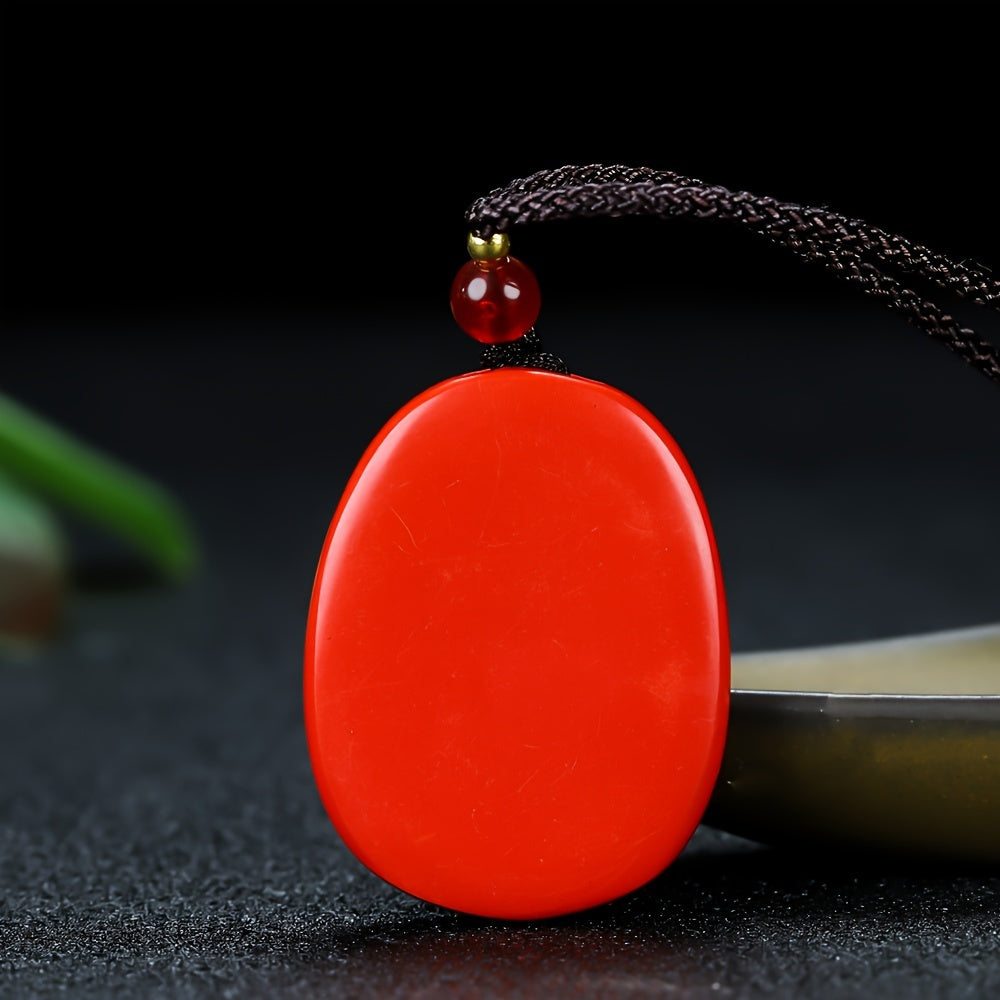
The choice of material, red cinnabar, adds another layer of meaning. Its fiery, vital color is associated with both life force (the Buddha's active compassion) and blood or rage (the demon's fierce energy). The smooth, polished surface invites touch, making the wearer a participant in this sacred dance of energies. The piece is not just to be seen, but to be felt and experienced.
Emotional & Social Significance: The Integrated Self
In a modern context, the symbolism of the Buddha and the demon resonates deeply with our own psychological struggles. We are often taught to suppress our "negative" emotions like anger, fear, and ambition. This pendant offers a different perspective: these are powerful energies that need to be acknowledged, understood, and integrated. Wearing it can be a personal affirmation of this process—a commitment to being both kind and strong, to having a compassionate heart and the courage to set firm boundaries.
This iconography provides a powerful antidote to the pressure to be perpetually pleasant or passive. It validates the need for fierce protection, for righteous anger in the face of injustice, and for the powerful will required to manifest positive change in the world. It is a symbol for the "spiritual warrior" who understands that true peace is not the absence of conflict, but the mastery of it.
Expert Commentary: Beyond Good and Evil
To understand this complex symbolism, we spoke with a historian of religion and a practicing Buddhist teacher.
Dr. Elena Vance, Historian of Religion: "The wrathful deities in Tibetan art are some of the most misunderstood figures in religious iconography. Western audiences often interpret them through a dualistic lens of good versus evil. But in their original context, they are psychological tools. They are visual representations of the tremendous energy required to break through delusion. They are not demons to be feared, but aspects of our own enlightened mind that we need to activate."
Lama Sonam, Buddhist Teacher: "We all have both the Buddha and the demon within. The Buddha is our capacity for love and quiet awareness. The demon is our capacity for focus, for saying 'no' to what harms us, for protecting our practice and others. To only cultivate one is to be incomplete. The goal is not to kill the demon, but to tame it, to make it a protector of your path. The image on the pendant is a constant reminder of this sacred union."
Technical Craftsmanship: Carving the Soul
Creating a piece like the cinnabar pendant requires immense skill. Cinnabar is a relatively soft mineral (Mercury Sulfide), but it requires a master carver to achieve such fine detail. The artist must first conceptualize the composition, ensuring the two figures are in dynamic balance. The carving process itself, whether done by hand with fine tools or with precision machinery, must be done with a steady hand to capture the subtle expressions on both faces. Finally, the polishing process brings out the stone's lustrous, deep red color, giving the piece its vibrant life force. Each step is a meditation, a transfer of understanding from the artist's mind to the stone.
Market Perspective and Fashion Trends
In the world of spiritual jewelry, there is a growing appetite for pieces that tell a deep story. Beyond simple gemstone meanings, consumers are drawn to symbols with rich philosophical and psychological depth. The Buddha and demon motif fits perfectly into this trend. It appeals to those on a serious spiritual path, as well as those who are simply drawn to its powerful aesthetic and the idea of integrated strength. It transcends simple "boho" style and enters the realm of talismanic, statement jewelry that is both beautiful and meaningful.
Conclusion: Embracing Your Whole Self
The image of the Buddha and the demon, carved into a single piece of vibrant red cinnabar, is more than just an ancient religious symbol. It is a timeless map for the human soul. It teaches us that our strength is magnified by our compassion, and our compassion is made effective by our strength. It is a call to stop fighting the shadows within and to instead invite them into the light, transforming them into allies on our journey.
To wear such a pendant is to wear a declaration of wholeness. It is an honoring of the full spectrum of human experience and a commitment to integrating all of one's powers—gentle and fierce, peaceful and wrathful—into a single, authentic, and enlightened being. It is a powerful reminder that the path to our highest self is not one of denial, but of courageous and compassionate integration.
