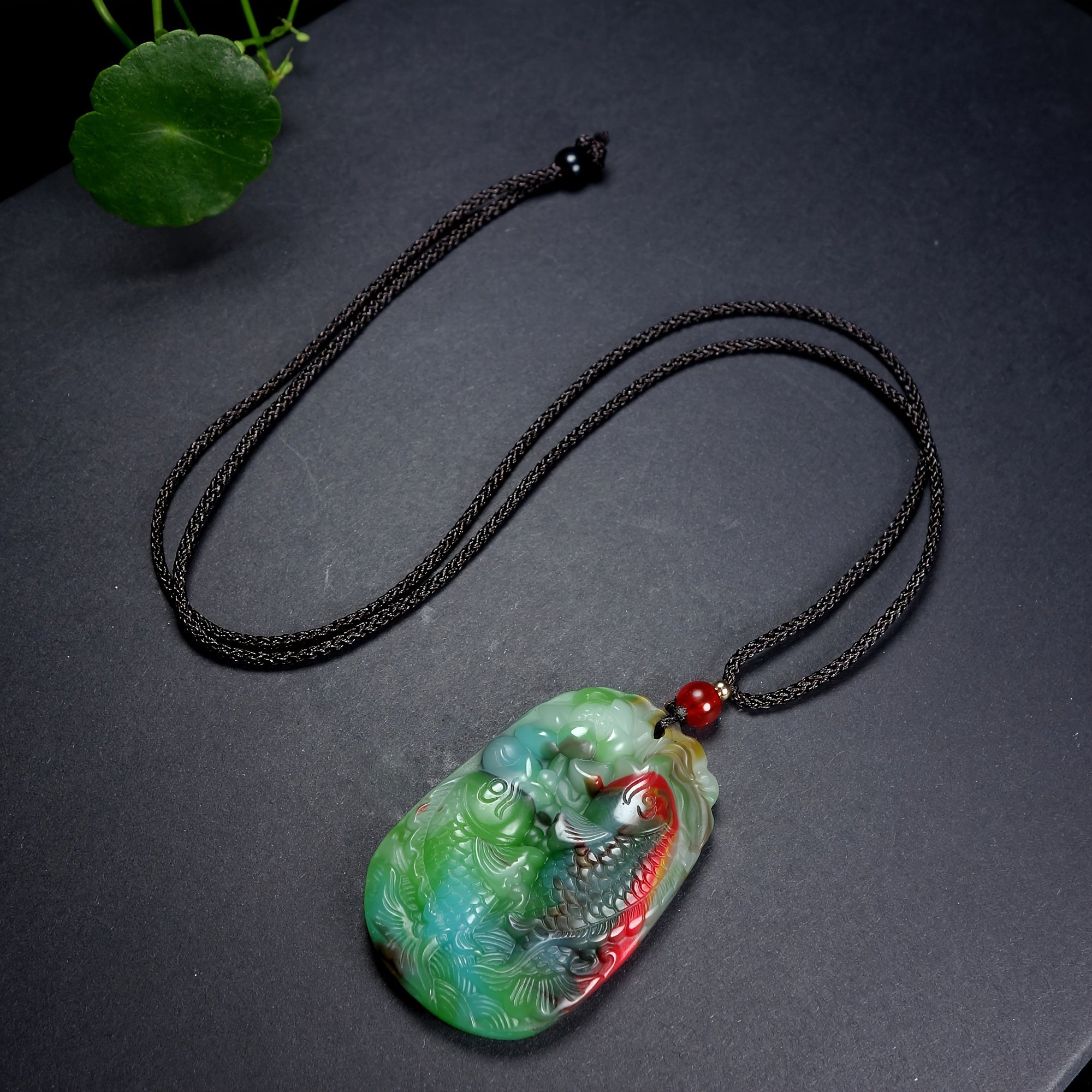


The Weight of Natural Stone
There's a particular kind of tired that comes not from doing too much, but from thinking in circles. You're sitting at your desk, and your hands are still, but your mind is running through the same three concerns like they're on a track. Your right hand moves to your chest almost on its own, searching.
What it finds isn't smooth. It isn't polished to a shine that reflects office lights. It's uneven, slightly rough in patches, cool against your skin. The stone has pores, tiny valleys and mountains that catch the light differently depending on the hour. Your thumb traces the contour of the fish shape, but what you're really noticing is the texture of time itself.
Natural materials have color difference—the tag says it like it's a warning. But after wearing this for weeks, you start to wonder if that's actually the point. The variations aren't flaws; they're records. This patch here might be slightly darker because of how the minerals settled millions of years ago. This lighter streak might be where water flowed through rock before humans existed.
When you're in a meeting that's going in circles, your fingers find these variations. The dark patch. The light streak. The tiny indentation that feels like a miniature crater. Your mind, which was stuck on quarterly reports or unresolved emails, suddenly has somewhere else to go. It goes geological. It thinks about pressure. About time measured in epochs rather than fiscal quarters.
The weight is specific—not heavy enough to be burdensome, but substantial enough that you're always aware it's there. On the subway home, when you're standing holding a strap, you feel it sway slightly with the train's movement. A gentle pendulum keeping time with the city's rhythm. In bed at night, when you take it off, there's a moment when your neck feels strangely light, like part of you is missing.
Some mornings, you put it on and it feels cold—really cold, like it absorbed the chill of the room overnight. Other times, if you've been holding it in your hand while thinking, it's already warm from your skin. The stone doesn't maintain a constant temperature. It participates in the thermal exchange of daily life. It remembers the cold of your winter walk. It holds the warmth of your afternoon in a sunlit cafe.
This is what people mean when they talk about materials having souls, maybe. Not in a mystical sense, but in the sense that they carry evidence of their history. The stone was somewhere before it was here. It was underground, under pressure, being formed by forces that had nothing to do with human design. Then someone found it, shaped it minimally, let it keep most of its original character.
When you wear it, you're not wearing a perfectly manufactured product. You're wearing a piece of geological time that now intersects with human time. Your time. The stone's coolness in the morning becomes part of your waking ritual. Its gradual warming becomes part of your day's rhythm.
The roughness that might have been polished away in another context remains. And that roughness becomes important. On days when everything feels too smooth, too curated, too digitally perfect—the slight unevenness of the stone feels like a relief. Like truth. Like something that hasn't been edited to be more palatable.
Your fingertips learn the topography better than your eyes do. In the dark, you can find the specific texture of that one rough patch. You can feel where the carving is slightly deeper. The material communicates through touch in a way that bypasses language entirely.
Material Companion
The stone mentioned here, with its particular weight and texture.