

The Chill of Stone, The Warmth of Metal: A Dialogue on Skin

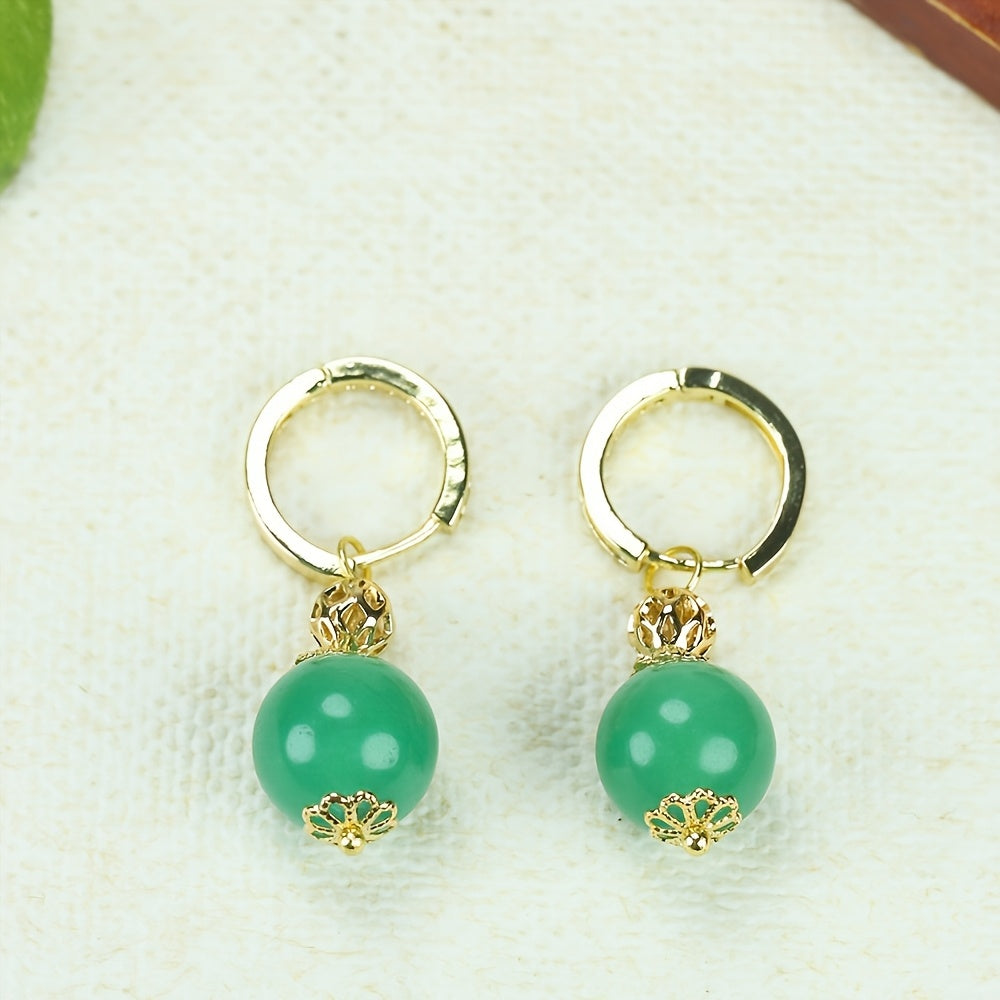
Your fingers are still a bit clumsy from sleep. They fumble in the small dish on your dresser, bypassing studs and chains until they find it: a small, spherical coolness. You pinch the apple green bead between your thumb and forefinger. For a second, it feels like holding a frozen raindrop. Then you guide the gold wire through your ear. The metal, by contrast, is already almost neutral. It doesn’t fight your skin’s temperature. The bead does.
That initial contrast is the entire first chapter. It’s not a thought. It’s a physical registration. Cool here. Warm there. In a world of constant mental chatter, this is a conversation that happens entirely in the language of sensation. It’s a dialogue your skin understands before your mind has a chance to label it.
Some people notice this more on overcast days, when the light is flat and the air is damp. The chill of the jade feels more pronounced, a tiny, precise point of clarity against the general grey. It’s a sensation that doesn’t ask for interpretation, only acknowledgment.
Jade’s Geological Whisper
Apple green jade isn’t a crystal that forms in dramatic, geometric points. It’s a nephrite, a metamorphic rock born under immense pressure and heat over eons. Its structure is interlocking and fibrous, which is why it’s so tough—it was literally forged under the weight of mountains. When you hold it, you’re holding a piece of that deep, slow, geological time.
But you don’t feel the eons. You feel the immediate, polite coolness. Stone is a poor conductor of heat. It holds its own temperature, stubbornly, against the warmth of your body. This isn’t aloofness; it’s integrity. It reminds you that you are touching something with its own history, its own pace, entirely separate from your morning rush.
Over the next hour, a quiet negotiation happens. The stone begins to surrender its coolness, slowly, molecule by molecule, to your skin. It doesn’t become hot. It becomes ambient. By mid-morning, it’s often forgotten, a neutral weight. The transition from “other” to “part of you” is so gradual you usually miss the exact moment it happens. That’s the point. It’s a lesson in integration that bypasses the mind and speaks directly to the body.
Gold’s Human Warmth
The hoop is a different story. Gold, especially this retro-finished version, is an excellent conductor. It doesn’t try to keep its own temperature. It almost immediately adopts yours. From the moment it touches your skin, it feels familiar, like an extension of your own warmth.
This warmth isn’t flashy. The finish is matte, soft, absorbing light rather than throwing it back in sparks. It feels like something that has been handled, worn, lived with. It carries the memory of human touch, both in its design intention and in its physical behavior. It’s the “yes, and…” to the jade’s initial “but.”
So you have this dialogue: the jade, asserting its otherness with a calm, cool touch. The gold, affirming connection with its immediate warmth. One is a reminder of the vast, non-human world of stone and time. The other is a reminder of human craft, history, and the body’s own persistent heat. They don’t compete. They complement. They complete a circuit.
The Body as the Third Material
The forgotten element in this dialogue is your own skin. It’s the medium through which the conversation happens. It’s the sensor, the translator, the territory where cool becomes warm.
You might find yourself, in a moment of distraction, reaching up to feel the earring. Not to adjust it, just to touch it. Your finger finds the bead. Is it still cool? Has it warmed? That simple, curious check-in is a tiny act of self-awareness. It pulls you out of the abstract storm of thoughts and into the present, physical reality of your body. For a split second, you are not worrying about the future or ruminating on the past. You are a sensing organism, investigating a temperature.
This is the hidden function of tactile jewelry: it turns the body from a mere mannequin into an active participant. The wearer isn’t just displaying an object; they are engaging in a silent, somatic experiment throughout the day.
A Vocabulary Beyond Words
We have endless words for emotions and thoughts, but a painfully limited vocabulary for sensation. “Cool.” “Warm.” “Heavy.” “Smooth.” These words are blunt instruments compared to the nuanced symphony of feeling.
An object like this earring creates a need for a more refined sensory language. It’s not just “cool.” It’s the initial shock-cool of morning. It’s the slow-yielding cool of the first hour. It’s the neutral ambient weight of afternoon. The gold isn’t just “warm.” It’s the immediate embrace-warmth of a conductor, the dull gleam-warmth of aged metal.
By wearing it, you become a student of this subtle language. You start to notice other contrasts: the steam off your coffee cup against the cool ceramic, the sun on one side of your face and the shade on the other. The earring becomes a tutor in attentiveness, training you to perceive the world through the often-ignored channel of touch and temperature.
It doesn’t promise peace. It offers a practice: the practice of feeling, deeply and without judgment, the simple physical reality of the moment you are in. And sometimes, that practice feels a lot like peace.