




The Weight of a Stone That Shows Two Faces: Texture, Temperature, and the Physics of Reflection
How the cool, solid weight of a natural stone pendant becomes a tactile anchor. Feeling the smooth carve of Guanyin on one side, the textured coil of the Dragon on the other, and the quiet shift between them.
E3 - The First Contact
The first time you pick it up, what you notice isn't the symbolism. It's the heft. Your hand makes a small adjustment, a recalibration to account for the unexpected density. 6.7 centimeters of carved narrative, 3.8 centimeters of depth—these are numbers until they're in your palm. Then they're physics. The stone is cooler than the air of the room. Not cold, but distinctly, reassuringly other. It has its own temperature, pulled from some deeper place than your living room.
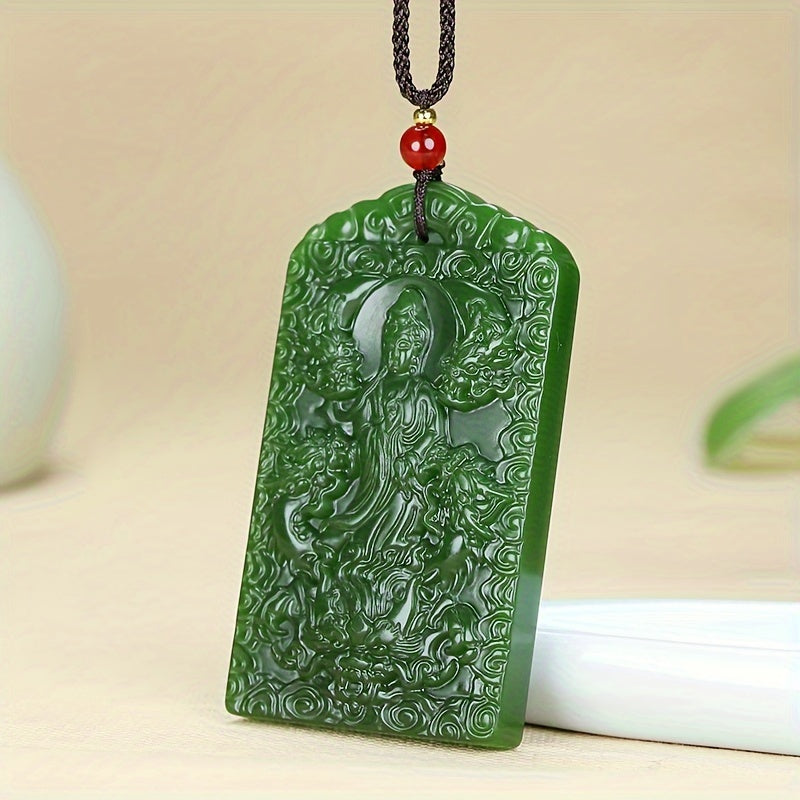
Your thumb moves. It finds an edge, then a smooth, flowing plane. You don't need to look to know this is Guanyin's side. The carve is so seamless it feels almost liquid, like stone remembering it was once mud, once sediment. There's no resistance, only guidance for your skin. You flip it. The transition is immediate. Now your thumb catches on texture. Minute ridges, a coiled topography. The Dragon's scales. It's the same stone, the same temperature, but a completely different conversation with your fingertips.
This is how meaning begins in the body: not with understanding, but with sensation. The double-sided pendant doesn't explain itself. It presents two distinct tactile realities and trusts you to notice the difference.
The Temperature of Attention
Wear it for a morning. The first hour, you're aware of the cool spot just below your collarbone. It's a gentle shock, a quiet wake-up call for your nervous system that isn't caffeine. By midday, the stone has warmed. Not to your exact body temperature—it retains a slight, stubborn coolness at its core—but enough that you only notice it when you move suddenly and feel its slight, independent swing on the 32cm rope.
This temperature shift is a record. A material memory of time spent in your presence. The stone isn't passive; it's in a slow dialogue with your skin. On anxious days, when your blood feels hot and hurried, that persistent cool center can feel like a calm point in a storm. On days of numbness or dissociation, the initial shock of it against your chest can be the thing that tethers you back to your body.
The natural stone acts as a thermal regulator of awareness. Not by magic, but by simple, constant contrast. It is always slightly "other," and in that slight difference, you find your own baseline.
The Textural Alphabet
Texture is a language without words. The Guanyin side speaks in vowels—open, flowing, uninterrupted. Your finger can travel its entire surface without a single catch. It encourages a kind of mental sigh. In moments of friction—a tense exchange, a crowded train—finding this smooth plane with your thumb becomes a somatic shortcut to exhale.
The Dragon side speaks in consonants. Stops, fricatives, hard edges. The scales provide micro-resistance. They ask your finger to pay attention, to engage rather than glide. When you're facing a task requiring precision or boundary-setting, this texture grounds you. It says: Here is structure. Here is definition.
Some people find they develop a preference without realizing it. They'll notice, after a week of wearing, that the pendant naturally rests with one face or the other against their skin. Not because they placed it that way, but because their body has chosen its preferred dialogue for that season of life. The object becomes a mirror of an unconscious need.
The Weight as Anchor
The pendant has mass. Not enough to be burdensome, but enough to be undeniable. On a 32cm rope, it sits at the center of your chest, right at the sternum—the body's architectural anchor point.
This weight serves a physiological function. In meditation practices, attention is often brought to the "hara" or lower dantian—a center of gravity in the belly. But for many in modern life, anxiety and overthinking live higher up, in the chest and throat. A gentle, constant weight at the sternum can act as a counterbalance, a gentle pull downward against the upward rush of frantic thought.
It's a subtle form of proprioception—your body's sense of itself in space. When you're lost in mental loops, the slight tug of the pendant with each step or turn of your head is a quiet, persistent reminder: You are here. In a body. That occupies space. This is the opposite of dissociation. It's an invitation back into embodiment.
The Rope as Horizon Line
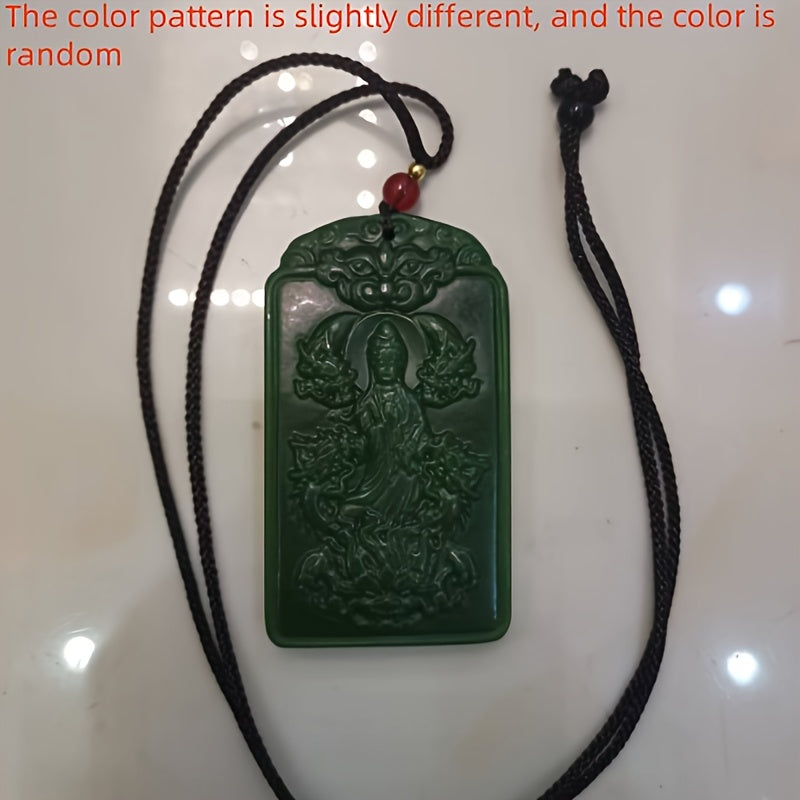
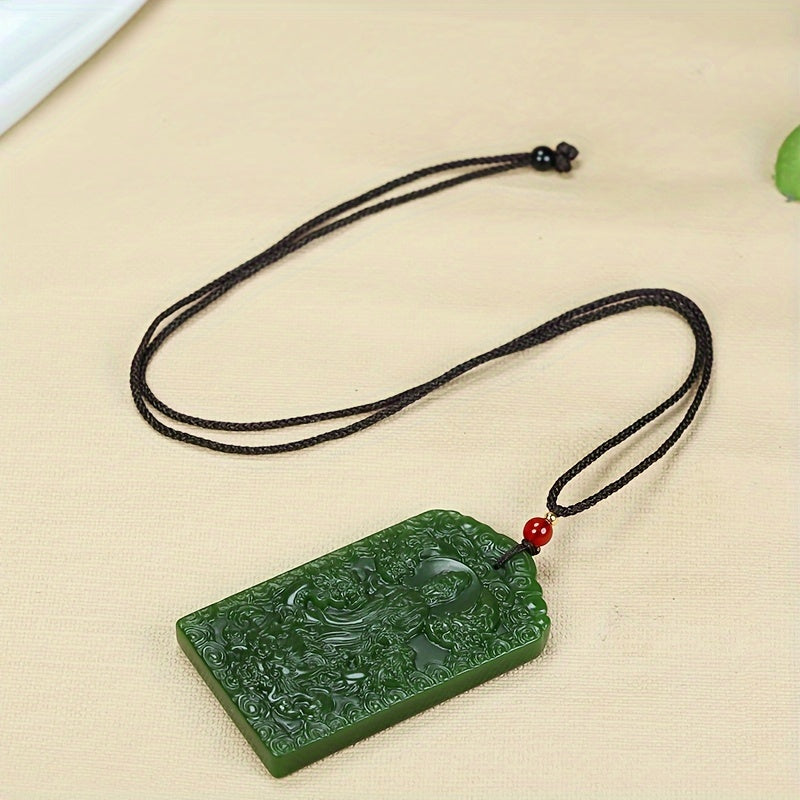
The 32cm measurement isn't arbitrary. It's the distance that allows the pendant to hang just so—not too high, where it would feel like a choker, not too low, where it would swing with every breath. It finds the horizon line of the upper chest.
The rope itself is a study in soft defiance. Against the hard, cool stone, it's warm and pliable. It's made of fibers that will, over months and years, soften further, conforming to the shape of your neck, holding the memory of your body's particular geometry. It will develop a patina from skin oils and the atmosphere, becoming a record of time in a way the stone cannot.
This contrast—hard stone, soft rope—creates a dynamic relationship. The stone is the fixed point, the anchor. The rope is the flexible tether that connects it to you, the living, moving being. Together, they model a kind of resilience: firmness at the core, adaptability at the point of connection.
The Patina of Time
New, the stone has a certain matte finish. It drinks light rather than reflecting it. Over time, something shifts. Not a polish, exactly, but a deepening. The constant, subtle friction of skin and clothing, the oils of your body, the atmosphere—they begin to work on the surface.
A sheen develops, particularly on the high points of the carve. It's slow, almost imperceptible from day to day. But one morning, maybe six months in, you'll catch it in a certain light and see that the Dragon's scales catch the sun differently. That Guanyin's robe has a soft luminosity it didn't have before.
This patina isn't wear. It's a collaboration. The stone offers its mineral constancy; you offer your lived life. Together, you create a surface that tells a story no one else can read in full, but that you feel every time your fingers trace the now-familiar contours.
It becomes, in the truest sense, your stone. Not because you own it, but because you have entered into a material relationship with it. You have changed each other.
The Flip as Ritual
The act of flipping the pendant is a tiny, private ritual. It requires intention. You can't do it absentmindedly; you must take the stone between your fingers, feel for the current face, and consciously turn it to the other.
People tend to develop personal codes for this. Some flip it at the transition between work and home—Dragon forward for the office, Guanyin forward for the evening. Some flip it when they feel a shift in their internal weather—from anxiety to calm, from passivity to agency.
The physical gesture becomes a punctuation mark in the sentence of the day. A way of saying: That chapter is done. This is a new one. It's a somatic declaration that is more powerful than a mental one because it involves the body in the decision.
The Silence of Stone
In a world of notifications and alerts, the dragon and guanyin pendant is profoundly silent. It doesn't buzz, ping, or flash. Its communication is limited to weight, temperature, and texture.
This silence is its gift. It demands nothing. It simply exists. In your pocket, on your chest, in your hand. Its presence is constant but non-intrusive. It's there when you need an anchor, but it doesn't interrupt you to remind you it's there.
This makes it the perfect companion for the overstimulated mind. It's a piece of the natural world—slow, patient, geological—that you carry into the digital frenzy. When everything else is shouting for your attention, the stone offers a quiet so deep you can hear your own thoughts again.
Its material truth is simple: it is what it is. A piece of the earth, carved by human hands, worn by a human body. In its tangible, uncomplicated reality, it offers a respite from the complicated, intangible anxieties of modern life. It doesn't solve them. It just sits with them, solid and cool, reminding you that you too are a physical being in a physical world, and that sometimes, that's enough.
Experience the Material Dialogue
The Dragon and Guanyin Double-Sided Pendant. Feel the weight, the texture, the quiet conversation between stone and skin.
View the Jewelry Piece →