





Baltic Amber: The Sunstone That Remembers Forests Older Than Human Memory
It starts with temperature. Not the stone's temperature, but yours. The moment amber touches skin, something quiet happens: it doesn't feel like an object. It feels like a conversation that's been waiting to continue.
Your hand knows before your mind does. The weight is wrong. Not heavy like metal, not light like plastic. Eight grams of Baltic amber feels like holding a condensed hour of afternoon sunlight. Not the heat, but the quality of light that falls through leaves when you're not trying to accomplish anything.
The science is straightforward: amber is fossilized resin from coniferous trees that grew 50 million years ago. The chemistry: complex polymers, succinic acid, terpenes. But language fails here. These words describe mechanism, not experience.
The Geological Pace of Warmth
What your skin registers is different. Amber has the lowest thermal conductivity of any gemstone. This means it doesn't steal your body heat like silver or gold. It doesn't stay stubbornly cool. Instead, it accepts warmth on its own terms—slowly, gradually, as if considering whether it trusts you.
This is where material becomes companion. When you first put on an amber pendant, there's a brief moment of coolness against your collarbone. Then, over five or six minutes, something shifts. The stone begins to feel less like "other" and more like an extension of your own thermal field.
Some people notice this transition during their morning routine. The amber starts cool from the night air on the dresser. By the time they've made coffee, it's reached skin temperature. By the first sip, it feels like it's always been there. The material teaches patience through physics.
Ancient Baltic tribes had a saying: "Amber doesn't hurry." They weren't being poetic. They observed that amber artifacts outlasted bronze, iron, even gold. Not through hardness, but through a kind of material resilience—the ability to accept change without breaking.

Inclusions: The Memory of Interruption
Look closely at a piece of Baltic amber. You might see tiny bubbles, fragments of ancient bark, sometimes a mosquito frozen in mid-flight. These inclusions weren't accidents. They were moments when the forest interrupted itself.
The resin flowed, then something fell into it. The flow continued around the interruption. Fifty million years later, we call these imperfections. But what if they're something else? What if they're the material's way of remembering that existence is always relational?
One collector described it this way: "The clean, clear amber pieces are beautiful. But the ones with inclusions feel true. They didn't form in some idealized vacuum. They formed in a real forest, with real things happening."
This is the material's quiet wisdom: perfection isn't about exclusion. It's about integration. The interruptions become part of the story without stopping the flow.
The Color of Accumulated Light
Baltic amber ranges from pale lemon to deep cognac. The color comes from oxidation over geological time. But that's the chemical explanation. The experiential truth is different.
Hold a piece to the light. It doesn't reflect like a mirror. It doesn't sparkle like a diamond. It glows from within, as if it absorbed sunlight for millions of years and is now gently releasing it.
This quality has a name in material science: diaphaneity. But the word feels inadequate. What's happening is more intimate. The stone becomes a filter for reality. Look through it, and the world takes on a honeyed quality. Not distorted, but softened.
Some people discover this accidentally. They're wearing an amber pendant while reading on a cloudy day. They glance down and notice: the page seems warmer, kinder. The amber hasn't changed the light. It has remembered a different relationship to light.

The Patina of Personal History
New amber has a certain brightness. But worn amber develops something else. Over months of skin contact, the surface acquires a soft sheen. Tiny micro-scratches appear, each one catching light at a different angle. The color deepens slightly at pressure points.
This isn't damage. It's conversation. The material responds to your life. It remembers the wool sweater you wore all winter, the sunscreen from last summer, the particular chemistry of your skin.
One woman noticed something after wearing the same amber pendant for three years. During a difficult period, she found herself holding it constantly. When things stabilized, she looked at it and saw: the surface had developed a richer patina exactly where her thumb most often rested.
The material had recorded her need without judgment. It hadn't solved anything. It had simply borne witness.
The Weight That Isn't About Gravity
Amber is light for its size. A teardrop pendant floats on a chain. But some people report a different sensation: it feels "substantial" in a way that has nothing to do with grams.
This might be what ancient cultures meant when they called amber "the stone of memory." Not that it helps you remember facts. But that it carries the weight of time made tangible. Fifty million years in your palm. The Paleocene epoch. Mammals just beginning their ascent. Flowers evolving. Continents drifting.
All of this contained in something that warms to your touch in minutes.
There's a humility in this material relationship. You hold geological time, and it accommodates your body temperature. Neither cancels the other. They coexist.
This might be the real lesson of material souls: objects don't have to choose between being ancient and being present. Amber manages both. It remembers forests that no human ever saw, while feeling perfectly at home against your skin in a subway car.
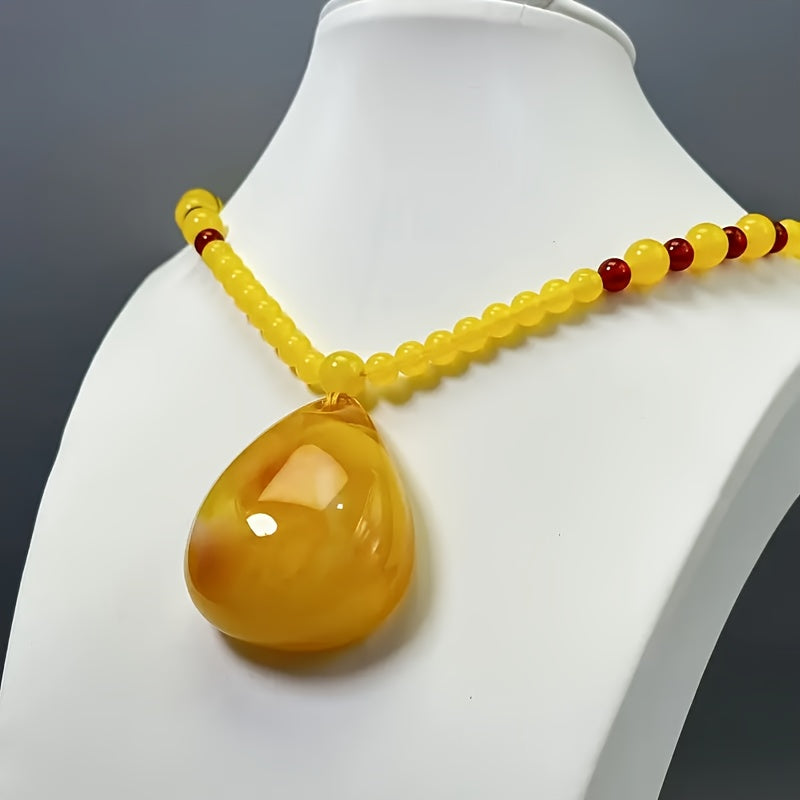
The Material Companion

Natural Baltic amber, fossilized sunlight that remembers when forests were new. Worn not as decoration but as a quiet dialogue between geological time and personal moment.
Experience the Material →