





The Alchemist of Transition — Archetype of Resilience and Emotional Reassembly in Modern Life
In the lexicon of human experience, certain figures stand as compass points. Not heroes in the classical sense, but archetypes—deep, recurring patterns of being that describe how we navigate specific territories of the soul. One such territory, perhaps the most universally visited yet personally bewildering, is the landscape of transition. Not the minor shifts of daily life, but the seismic events that dissolve a familiar world: loss, profound change, the end of a chapter that once defined us.
Into this landscape steps the Alchemist of Transition. This is not the Warrior who fights the change, nor the Victim who is crushed by it. The Alchemist operates on a different principle entirely. Their core action is not resistance or surrender, but perception. They look at the scattered pieces, the emotional ashes, the dissolved structures, and ask a quiet, radical question: What enduring patterns remain? What latent form is waiting to be recognized?

The Modern Condition: When Everything is Flux
We live in a culture that glorifies the fresh start while secretly fearing the void that makes it necessary. Our narratives are of breakthroughs, pivots, and radical reinventions. We are sold the mythology of the leap. Yet, for anyone who has lived through a true ending, the reality feels less like a leap and more like a slow, confusing freefall. The ground of old identities gives way, and we are left suspended in the in-between.
In this space, reaction is the default. We grasp for the nearest solid-looking idea: I must get over this. I need to be strong. I have to move on. These are reactive postures, born of the discomfort of ambiguity. The Alchemist archetype invites a different stance: non-reactive observation. It is the capacity to be in the dissolution without immediately trying to fix it, to sort it, or to escape it. It is the practice of seeing what is actually there, in the rubble.
The Alchemist does not see ashes as waste, but as the fundamental material from which all new forms must be shaped.
Seeing Is Not Passive: The Architecture of Recovery
This is the crucial misunderstanding about resilience. It is often mistaken for toughness, for an imperviousness to pain. The Alchemist shows us it is something more subtle and more powerful: it is reconstructive vision.
Consider the beehive pattern engraved upon the Darhai Phoenix pendant. A hive is not a random aggregation; it is a precise, hexagonal architecture, the most efficient structural form in nature. It represents order, community, and diligent creation. Now, imagine that pattern not as something built from new materials, but as a blueprint discovered within a pile of splintered wood and wax. That is the Alchemist's work.
After a loss, our internal world can feel like that pile of splinters. The Alchemist’s task is to sit with those splinters and begin to perceive the original joints, the grain of the wood, the traces of the old structure. This is not about rebuilding the exact same hive. It is about understanding the principles of hive-making that are still intact within you—your capacity for connection, your instinct for creating order, your ability to labor patiently toward a collective good (even if that "collective" is now the reconciled parts of your own self).

The Phoenix & The Hive: A Symbolic Union
The Darhai Phoenix pendant merges the symbol of cyclical rebirth with the ancient beehive motif—a direct representation of the Alchemist's work. It speaks of rising, but only through the patient, architectural process of reassembly.
The Myth & Symbol Layer: Why the Phoenix Endures
The Phoenix myth survives not because we believe a bird literally ignites and reforms from its ashes, but because it perfectly diagrams a psychological and emotional truth we all recognize. The fire represents the transformative crisis—the event that cannot be survived unchanged. The ashes represent the state of dissolution—where old forms are gone, but the essential material of experience remains. The rebirth represents the emergence of a new form that contains the memory of the fire.
The Alchemist is the one who tends that process. They are the consciousness that chooses to stay with the ashes, to sift through them, to find the few, precious granules of gold—the insights, the clarified loves, the non-negotiable truths—that the fire has revealed. They understand that the new form must incorporate these granules, or it will be hollow.
The Modern Struggle: Why We Fail to "See"
Our contemporary environment is arguably hostile to the Alchemist’s practice. We are flooded with stimuli that demand immediate reaction, not patient perception. Grief has a timeline. Recovery is measured in productivity. We are encouraged to "let go" swiftly, often interpreting that as "forget." This cultural pressure blinds us to the intricate, slow work of emotional reassembly.
The struggle, then, is to create the conditions for seeing. It means carving out moments of silence amidst the noise. It means tolerating the discomfort of not having an answer. It means rejecting the simplistic narrative of "before" and "after" in favor of the more complex, truthful narrative of "through."

Non-Reactive Observation: The Core Practice
How does one cultivate this Alchemist's gaze? It begins with a simple, deceptively difficult shift: from asking "How do I fix this?" to asking "What is here to be seen?"
This is a practice without an agenda. You might sit quietly and simply notice the constellation of feelings in your body—not to change them, but to acknowledge their shape. You might journal not to find solutions, but to describe the landscape of your thoughts with as much accuracy as possible. You might look at an object that reminds you of the loss and observe the cascade of memories and sensations without following them into a story of regret or longing.
In these moments, you are practicing the Alchemist's core skill: discernment without judgment. You are separating the raw materials of your experience—the sorrow, the anger, the love, the confusion—and observing their inherent properties, as an alchemist would observe sulphur or mercury.
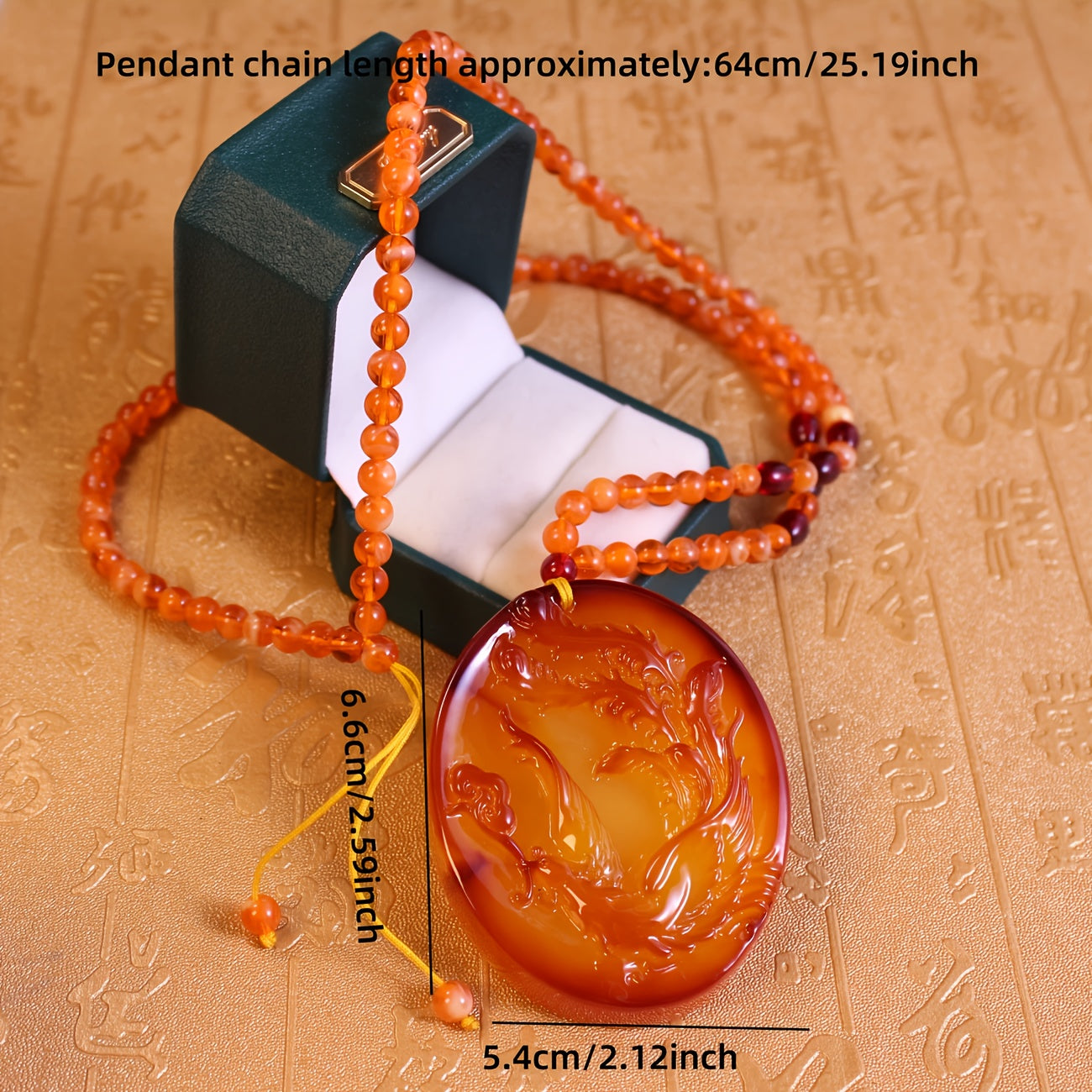
The Object as a Practice Anchor
A symbolic object, like the Phoenix pendant, can serve as a physical anchor for this practice. Its weight and texture bring you back to the present moment, and its symbolism gently redirects your focus from reactive struggle to the possibility of perceived structure within change.
The Role of the Object: Jewelry as a Physical Reminder
This is where a cultural object, worn on the body, transcends adornment. A piece like the Phoenix pendant is not a magic talisman that performs the alchemy for you. It is a reference point. Its cool silver against the skin is a sensory interrupt to spiraling thoughts. The act of feeling the engraved lines under your fingertip is a tactile meditation that can ground you in the here and now.
It whispers, without words: Remember the pattern. Remember that dissolution contains the seed of form. You are not just in the fire; you are also the one who can perceive the shape emerging from the ash. It externalizes the archetype, making it tangible, wearable, and present in your daily life.
Daily Life as the Alchemist's Laboratory
The work of the Alchemist is not confined to meditation cushions or therapist's offices. It happens in the mundane. It is the choice to cook a nourishing meal when you feel empty. It is the decision to take a walk and notice the sky instead of numbing out with a screen. It is the small act of organizing a drawer—creating a pocket of order within chaos.
Each of these acts is a small, deliberate placement of a hexagon in your new, internal hive. They are not grand gestures of healing, but the minute, architectural labors of reassembly. Over time, these actions accumulate. They build a new structure of living—one that is not a replica of the old, but a different, often more resilient and conscious, form.

Why Awareness is Not a Slowdown
There is a pervasive fear that to look at our pain, to sit with our transitions, is to get "stuck." The Alchemist archetype challenges this. What looks like stuckness from the outside is often the most vital internal motion. The true stagnation is in repetitive, unconscious reaction—replaying the same stories, engaging the same defenses.
The slow, perceptive work of the Alchemist is what actually generates forward momentum. It is the difference between hastily gluing broken pottery back together (which will always be fragile along the fault lines) and patiently melting down the pieces to cast something new, strong, and whole. The latter takes more time and more heat, but the result is integrated, not merely repaired.

A Companion for the Process
Choosing to wear such a symbol is an agreement with yourself to honor the process, not just the outcome. It is a commitment to the Alchemist's path—the path of seeing, sifting, and finding form within the formless stages of change.
Return to the Symbol Core: The Alchemist's Gift
The Alchemist of Transition ultimately offers a gift of profound agency. They reframe the narrative of "what happened to me" into "what is becoming within me." This is not positive thinking; it is structural thinking. It is the recognition that you are not just the site of a catastrophe, but also the laboratory where a new compound of self is being formulated.
This archetype does not promise an end to pain. It promises something more valuable: meaningful integration. It assures us that our experiences, especially the painful ones, are not wasted material. They are the very substance from which a wiser, more nuanced, and more compassionate self can be assembled.
To recognize the Alchemist within you is to grant yourself permission for the full, messy, non-linear timeline of healing. It is to pick up the scattered pieces not with despair, but with a curious, discerning eye, asking not "Why did this break?" but "What can now be made from what remains?"
Seeker's Dialogue: Invitation to the Inner Laboratory
This understanding naturally raises questions, the kind that Google searches cannot easily answer but the soul persistently asks:
Who is this archetype really for? It is for anyone who feels caught in the "aftermath," who is tired of forcing a "fresh start," and who intuits that there is a deeper, more authentic way to process change. It is for the one who is ready to trade the struggle of "moving on" for the practice of "moving with."
Can I cultivate this if I'm not "spiritual"? Absolutely. The Alchemist is a psychological and emotional model, not a religious one. The "laboratory" is your own awareness; the "elements" are your thoughts, feelings, and experiences. The practice is secular mindfulness applied to the specific task of navigating transition.
Does wearing a symbol like the Phoenix help, or is it just a reminder? This is the essential distinction. It does not "help" in the sense of doing the work for you. Its function is precisely as a reminder—a beautiful, weighted, tactile reminder of the perspective you are choosing to cultivate. In moments of forgetfulness, when you slip back into reactive pain, its presence can gently nudge you back toward the Alchemist's gaze. In that sense, it is a tool for consistency in your practice.
The dialogue is always open. The questions are the first material in the Alchemist's vessel. What question about your own transition is waiting to be seen, not just answered?
