




Seeker's Dialogue: Can a Symbol Help Me Move On? Wearing the Phoenix Without Forgetting the Fire
This is not a guide. It is a conversation. It begins where search queries end—in the ambiguous space between a genuine human question and the simplistic answers the internet often provides. Questions like: How do I move on? Can an object hold meaning for me? Is it wrong to want a reminder of strength? These are not problems to be solved, but territories to be explored. This dialogue is for the seeker who holds both a desire for renewal and a deep respect for what has been lost. It is for those who suspect that "moving on" might be the wrong goal altogether.
We often approach symbols of rebirth, like the Phoenix, with a hidden expectation: that they will help us transcend our pain, to rise above it and leave it in the ashes. But what if the Phoenix's deeper teaching is about integration, not transcendence? What if the fire is not something to be forgotten, but a transformative heat that becomes part of the new form's very structure? This dialogue explores that tension.
 Who is this kind of jewelry really for?
It is not for the person seeking a magical amulet to erase the past. It is not for the spiritual bypasser who wants to adorn themselves with the appearance of enlightenment without the labor of integration. It is also not solely for those in the acute, raw throes of fresh grief, where any symbol might feel like an insult to the magnitude of the pain.
It is for the person in the aftermath. The one who has been through the fire, who has sat with the ashes, and who now, perhaps hesitantly, is beginning to wonder: What now? What can be built here? It is for the person who understands intuitively that they will never be the same, and who is now faced with the more profound question: "Who will I become, incorporating this change?" This jewelry is a companion for that becoming—a tangible point of focus for an intangible process.
The Phoenix is not a symbol for forgetting the fire; it is a symbol for carrying the wisdom of the fire forward in a new, more conscious form.Is "moving on" even the right goal?
Our culture is obsessed with "moving on." It implies leaving a place, a state, a feeling behind. It suggests a linear progression: past (bad) → present (moving) → future (good, "over it"). But human psychology and emotion are not linear. Grief, trauma, and profound change become threads in the tapestry of our identity; they are not chapters we close.
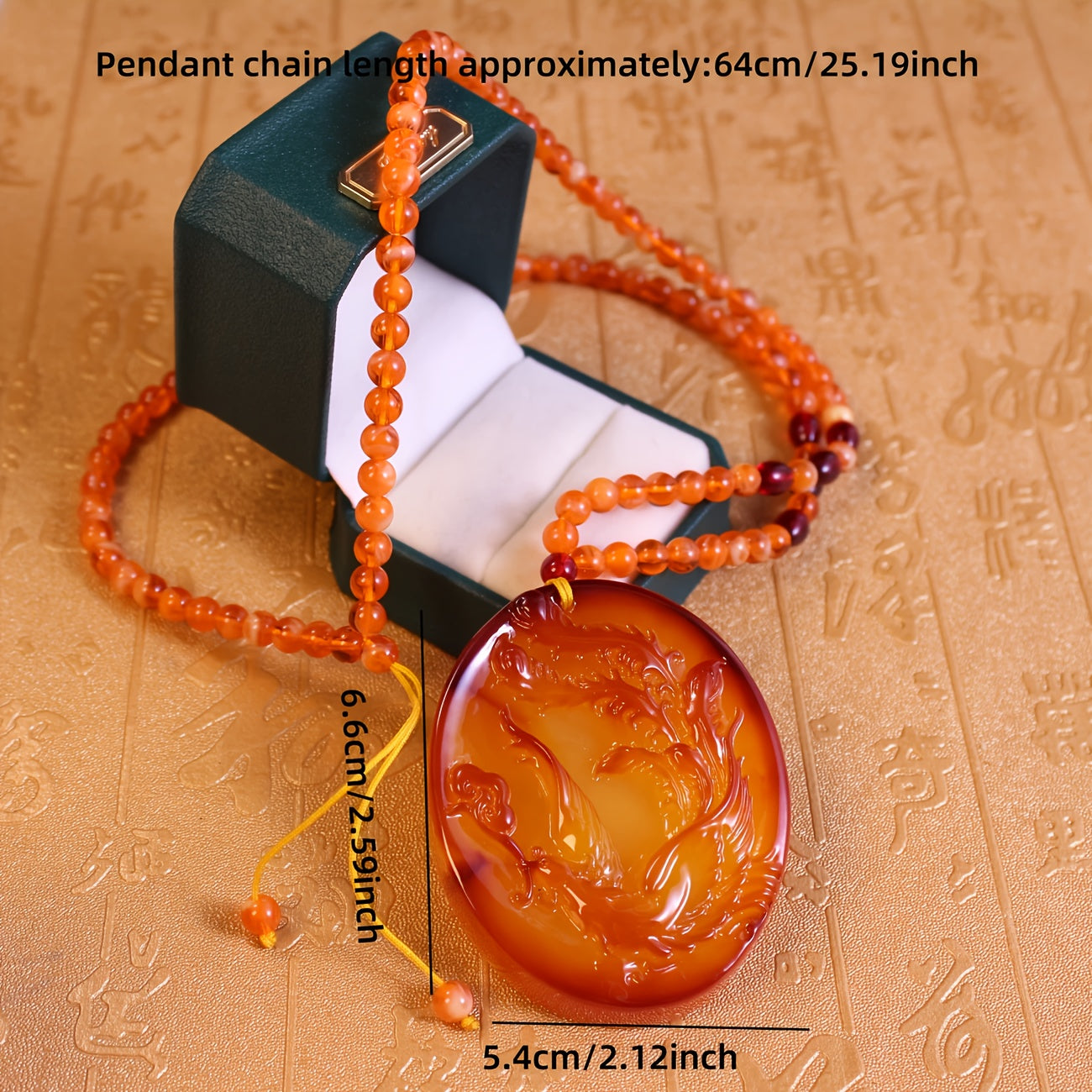
Perhaps a more truthful goal is "moving with." Moving forward while taking the experience with you—not as a bleeding wound, but as integrated knowledge, as depth, as compassion. The Phoenix doesn't "move on" from its ashes; it incorporates them into its new life. The beehive pattern on the pendant suggests how: through deliberate, patient reconstruction. The goal shifts from escape to integration, from erasure to architecture.
So, if you feel a resistance to the phrase "move on," trust that resistance. It may be your integrity recognizing that some experiences are too significant to be merely left behind. The question then becomes: How do I carry this with grace? How do I let it transform me into someone wiser, not just someone wounded?

A Focus for the Question
An object like this doesn't answer the question "How do I move on?" Instead, it holds the space for you to ask the better question: "How do I integrate this into who I am becoming?" Its presence is a steadying influence for that inquiry.
This is a crucial modern dilemma. We are rational beings, often skeptical of "magical thinking." We don't believe a piece of metal can mystically heal us. And yet, we are meaning-making creatures. We imbue objects with significance—wedding rings, heirlooms, photographs.
Wearing the Phoenix without a superstitious belief in its power is actually the more profound path. It turns the symbol into a psychological tool rather than a mystical crutch. You are not wearing it so that it will make you resilient. You are wearing it because you have chosen the archetype of resilience as a guide. You are aligning yourself with its story. The "power" is not in the pendant; it is in your conscious choice to let its meaning influence your mindset and actions.
It functions like a compass. A compass doesn't create north; it points to it. Similarly, this symbol doesn't create resilience; it points your attention toward your own inherent capacity for it. Every time you notice it, you have a micro-opportunity to remember your intention: to rebuild, to rise with dignity, to find pattern in the aftermath.
The Dialogue with the Self: When the Pendant Asks Questions
The most interesting dynamic occurs when the symbol stops being a passive reminder and starts acting as a mirror, reflecting your own state back to you.
On a day when you feel strong and integrated, you might put it on and feel a sense of alignment. "Yes, this represents me today." On a day when you feel shattered, putting it on might create a gentle tension. The pendant's message of dignified rebirth contrasts with your inner feeling of collapse. This tension is not a failure; it is the beginning of the dialogue.
The pendant, in its silent, solid way, asks: "What would the Phoenix do in this feeling? Not to escape it, but to be in it differently? Where is the tiniest hexagon of strength you could build right now?" It doesn't shout answers. It asks you to find your own, moving you from passive suffering to active, if weary, participation in your own healing.

The Mirror on Your Skin
Worn close to the heart, the pendant becomes part of your daily self-perception. It can reflect back not who you are in every moment, but who you are choosing to become across moments—a being capable of holding both shadow (the ashes) and light (the rising).
This may be the most tender and important question. It speaks to a deep loyalty to our own suffering, a fear that by embracing a symbol of renewal, we are betraying what we lost or diminishing the gravity of what happened.
Consider this perspective: The most profound respect we can pay to a difficult experience is to allow it to transform us into someone more authentic, compassionate, and awake. To remain stuck in the ashes forever is not loyalty; it is a different kind of forgetting—forgetting our own potential for life.
Wearing the Phoenix is not a declaration that "everything is fine now." It is a declaration that "what happened mattered, and because it mattered, I choose to not let it end in destruction alone. I choose to let it lead to a more conscious creation." It honors the fire by acknowledging that its heat was transformative, not just destructive. The beehive engraving specifically honors the labor of that transformation—the hard, patient work of making meaning.

A Different Kind of Function: The Object as Stake in the Ground
In a world of digital ephemera and shifting identities, a solid sterling silver object serves a unique function: it is a stake in the ground. It is a physical declaration of an internal commitment.
Buying it (or receiving it) can mark the moment you decided to engage consciously with your process of integration. Wearing it daily is the ritual that reaffirms that commitment. Over years, it becomes an artifact of your own journey. Its developing patina will be a record of the atmosphere it lived in—the salt of your sweat, the oils of your skin, the air of your city—just as you carry the invisible patina of your experiences.
It functions less like a tool and more like a witness. It says, "I was here for this. I chose this path." That in itself can be a source of strength, a reminder of your own agency during a time when you may have felt powerless.

Your Stake in the Ground
This piece can serve as that physical marker—a beautiful, durable testament to your choice to engage with your story consciously, to move from being a victim of circumstance to an architect of meaning.
Closing the Dialogue (For Now): An Open-Ended Invitation
This dialogue has no neat conclusion because your process doesn't either. The questions may change. Your relationship to the symbol will certainly evolve. Some days it will feel deeply resonant; other days it may just be a piece of jewelry. Both are okay.
The final takeaway is not an answer, but an invitation: to hold your questions about moving on, healing, and symbols with more gentleness and complexity. To allow for the possibility that healing is not a destination of "arrival," but a manner of "traveling."
The Phoenix pendant, if you choose it, becomes a fellow traveler—one that doesn't pull you forward, but walks beside you, its silent form holding the space for your own answers to emerge. It asks only that you remember: the fire is part of your story, but it does not have to be the end of it. The next chapter is yours to architect, one deliberate, hexagonal choice at a time.
A Companion for the Dialogue