





How Do You Wear a Symbol Without Adopting a Belief?
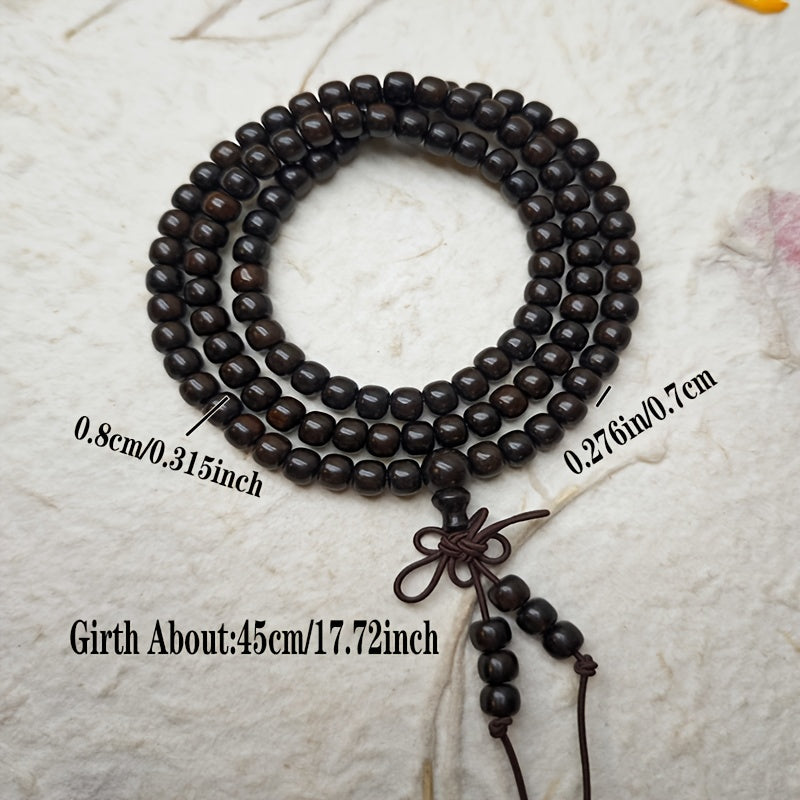
You see it—a string of dark, fragrant beads. You feel a pull. It's aesthetic, yes, but it's something more. It feels old, grounded, intentional. There's a whisper of depth there. But then, almost immediately, a second wave of feeling arrives: hesitation. Is this for me? You're not Buddhist. You don't chant mantras. You have a deep respect for the traditions it comes from and a healthy fear of cultural appropriation. You don't want to be a spiritual tourist, wearing a symbol as a costume. But the pull remains. The question hangs in the air, sincere and fraught: How can I engage with this symbol in a way that is respectful, authentic, and truly my own?
This tension is not a problem to be solved, but a dialogue to be entered. It's a sign of a conscious, caring mind. Let's explore this together, not with definitive answers, but with perspectives that might help you find your own relationship to the symbol you're drawn to.
This is the gatekeeper question. Historically, the mala is a tool within Dharmic traditions (Hinduism, Buddhism, Jainism) for counting mantras or breaths in meditation. Its "for-ness" is clear in that context. But objects, especially powerful ones, have a way of traveling. Their meaning can evolve as they cross cultural boundaries.
Consider this: Is a piano only for Europeans because it was perfected there? Is a food only for the culture that invented it? Objects and practices can be rooted in a culture, yet resonant beyond it. The key is in the how of the engagement. A mala is not exclusively "for" anyone in a possessive sense. It is, however, most meaningful for someone who engages with it consciously—who understands or seeks to understand its context, and who uses it in a way that aligns with their own sincere search for focus, patience, or presence. It is for the person who will not treat it as a mere decoration, but as an object with a history and a potential function.
This gets to the core of utility versus doctrine. Let's separate the tool from the theology.
The mala is, at its simplest, a tactile counting device. Its design—108 beads on a loop—is a brilliant piece of cognitive ergonomics for focusing a wandering mind. The belief system might explain why one should focus the mind (to attain enlightenment, to please a deity) and what to focus on (a specific mantra).
But the mechanism of focus itself is psychologically universal. You can use the tool's mechanism—the rhythmic, tactile progression—for your own secular intention: to calm anxiety, to enhance concentration, to create a mindful pause. You are using the "how" without necessarily subscribing to the "why." This is similar to using yoga for physical flexibility and stress relief without adopting Hindu cosmology. It's a matter of being clear with yourself about your intention. Are you using it as a functional psychological tool, or are you pretending to a belief you don't hold? The former is often authentic; the latter is usually where discomfort (and appropriation) lies.
Navigating the Space: From Consumer to Engager
The shift from problematic to respectful engagement is a shift in identity: from consumer to engager.
- The Consumer sees the symbol as a product with aesthetic or trendy value. They take the look, discard the context, and use it to signal an identity. The meaning is shallow and self-referential.
- The Engager sees the symbol as a node in a web of meaning. They are curious about its origins. They may not adopt the entire belief system, but they honor the depth from which it came. They ask, "What can this object mean to me, within my own life and values, while acknowledging its broader story?" Their use adds a personal layer of meaning without erasing the original ones.
Wearing a mala as an Engager might mean you wear it as a reminder of your own commitment to patience (inspired by the sandalwood's slow growth) and focus (inspired by the 108-bead structure). You are not claiming to be a Buddhist practitioner; you are acknowledging that this tool's design resonates with your human need for structure and grounding.
This is the most subtle and personal question. The line between a sincere search and spiritual window-shopping can be thin. Here are a few reflective prompts:
- Motivation Check: Is the desire for this object followed by a desire for a practice (however small), or just for possession? Does thinking about it make you want to sit still and breathe, or just to have it look a certain way on your wrist?
- The Test of Time: Does the pull persist after days or weeks, or is it a fleeting fascination with the "exotic" or "mystical"? Sincere resonance tends to linger and recur.
- Depth vs. Surface: Are you interested in the material (the feel of the wood, the weight) and the possible personal use, or primarily in how it might be perceived by others as a "spiritual" accessory?
If your interest leans toward practice, personal resonance, and materiality, it's likely a genuine seeking of meaning. If it leans heavily toward image, novelty, and external signaling, it might be more about escape or identity-construction. Neither is inherently "bad," but clarity here will determine whether the object becomes a meaningful companion or just another item in a drawer.
The Role of Learning: Respect as a Foundation
Respectful engagement is built on a foundation of basic knowledge. You don't need a PhD, but a little learning goes a long way.
For a mala, this might mean understanding:
- Why 108? (Exploring its historical and symbolic significance).
- What is sandalwood's role in the cultures that cherish it? (Its use in ritual, medicine, and craft).
- How is it traditionally used in meditation?
Creating Personal, Not Borrowed, Meaning
This is the heart of the matter. The goal is not to borrow a prefabricated meaning from another culture, but to allow the object's properties and history to inspire meaning within your own life context.
For example:
- The 108 beads might remind you of the finite, completable tasks in a day, versus the infinite overwhelm of a to-do list.
- The sandalwood's scent, released by warmth, might become a personal metaphor for how patience and time ("warmth" applied to a situation) can reveal hidden value.
- The circle might symbolize the cyclical nature of your own energy—the need for rest and return.
Embracing the Ambiguity
Ultimately, this dialogue doesn't end with a clear, comfortable answer. It lives in a space of respectful ambiguity. You may always feel a slight tension between your appreciation and your non-belonging. That's okay. That tension can be a guardian of integrity, a reminder to engage thoughtfully rather than casually.
If you proceed with curiosity, respect, and a commitment to find your own authentic use for the tool, you are likely walking a path of appreciation. You are not taking; you are meeting a cultural artifact halfway, and allowing it to transform, in a small way, how you move through your own world.
This dialogue is embodied in the 108-Bead Black Sandalwood Mala. It invites not blind belief, but thoughtful engagement with its history, material, and design, leaving space for your own meaning to unfold.
View the Jewelry Piece →