





The Temperature of Stone: What Happens When Skin Meets Cool Jade and Warm Crystal
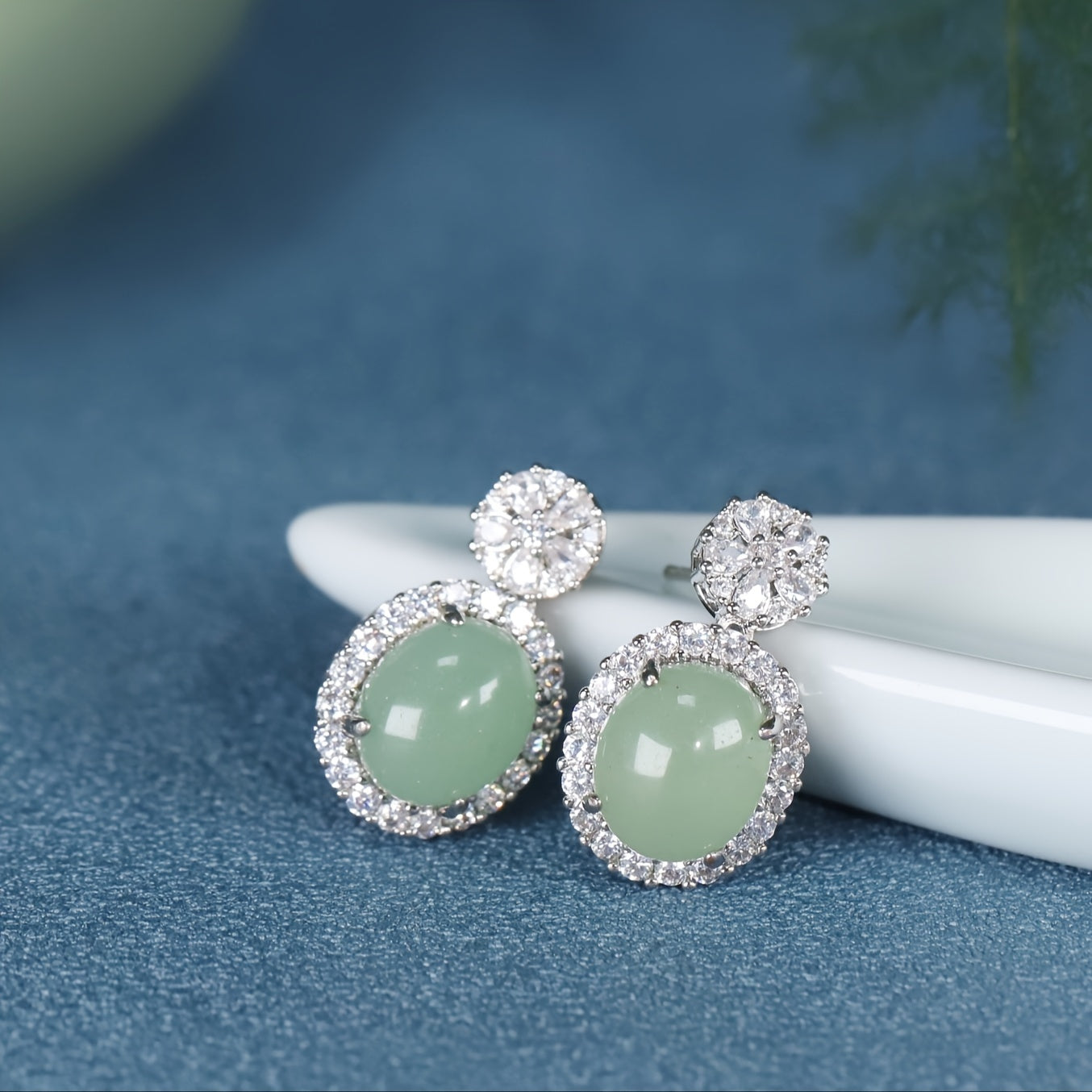
The first time you put them on, there's a moment of slight surprise. Not at the weight—which is present but gentle—but at the temperature difference. The silver hook feels neutral, already adjusting to the warmth of your fingers. But the green jade pendant, when it touches the skin just below your earlobe, carries a distinct coolness. It's not cold, exactly. Not like metal left on a winter windowsill. More like the temperature of a river stone in early morning shade: a coolness that feels ancient, geological, and quietly alive.
This initial sensation lasts only seconds. Within a minute, maybe two, the jade warms. It borrows your body heat, settles into you. But in those first seconds, something registers. A memory that isn't yours, but the stone's. A record of deep time meeting human time.
We rarely think about materials this way. In a world of synthetic fabrics and temperature-regulated environments, we've lost touch with what it means to feel the actual thermal properties of stone, wood, or metal against our skin. Jewelry becomes one of the last places where this conversation still happens—where the body can still feel the difference between materials that have known millennia of compression and those that were shaped yesterday.
The Geological Biography of Jade
To understand why jade feels the way it does, you have to understand what it is. Not just "a green stone," but a material with a specific history written in pressure and time.
Jade refers to two distinct minerals: nephrite and jadeite. The earrings use nephrite, the older brother in geological terms. Nephrite forms under immense tectonic pressure, when magnesium-rich rocks are transformed over millions of years. The process creates interlocking fibrous crystals—a structure so dense that it's tougher than steel. This is why jade feels substantial in the hand: it's literally packed with more connections per square millimeter than most stones.
But this density also affects how it interacts with temperature. Dense materials have what's called high thermal inertia. They resist temperature changes. That initial coolness you feel isn't just "cold"; it's the stone's stubborn retention of the ambient temperature of the room, its reluctance to immediately surrender to your body's warmth. It has its own thermal rhythm, slower than yours.
This quality was noticed centuries ago. In ancient China, jade was sometimes called "the stone that remembers winter in summer." Emperors would hold jade ornaments during hot months, finding comfort in their persistent coolness. The stone wasn't just decorative; it was functional, a small climate regulator worn on the body.
The green color itself tells a story. Nephrite's green comes from iron content. The specific shade—from pale celadon to deep spinach green—depends on how much iron and in what oxidation state. The stone in these earrings tends toward a mid-range green with subtle variations: evidence of the specific conditions in its particular patch of earth, a biography written in chemistry.
When you touch it, you're touching the result of a process that began before humans walked upright. The coolness is a message from that deep time: "I have been here, holding this temperature, through ages you can only imagine."
The Crystal's Different Conversation
The companion stone—the raw crystal point—offers a contrasting dialogue. Where jade is opaque, dense, and smoothly polished, the crystal is transparent, faceted, and left intentionally rough in places. Where jade feels cool and substantial, the crystal feels... different.
Rock crystal (clear quartz) is silicon dioxide in its purest form. It forms in hexagonal prisms that grow point by point, molecule by molecule, in geothermal cavities. Its structure is ordered, geometric—the opposite of jade's fibrous entanglement. This order affects how it feels.
When you run a finger along the crystal's facets, there's a clarity to the sensation. Each ridge is definite. The polished parts are frictionless, almost slippery. The rough base feels complex, like miniature mountain ranges under your fingertip. And the temperature? Slightly different from the jade. Crystals often feel cooler longer, especially the larger points. Their structure conducts heat differently.
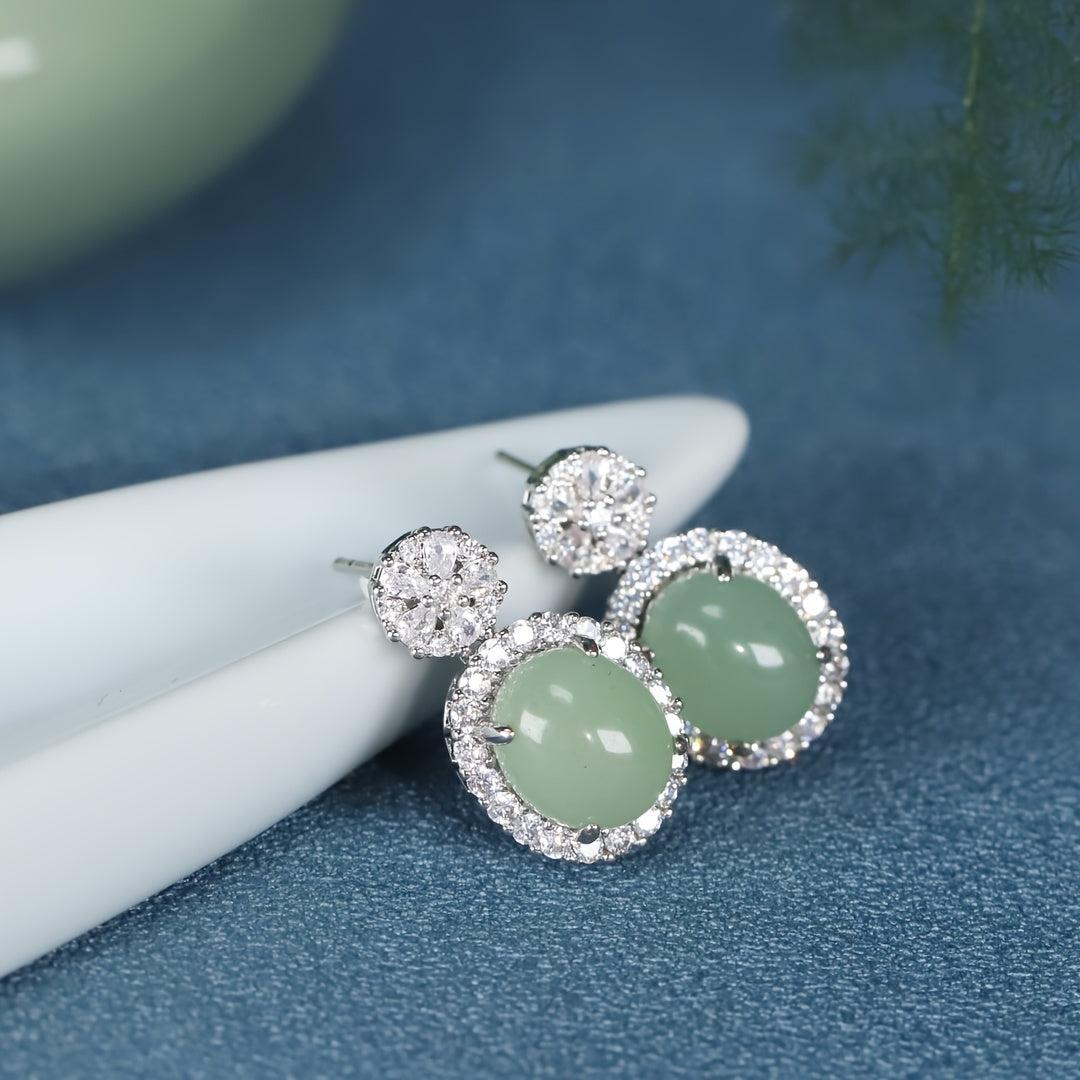
But more than temperature, there's a textural conversation happening between the two stones. One is all rounded curves (the jade cabochon), the other is all sharp geometry (the crystal point). One invites a smooth caress; the other invites exploration of its edges and planes. Together, they create a tactile experience that's never monotone. Your attention moves between them, comparing, noticing.

This isn't accidental design. The pairing creates what neurologists might call "sensory richness." When we experience multiple textures and temperatures together, our perception becomes more acute. We notice more. The earrings become not just something we wear, but something we feel ourselves wearing throughout the day.
The Body's Thermal Memory
Our skin is a remarkable recording device. It remembers textures, temperatures, pressures. This is called haptic memory, and it operates mostly below conscious awareness. You don't usually think, "I'm remembering the feel of wool from childhood," but your body does.
When you wear the same earrings day after day, something subtle happens. Your skin begins to recognize their specific thermal signature. The initial coolness of the jade becomes a familiar sensation, a little ritual of morning contact. You might start to notice that the warming time changes with the seasons: slower on cold winter mornings, faster in summer.
This creates a private relationship with the material that has nothing to do with symbolism or meaning. It's purely somatic. The stone becomes part of your body's sensory landscape, like the feeling of your own breath or heartbeat.
Some people report that after wearing such pieces for months, they develop what might be called "material anticipation." As they reach for the earrings in the morning, their body already expects that particular coolness. When they put them on, there's a small satisfaction in the confirmation: yes, there it is, that familiar sensation. It's comforting in the way any reliable, gentle sensation is comforting.
- The Morning Coolness: That first contact, a brief reminder of otherness before the stone joins your thermal world.
- The Warming Curve: The gradual equalization, how long it takes on different days, in different moods.
- The Weight Distribution: How the stones hang, their slight swing when you turn your head, the difference between stillness and motion.
- The Textural Contrast: Smooth jade against faceted crystal, a dialogue of surfaces.
- The Sound: The almost imperceptible click when stones touch each other with certain movements.
These sensations create what anthropologist Tim Ingold calls a "weather world"—a personal climate of experiences that surrounds us. The earrings become part of your weather: a small, predictable element in the day's sensory environment.
When Materials Outlive Their Stories
There's an interesting phenomenon that happens with well-worn natural materials. The initial reasons for choosing them—the symbolism, the aesthetic appeal, the meaning—eventually fade into background noise. What remains is the physical relationship.
You might have chosen the earrings because you liked the idea of the open circle symbol, or because green is your favorite color, or because they seemed to represent something about personal growth. But six months later, you're not thinking about symbolism when you put them on. You're thinking, "I like how these feel." Or maybe you're not thinking at all; you're just putting on your earrings.
This might seem like a diminishment. The profound has become mundane. But in the logic of materials, it might be the opposite: the beginning of a deeper relationship.
When we stop seeing objects through the filter of what they "mean" and start experiencing them through what they are, something shifts. The jade is no longer "a symbol of virtue" or "a connection to ancient China." It's just this particular green stone that feels cool in the morning and warm by afternoon. The crystal is no longer "a clarity symbol" or "an energy amplifier." It's just this faceted point that catches the light in a certain way when you pass a window.
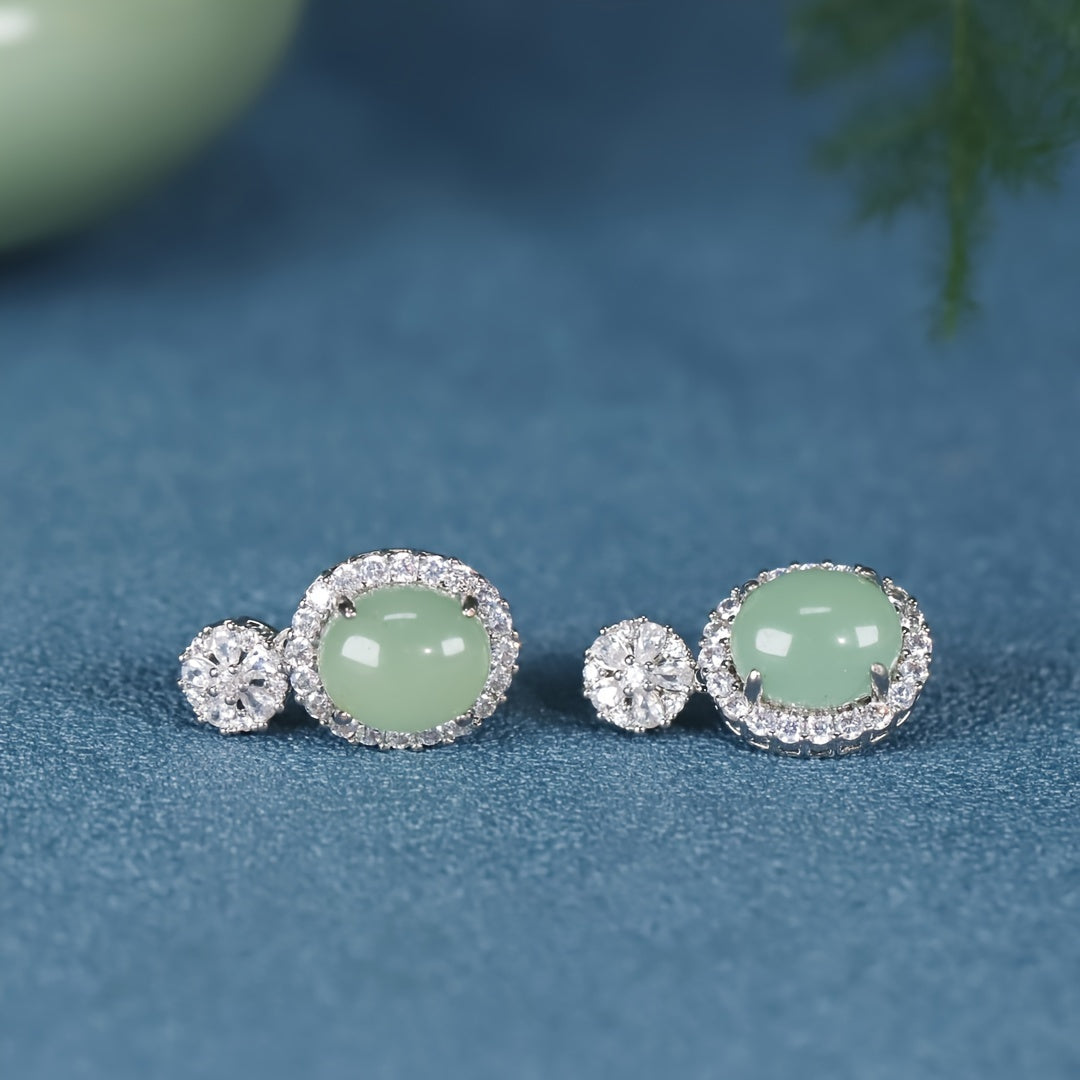
This material relationship has its own intelligence. It teaches through repetition and sensation rather than through ideas. You learn, through daily wear:
• That natural materials have their own rhythms (the warming time, the way they feel different in humidity)
• That weight can be comforting rather than burdensome
• That texture creates interest even when you're not looking
• That objects can be companions without needing to "do" anything
This education happens in the background, through thousands of tiny, mostly unconscious moments of contact. Your body learns what your mind might never articulate: that there's value in materials that have history, that feel real, that interact with you rather than just decorate you.
The Silver's Mediating Role
The sterling silver hook deserves its own attention. In material terms, silver is the diplomat between stone and skin. It's more conductive than either jade or crystal, so it warms almost instantly to body temperature. It becomes a thermal bridge: your warmth flows through the silver to the stones.
But silver also has its own material personality. It tarnishes slowly when exposed to air, developing a patina that records where it's been. The oils from your skin, the humidity in the air, the occasional contact with cosmetics or seawater—all these leave subtle traces. Over months and years, the silver changes. Not dramatically, but enough that if you compared a new pair to a worn pair, you'd see the difference.
This change is often feared in jewelry ("It's tarnishing!"). But in the context of material souls, it might be understood differently: as the silver's way of recording time. The patina is a visual memory of all the days it was worn, all the environments it passed through.
The open circle form of the hook adds another layer. Unlike a closed loop, the open circle allows air and light to pass through freely. This isn't just symbolic; it affects how the silver ages. The entire surface gets relatively even exposure, so the patina develops uniformly. There are no hidden corners that stay shiny while the rest darkens.
When you clean silver jewelry, you're essentially erasing its memory. Some people prefer this—they want their jewelry always looking new. Others come to appreciate the patina as evidence of a relationship. The slightly darkened silver looks like it has been somewhere, done something. It looks like it belongs to someone.
The Daylong Dialogue
Wearing these materials through a full day creates a rhythm of noticing that most of us have forgotten how to observe.
Morning: The initial coolness. The slight adjustment as they settle into place. The first awareness of their presence as you move through your morning routine.
Midday: By now, they've fully warmed. You've mostly forgotten them—they've become part of your sensory background. But occasionally, when you turn your head quickly and feel their slight swing, or when light hits the crystal in a certain way, you're reminded.
Afternoon: There might be a moment of fatigue or distraction when your hand goes unconsciously to an earring. Not to adjust it, just to touch it. The familiar texture grounds you briefly. This is haptic anchoring—using touch to return to the present moment.
Evening: Taking them off, you feel their weight in your palm one last time. They're warm from your body heat. You might notice how different they feel in your hand versus on your ear. Off the body, they're just objects. On the body, they were partners in sensation.
This daily cycle repeats, with subtle variations. On rushed days, you might barely notice them at all. On quiet days, you might be more aware of their presence. The materials don't change; your awareness does.
Why This Still Matters
In an age of digital everything—screens that have no texture, interfaces that have no temperature, notifications that demand attention but offer no tactile satisfaction—the simple physicality of natural materials becomes quietly revolutionary.
Wearing stone and silver isn't about rejecting technology. It's about maintaining a connection to a different kind of reality: one that operates on geological time rather than network time, one that values sensation over information, one that offers companionship without demanding interaction.
The coolness of jade in the morning is a reminder that some things have rhythms much slower than human impatience. The gradual warming is a lesson in patience. The weight is a reassurance that not everything needs to be lightweight to be valuable. The texture is proof that complexity can be beautiful without being complicated.
When you choose to wear natural materials, you're choosing to carry a piece of the earth's timeline with you. You're choosing to participate in a sensory world that existed long before smartphones and will exist long after. You're choosing to remember, through your skin, that you too are a material being, with your own temperature, weight, and texture, moving through time.
And sometimes, on days when everything feels too fast, too digital, too abstract, that cool touch of stone against your skin can feel like the most real thing in the world.
