

Do I Actually Believe in Good Fortune?
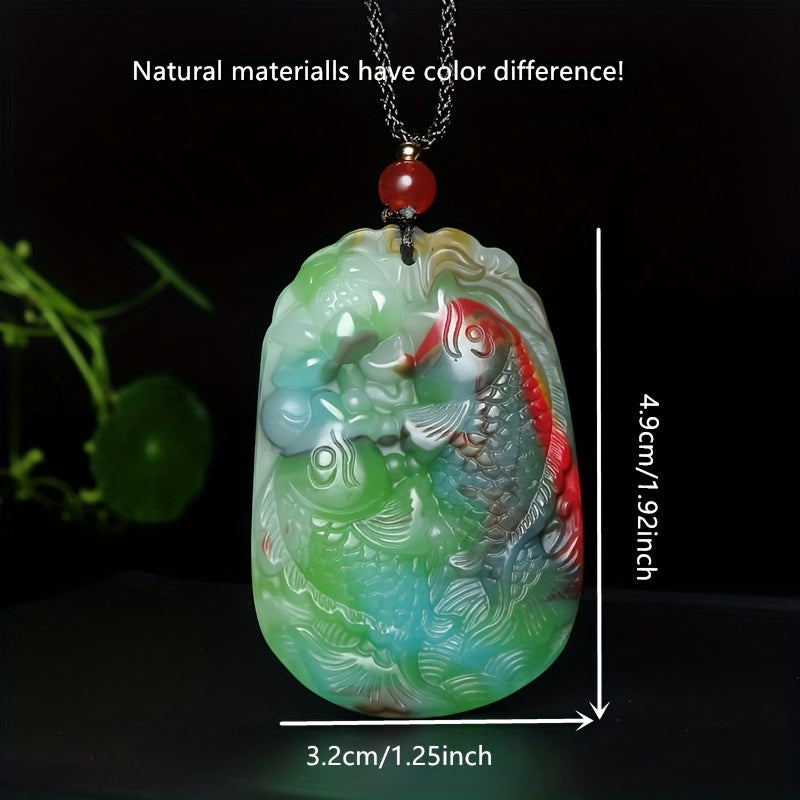
It's 11:37 PM. You've been scrolling through the same product page for twenty minutes. The stone fish pendant glows on your screen. The description talks about cultural symbols, about presence, about daily companionship. Your cursor hovers over "Add to Cart."
But you don't click. Something holds you back. It's not the price. It's not the practicality. It's a quiet question that surfaces in the space between intention and action: Do I actually believe in any of this?
The pendant references nian you yu—a symbol of abundance, of having more than enough. But you live in a world of student loans, of rent increases, of uncertain job markets. You don't feel abundant. You feel like you're constantly calculating, budgeting, making do. Can a stone fish change that? Should it even try?
Am I purchasing a piece of jewelry, or am I purchasing the hope that my life will become more abundant? And if it's the latter, isn't that a little... naive? Superstitious? Desperate, even?

And what does it mean that I'm considering it while sitting in my apartment, surrounded by IKEA furniture, with three different subscription services charging my credit card monthly? Is this connection to tradition authentic, or am I just romanticizing a past I never experienced?
The description says "not a charm for good fortune, but a companion for presence." This appeals to you. You're tired of things that promise transformation. You're suspicious of quick fixes. But companionship? Presence? Those feel different. Those feel like things you actually need.
Still, the hesitation remains. If you wear this, people might ask about it. "Oh, what does that mean?" they'll say. And you'll have to decide: do you give the cultural explanation? Do you talk about fish symbolism and abundance? Or do you say what you actually feel: "I just like how it feels. It's cool in the morning. It has texture. It reminds me to breathe."
If no one ever saw it, if no one ever asked about it, would I still want it? Or is part of the appeal the potential conversation, the opportunity to explain the symbolism, to position myself as someone who understands deeper meanings?
You look at the dimensions: 4.9cm by 3.2cm. Small enough to be subtle. Substantial enough to feel like something. The chain is adjustable—you could wear it under your shirt, keep it private. Or you could let it show, make it part of your outward presentation.
The note about natural materials having color difference catches your eye. It's presented as a warning, but you read it as an invitation. This won't be perfect. This won't be identical to the picture. This will be unique, with its own variations, its own history written in stone before it ever reached you.
Maybe that's the point. Maybe the hesitation isn't about whether you believe in good fortune. Maybe it's about whether you're ready to accept something imperfect. Something that doesn't promise results. Something that just is what it is: a stone, shaped like a fish, on a chain.
Be honest. Not with the website, not with anyone who might ask about it. Just with yourself, at 11:42 PM, with the cursor still hovering. If I buy this and wear it every day for a year, what do I imagine will be different? And is that expectation fair to place on a piece of jewelry?
You think about your morning routine. Coffee. Email check. Rush out the door. Maybe this could be a pause in that routine. Putting it on could become a moment of intention. Not "I'm putting on a good luck charm," but "I'm choosing to wear this today. I'm choosing to notice it. I'm choosing to let it be part of my day."
The cultural symbolism becomes background music. Nice to know about, but not essential. What's essential is the weight. The texture. The way it might feel when you touch it during a difficult meeting. The way it might become familiar over time.
You minimize the browser window. Not because you've decided against it, but because you need to sit with the questions. The hesitation isn't an obstacle; it's the most interesting part. It's asking you to clarify what you actually want from the objects you bring into your life.
The Morning After the Hesitation
You wake up thinking about it. Not in an obsessive way, but in that quiet way certain questions linger. While making coffee, your hand goes to your chest out of habit, even though there's nothing there. You're reaching for something that doesn't exist yet.
This is interesting. The hesitation has created a space where the object already exists in your imagination. You're already relating to it, already anticipating how it might feel, already wondering about its place in your life. The decision hasn't been made, but the relationship has already begun.
Shouldn't this be simpler? See something you like, buy it, wear it. Why does this feel like it requires more consideration? And what does that say about me—that I overthink things? Or that I care about intentionality?
You scroll through the page again on your phone. Different time of day, different light in your kitchen. The stone looks different. In the morning light, the variations in color seem more pronounced. You can imagine how they might catch the light at different angles throughout the day.
The "Natural materials have color difference" note makes more sense now. It's not an apology; it's an explanation of character. Like meeting someone and being told "they have strong opinions" or "they're quiet until you get to know them." It's telling you what to expect, not warning you away.
You think about the fish symbol again. Not as a magical charm, but as a pattern. Fish swim. That's what they do. They don't question it. They don't wonder if they're swimming correctly. They just swim. There's something appealing about that simplicity. Not as something to emulate, but as something to remember when you're overcomplicating things.
What's the actual worst-case scenario? I spend money I could have spent elsewhere. I wear it a few times and it sits in a drawer. I feel silly for buying into something. These aren't catastrophic outcomes. They're just... outcomes. Manageable ones.
But there's another possibility: what if you buy it and it becomes exactly what you didn't know you needed? Not a transformative object, but a consistent one. Something you put on without thinking after a while. Something that becomes part of your landscape. Something that, in six months, you can't imagine not having.
You notice the chain is adjustable. This feels significant. You can decide how to wear it. Close to your neck, hidden under clothing. Lower, where it's more visible. Somewhere in between. The adjustability means you get to choose the relationship. It can be private or public. It can change day to day.
This addresses one of your hesitations: the performative aspect. If you wear it under your shirt, it's just for you. No explanations necessary. No positioning yourself as someone who understands cultural symbolism. Just you and a stone fish, having a quiet relationship no one else needs to know about.
Probably. But maybe that's okay. Maybe the meaning-making is part of the process. Maybe the hesitation, the questions, the late-night scrolling—these are all part of what makes an object meaningful. Not the object itself, but the space we create for it in our minds before it arrives.
You close your phone. The question has shifted. It's no longer "Do I believe in good fortune?" It's "Do I want this particular object in my daily life?" And maybe, just maybe, "Am I willing to let it be just an object, without expecting it to change anything except maybe my awareness of my own neckline?"
The cultural symbolism becomes interesting in a new way. It's not something you have to believe in; it's something you get to reference if you want to. Like knowing the history of a building you live in. You don't have to think about it every day, but it's there, adding layers to your experience.
The fish swam through centuries of meaning before it reached your screen. Now it's swimming through your hesitation, your questions, your morning coffee ritual. Where it goes next is up to you.
The Object of Contemplation
Sometimes the most interesting part is the space before deciding.