





Choosing Companionship: A Dialogue on Hesitation, Meaning, and Wearing Symbols Without Belief

There's a particular kind of hesitation that happens with certain objects. Not the hesitation of "can I afford this?" or "will this look good?" Those are calculations. This is different.
This hesitation feels like standing at a threshold. You're drawn to the object—maybe the way light catches the grain, the particular weight in your hand, the subtle scent that appears only when you're close. But something holds you back. Not practical concerns. Something quieter, more internal.
It might express as questions: "But what does it mean?" "Do I have the right to wear this?" "Am I the kind of person this belongs to?"
Or it might not express as questions at all. Just a lingering, a putting down and picking up again, a "I'll think about it" that stretches into weeks.
1. Naming the Hesitation
Let's sit with this hesitation for a moment. Not to resolve it, but to understand its texture.
Perhaps it feels like: "I'm drawn to this, but I don't know why. Shouldn't I know why before I choose it?"
Or: "This feels meaningful, but I haven't earned that meaning. It belongs to a tradition I wasn't born into, a practice I don't follow."
Or: "What if I wear it and someone asks what it means? What would I say?"
Or the quietest version: "What if I choose this and it becomes just another object? What if the meaning I sense now disappears with familiarity?"
These aren't shopping questions. They're relationship questions. They're about how we connect with objects, with symbols, with the stories we tell ourselves about who we are and what matters.
Internal Check
Which hesitation resonates most?
- The need to understand before choosing
- The worry about cultural permission
- The fear of being asked to explain
- The anxiety that meaning might fade
- Something else entirely—what?
There's no correct answer. The point is to notice which hesitation is most alive for you right now.
2. Layer One: Fit and Permission
The first layer of hesitation often concerns fit. Not physical fit, but existential fit. "Is this appropriate for me?"
This question assumes there's a correct way to relate to symbolic objects. That certain objects belong to certain people based on identity, belief, or knowledge.
But consider: throughout history, symbols have always traveled. They've crossed cultures, been adapted, been misunderstood, been reinterpreted. The lotus didn't stay in one tradition. The tree of life appears in multiple religions. The spiral appears in Celtic art, in Indigenous Australian art, in ancient petroglyphs worldwide.
Symbols are migrant by nature. They don't have passports. They don't require visas.
Yet we live in a time of heightened sensitivity about cultural appropriation—and rightly so. The question isn't whether we should be sensitive (we should). The question is: where is the line between respectful resonance and harmful appropriation?
Perhaps one way to approach this: Appropriation takes without understanding, without relationship, often for profit or trendiness. Resonance meets something already alive in you, seeks to understand its origins, honors its history without claiming ownership.
With sandalwood specifically: the wood itself has traveled for millennia. From Indian forests to Chinese temples to Japanese incense ceremonies to European cabinets of curiosity. It has been sacred in some contexts, medicinal in others, decorative in others. No single tradition owns it.
But still the hesitation: "Do I need permission to wear this?"
Maybe the question isn't about external permission. Maybe it's about internal alignment. Does wearing this feel like claiming something that isn't yours? Or does it feel like meeting something that already resonates with your own experience?
3. Layer Two: Visibility and Misreading
The second layer concerns being seen. "What if someone reads this symbol differently than I do?"
This is particularly relevant with subtle symbols. A sandalwood medallion isn't obviously religious. It doesn't declare allegiance to a specific tradition. But someone might assume things: "Oh, you're Buddhist?" "Are you into aromatherapy?" "Is that a meditation thing?"
The fear isn't just about being misunderstood. It's about being asked to explain something you might not have words for.
There's a cultural expectation that if you wear a symbolic object, you should be able to explain it. To have a clear, coherent story. "This represents X." "This reminds me of Y." "This is from Z tradition."
But what if your relationship with the object isn't that clear? What if it's more feeling than meaning? More resonance than representation?
And what if—here's the radical possibility—you're allowed to wear something without having an explanation ready? What if "I just like it" or "It feels meaningful to me" is sufficient?
This isn't about being evasive. It's about honoring that some relationships with objects are private, personal, and don't need to be translated into public language.
4. Layer Three: Motivation Check
The third layer goes deepest: "Why do I want this? What am I hoping it will do for me?"
This is where we encounter the modern tendency to instrumentalize everything. To ask not "what is this?" but "what will this do for me?"
With symbolic objects, this often takes the form of expectation: "This will remind me to be present." "This will help me feel grounded." "This will connect me to something spiritual."
There's nothing wrong with these hopes. But they place a burden on the object. They make it responsible for creating a certain state in you.
What if, instead, the object simply accompanies you through whatever states arise? What if its role isn't to create meaning, but to witness your search for meaning?
Motivation Inquiry
Ask yourself quietly:
"Am I hoping this object will...
- ...make me into someone I'm not yet?"
- ...compensate for something I feel is missing?"
- ...signal something to others about who I am?"
- ...create a feeling I can't create on my own?"
Again, no judgment. Just noticing. Sometimes our motivations are mixed. Sometimes they change over time.
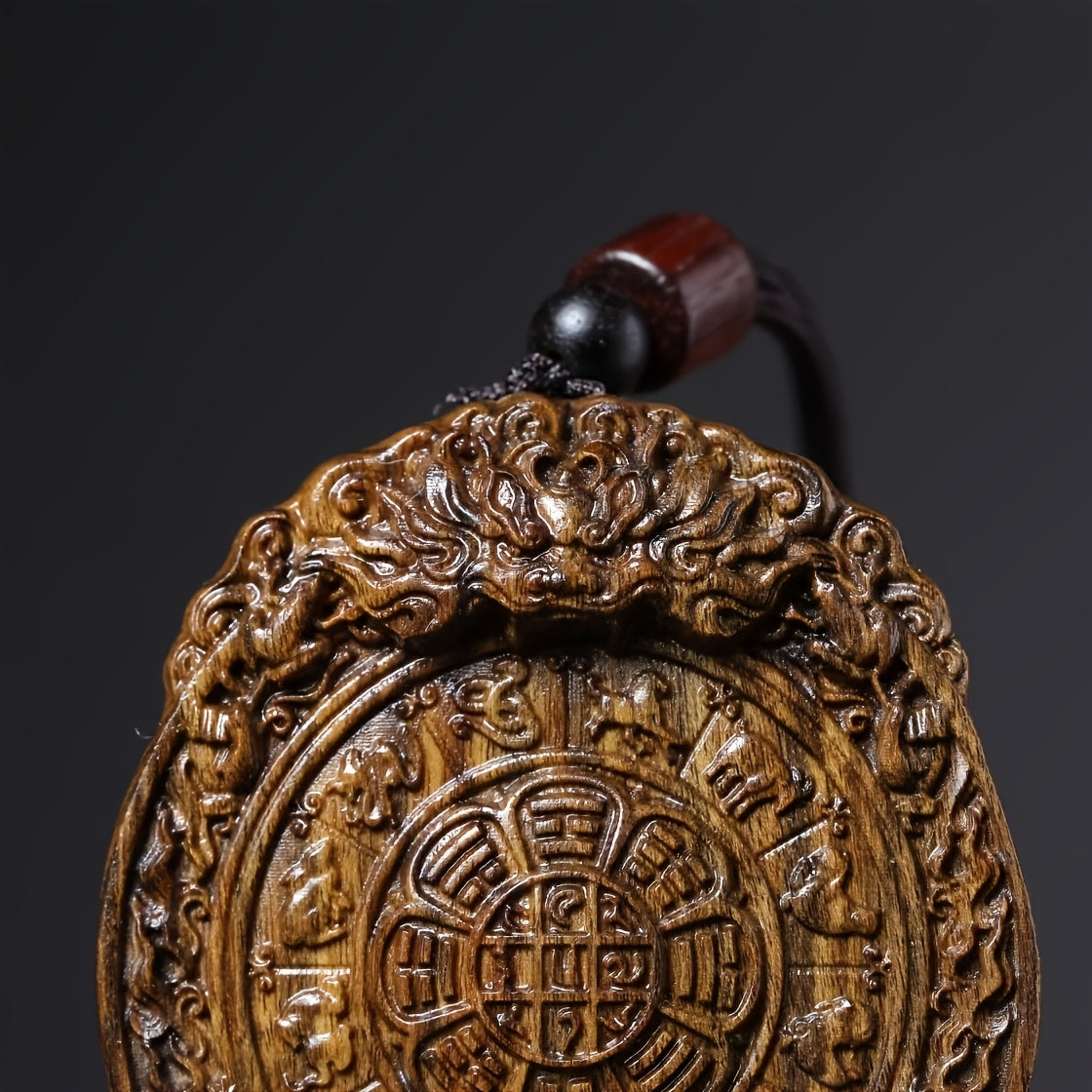
Consider the sandalwood medallion as a companion rather than a solution
View the Jewelry Piece →5. The Temporal Turn: Time Without Certainty
Here's where time enters the conversation. Most hesitations assume meaning must be established before the relationship begins. You understand, then you choose. You know what it means, then you wear it.
But what if meaning develops through relationship? What if you don't need to know what something means before you begin wearing it—because the wearing itself generates meaning?
Consider how relationships with people work: You don't fully know someone before becoming friends. The knowing develops through shared time, through experiences, through weathering conflicts and celebrating joys.
Could the same be true with objects? Could meaning be something that grows between wearer and worn, rather than something inherent in the object itself?
With daily wear, over weeks and months:
- The wood develops patina from your skin oils
- The scent becomes associated with your daily rhythm
- The weight becomes familiar, part of your bodily awareness
- Certain textures become touchpoints during specific moods or activities
These aren't symbolic meanings in the traditional sense. They're personal, physical, experiential meanings. They can't be understood before wearing—only through wearing.
6. The Permission of Unfinished Meaning
This leads to perhaps the most liberating possibility: permission to let meaning remain unfinished.
Our culture loves resolution. We want clear definitions, finalized interpretations, completed narratives. We want to know what things mean.
But some experiences resist this completion. Some relationships with objects—like some relationships with people—are richer when allowed to remain somewhat mysterious, somewhat undefined.
A sandalwood medallion can mean different things on different days:
On a rushed morning: A reminder to breathe
During a difficult conversation: Something to ground nervous hands
In a moment of joy: A companion in celebration
During uncertainty: A point of continuity when everything else feels shifting
These aren't contradictory. They're layered. The object becomes a container for multiple meanings, all true at different times.
This requires accepting that meaning can be fluid. That your relationship with the object can change. That today's understanding might differ from tomorrow's.
7. The Social Dimension Revisited
Returning to the fear of being asked to explain: What if you're allowed to have a private relationship with a public object?
What if, when someone asks "What does that mean?" you're allowed to say:
"I'm not sure yet."
"It means different things at different times."
"That's between me and the wood."
Or simply: "I like it."
These responses might feel uncomfortable at first. We're trained to have answers. But they honor the truth that some meanings are personal, evolving, and don't need to be translated for public consumption.
Interestingly, this often creates more authentic conversations than rehearsed explanations. "I'm not sure yet" invites curiosity rather than closing discussion. "It means different things" acknowledges complexity. "I like it" is honest and simple.

8. The Material as Teacher
Sandalwood specifically offers particular lessons about patience with meaning:
It reveals slowly: The scent appears only with warmth. The patina develops over months. The full depth of color emerges with time. The material itself teaches that some things can't be rushed.
It responds to touch: Unlike materials that remain unchanged, sandalwood records your interaction. Your body changes the wood; the wood changes your awareness. It's a dialogue.
It's both durable and delicate: It lasts for decades but responds to care. It teaches balance between resilience and sensitivity.
It has traveled: As mentioned earlier, sandalwood has crossed cultures for centuries. It carries that history in its grain, but doesn't demand you understand all of it immediately.
The material itself models the kind of relationship it invites: patient, responsive, layered, historically aware but not bound by history.
9. Practical Decision Framework
If you're hesitating, here's a framework that might help—not to eliminate hesitation, but to navigate it:
Decision Questions (Not Checklist)
1. Resonance check: When you hold it, do you want to keep holding it? Does putting it down feel like parting?
2. Burden check: Does wearing it feel like putting on a costume or putting on something that feels like "you"?
3. Time check: Can you imagine wearing it in six months? Does it feel like a passing fascination or something with staying power?
4. Self-check: Are you choosing this because you like it, or because you think you should like what it represents?
5. Space check: Does it leave room for your own meaning, or does it come with a prescribed story you must adopt?
Notice which questions feel most relevant. There are no right answers—only information about your relationship with the object.
10. The Risk of Waiting for Certainty
Here's the paradox: If you wait until all hesitation is resolved, you might never choose. Because some hesitations aren't meant to be resolved—they're meant to be carried.
The hesitation about cultural permission, for example, might never fully disappear if you're crossing cultural boundaries respectfully. That's okay. That hesitation can keep you humble, keep you learning, keep you aware of context.
The hesitation about meaning might persist because meaning is never fixed. That's also okay. That hesitation can keep your relationship with the object alive, curious, evolving.
Perhaps the goal isn't to eliminate hesitation, but to distinguish between:
Protective hesitation: "This doesn't feel right for me" (listen to this)
Fear-based hesitation: "What will people think?" (question this)
Humility hesitation: "I don't fully understand" (carry this)
11. Companionship as Alternative to Symbolism
Perhaps we need a different framework than "symbolic object." Perhaps "companion object" is more accurate for things like the sandalwood medallion.
A symbol represents something else. A companion simply accompanies.
A symbol has prescribed meaning. A companion develops meaning through shared time.
A symbol declares. A companion is present.
If you think of the object as a companion rather than a symbol, many hesitations dissolve:
"Do I understand this companion fully before spending time together?" No, understanding develops through time.
"Do I need permission to be accompanied?" No, companionship is offered freely.
"What will this companion do for me?" Less important than "How will we be together?"
This shift—from symbol to companion—might be the key that unlocks the hesitation.
12. The Unanswered Questions
We won't end with answers. We'll end with the questions that might remain—that perhaps should remain:
Will this object become meaningful through wear, or will the meaning fade?
Will I feel comfortable being seen with it, or will I wish it were more private?
Will it feel like part of me, or like something I'm trying on?
Will the cultural associations feel respectful or appropriative over time?
These questions can't be answered in advance. They can only be answered through experience.
13. The Invitation
So here's the invitation, if it resonates:
Consider that hesitation isn't a stop sign. It's a threshold. A place to pause, to notice, to check in—and then perhaps to step forward anyway, carrying the questions with you.
Consider that meaning doesn't have to be established before relationship. It can grow through relationship.
Consider that you're allowed to have private relationships with public objects. You're allowed to say "I don't know yet" when asked to explain.
Consider that the wood itself has been waiting for decades to meet someone's skin, to warm to body temperature, to release its scent slowly, to develop patina through touch. It has no expectations. Only availability.
The choice, ultimately, isn't between understanding and not understanding. It's between remaining at the threshold or stepping across it, questions in hand, into whatever relationship wants to unfold.
And perhaps that's the deepest companionship any object can offer: not answers, but a shared journey with the questions that matter most to you.
The wood waits. Not with answers. With patience. With the possibility of shared time. The hesitation is yours to carry—or to set down, if you're ready.
