





The Modern Seeker: Navigating Between Yearning and Grounded Practice
You know this person immediately. Or perhaps you recognize them as a part of yourself. They are the one with the bookshelf that holds philosophy alongside neuroscience, poetry next to psychology. They have a notes app filled with questions that have no quick answers. They feel a persistent, quiet pull toward depth—in conversation, in work, in understanding themselves and the world. They are not necessarily religious, but they are undeniably spiritual in the original sense of the word: concerned with the human spirit. This is not the Wandering Ascetic of old, barefoot on a mountain path. This is the Modern Seeker: grounded, perhaps in a career and a home, but with an inner life that reaches toward the perennial questions.
The Modern Seeker's primary characteristic is a specific kind of curiosity—one that values the question as much as, if not more than, the answer. They are collectors of frameworks, not just facts. They might explore Stoicism, Buddhist mindfulness, Jungian psychology, or systems theory, not to adopt a dogma, but to find useful lenses through which to see their own experience more clearly. They are synthesizers. And crucially, they feel a growing fatigue with the purely abstract. After a certain point, more information becomes noise. What they yearn for is embodiment: a way to bring the search from the head into the hands, into the daily rhythm.
The Seeker's Dilemma: The Ocean of Information and the Thirst for Experience
The Modern Seeker exists in a unique historical tension. They have access, via the internet, to more spiritual teachings, philosophical systems, and esoteric knowledge than any generation in history. This is both a blessing and a curse. It can lead to a state of "spiritual consumerism"—hopping from one practice to the next, collecting insights like trinkets, never landing anywhere long enough for roots to form.
The deeper dilemma is the gap between knowing about and knowing through. One can understand the concept of mindfulness intellectually, but that is radically different from the felt experience of a calm nervous system. One can read all about the symbolism of the lotus, but that is not the same as the quiet reassurance that arises when touching its carved form during a difficult day. The Seeker feels this gap acutely. Their journey evolves from gathering information to seeking integrative experience.
Pattern Recognition: From Chaos to Coherence
A key strength of this archetype is pattern recognition. They are often the ones who can see the underlying structure in a messy situation, the common thread in disparate ideas, or the repetitive behavioral loop in themselves or others. This skill, however, can turn inward and become a source of suffering if it only catalogs flaws or inconsistencies.
The progression for the healthy Seeker is to move from using this skill for analysis to using it for synthesis and grounding. They begin to look for patterns of coherence, for practices that weave together their values, their intellect, and their sensory life. They start to prefer a simple, repeatable action that holds meaning (like moving through a string of beads) over a complex theory that has no daily application.
The Role of the Tangible Object: From Seeker to Practitioner
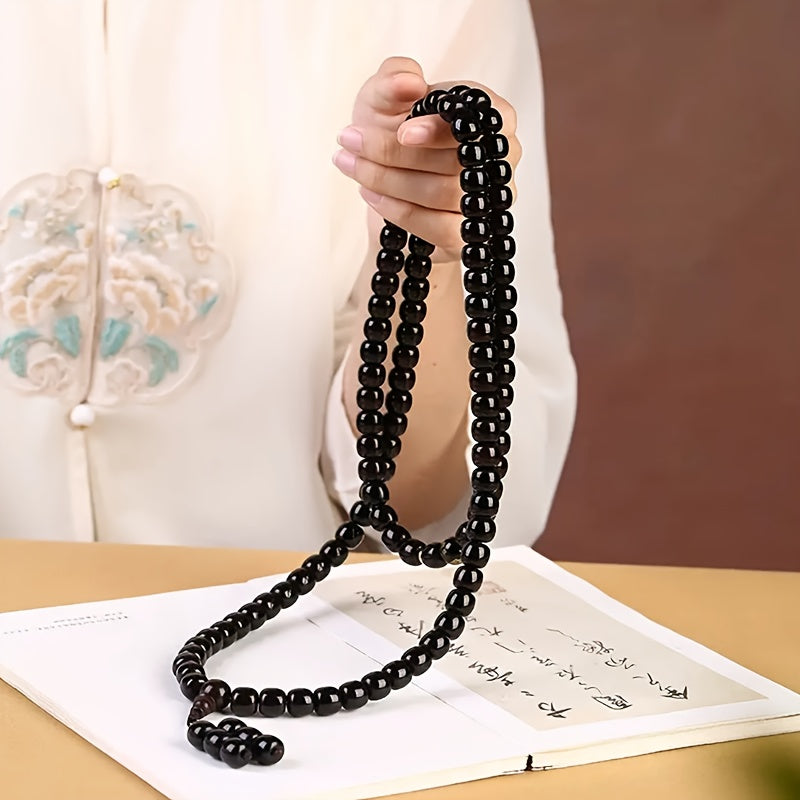
This is where an object like a sandalwood mala becomes significant. For the Modern Seeker, it represents a bridge. It is a physical, tactile point of convergence for their searching mind.
- It satisfies the intellect: The 108-bead count carries historical and symbolic weight, offering a framework to contemplate.
- It engages the senses: The wood's weight, warmth, and scent provide a direct, non-conceptual experience.
- It structures time: It offers a finite, completable practice amidst infinite digital scroll.
- It demands nothing but presence: It has no screen, no notifications, no new content. Its value is unlocked only through attentive interaction.
The object helps catalyze the shift from Seeker to Practitioner. The Practitioner is the Seeker who has chosen a few paths to walk consistently, understanding that depth is found through repetition and commitment, not through perpetual novelty.
Boundaries & Distance: The Seeker's Need for Containment
A common shadow aspect of the seeking mind is boundary dissolution. The desire to understand everything can lead to over-identification with the pain of the world, spiritual bypassing of personal issues, or a loss of grounding in one's own life. The healthy Seeker learns the necessity of containers.
A practice, by definition, is a container. It has a beginning and an end (one round of the mala). It has a form (the beads, the breath). This container is not a limitation; it is what makes the inner work possible. It creates a sacred distance between the Seeker and the overwhelming vastness of their own questions. It says, "For these 108 breaths, just do this." This bounded focus is a profound relief to the unbounded seeking mind.
Daily Friction as the Real Arena
The Modern Seeker's spirituality is not tested on retreat; it is forged in daily friction. It's in the stressful commute, the difficult conversation, the moment of boredom or anxiety. The true purpose of a grounding object or practice is to be a resource precisely here.
When the Seeker feels scattered, reaching for the mala is not an escape. It is a re-centering. The tactile action pulls the cognitive mind out of its narrative loops and into the body. The rhythmic counting provides a neutral focus. The scent acts as a neurological anchor to a calmer state. This turns seeking from a theoretical activity into an applied skill for living well.
Integration: The Seeker's Maturation
The maturation of this archetype is marked by integration. The search becomes less about finding something "out there" and more about uncovering and embodying coherence "in here." The external frameworks and objects are no longer seen as sources of truth, but as mirrors and tools that help them see and shape their own inner landscape.
The Integrated Seeker understands that meaning isn't found; it is built through consistent, conscious action. They move from asking "What is the meaning of life?" to asking "How can I live this day with more integrity, presence, and care?" The quest becomes quiet, humble, and deeply personal.
Archetype Recognition: A Mirror for Self-Understanding
If you see yourself in this pattern, it is not about labeling yourself. It is about gaining clarity on your own inner drivers. Recognizing the Seeker in you can help explain:
- Why you feel restless after consuming too much content without a practice.
- Why you are drawn to objects with cultural depth and material presence.
- Why a simple, repetitive action can sometimes feel more meaningful than a grand new idea.
This recognition allows you to channel your seeking energy more effectively—toward grounded practice, toward integrative objects, toward the depth that exists not over the horizon, but in the very next conscious breath, the very next bead on the string.
For the Modern Seeker ready to ground their search, the 108-Bead Black Sandalwood Mala serves as both compass and anchor.
View the Jewelry Piece →