





The Grounded Observer: The Archetype Who Wears Warm Stones in Cold Rooms
You might recognize them in coffee shops. Not the ones typing furiously or taking selfies, but the person by the window, hands wrapped around a mug, watching steam rise. Their attention isn't absent—it's just placed differently.
Some people navigate social spaces like they're mapping atmospheric pressure. They notice when a room's emotional temperature drops. They feel the shift when conversation moves from genuine to performative. Their first instinct isn't to fix it, but to locate themselves within it.
The Grounded Observer doesn't wear amber because it's fashionable. They wear it because it remembers sunlight. In meeting rooms with fluorescent lighting that makes everyone look slightly ill, the amber at their throat becomes a private counter-narrative: natural light still exists.
The Anatomy of Atmospheric Awareness
This archetype has a particular relationship to their own nervous system. They don't try to transcend bodily responses. Instead, they've developed a quiet literacy. The tightness in the chest before an unnecessary conflict. The slight buzzing in the hands when overstimulated. The way attention scatters in rooms with too many screens.
For them, the amber pendant isn't spiritual jewelry. It's atmospheric equipment. Like carrying an umbrella not because it's raining, but because you know your own relationship to weather.
One woman described it this way: "On days when I have back-to-back virtual meetings, I put on the amber necklace after the first one. By the third meeting, it's warm from my skin. During particularly abstract discussions, I'll find my thumb resting on it. The warmth reminds me: I have a body, and this conversation is happening to that body, not just to my thinking self."
This isn't dissociation. It's the opposite: a deliberate re-association with the physical ground of experience.

The Quiet Threshold of Enough
Modern culture celebrates excess: more information, more stimulation, more connection. The Grounded Observer has a different metric. They're attuned to the moment when enough becomes too much.
This isn't about being fragile. It's about precision. They know that their best thinking happens not in bombardment, but in the spaces between inputs. The amber pendant becomes a tactile marker for that space.
There's a particular gesture you might notice: hand rising to collarbone, fingers finding the teardrop shape. It happens during video calls when someone is talking in circles. In elevators with aggressive perfume. Waiting in line while surrounded by advertisements. The touch isn't magical thinking. It's physiological redirection: moving attention from overwhelming input to simple sensation.
One man noticed the pattern after six months of wearing amber. "I touch it most during transitions. Leaving work, switching tasks, after difficult conversations. It's like my nervous system needs a comma. The amber is that comma."
The Sovereignty of Personal Climate
We talk about "creating boundaries" as psychological work. For the Grounded Observer, boundaries start as physical awareness. They notice where their body ends and the atmosphere begins.
Amber assists this noticing through its thermal properties. Its gradual warming creates a subtle feedback loop: your body affects the stone, the stone reflects that effect back to you. This isn't esoteric. It's basic thermodynamics made personal.
In overly air-conditioned offices, the pendant becomes a small source of warmth exactly where the carotid artery pulses. On crowded public transport, its weight provides a counter-sensation to the press of bodies. During anxious moments, its smooth surface offers a texture different from the mind's jagged edges.
None of this "solves" anything. That's the point. The Grounded Observer isn't seeking solutions to atmospheric discomfort. They're seeking companionship within it.

The Unspoken Grammar of Choice
This archetype makes choices differently. They don't ask "What looks good?" but "What feels true to the day's weather?" Not the meteorological weather, but the emotional and atmospheric weather they'll be navigating.
A Grounded Observer might choose amber on days with difficult conversations ahead. Not because they believe it will make things easier, but because its weight provides a gentle counterbalance to words that might otherwise float away unanchored.
They might choose it on days of tedious administrative work. The stone's gradual warming becomes a quiet timeline: by the time it reaches skin temperature, the most monotonous tasks are usually done.
They might choose it simply because it's Tuesday and the light through the window has that particular pale quality that sometimes makes everything feel temporary. The amber remembers permanence without having to say it.
The Companionship of Durability
What the Grounded Observer recognizes in amber isn't its beauty first. It's its material patience. Fifty million years of existence has given the stone a certain relationship to time.
This resonates with people who feel temporally dislocated—living in digital environments that privilege the instantaneous, working in economies that demand quarterly growth, navigating relationships mediated by technologies that didn't exist five years ago.
Against this backdrop, amber offers a different tempo. It warmed slowly in ancient forests. It fossilized over epochs. It reaches skin temperature over minutes, not seconds. Wearing it becomes a practice in geological pace.
One woman put it simply: "When I'm feeling frantic, I hold the amber. I think: this existed before mammals dominated the earth. It will exist long after I'm gone. My current emergency is probably not geological."
This isn't nihilism. It's perspective. The amber doesn't diminish her concerns. It simply places them within a larger container of time.
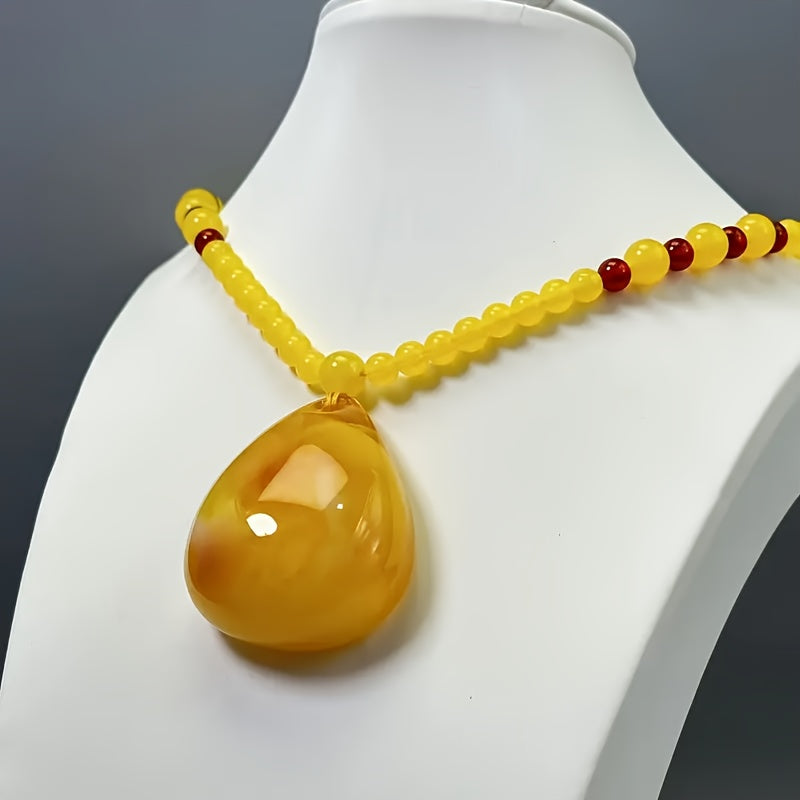
For the Grounded Observer

A natural amber teardrop on a 65cm chain. For those who notice atmospheric shifts and choose to carry their own weather.
Explore the Companion →