




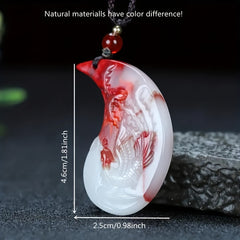


Imitation Red and White Jade Dragon Phoenix Pendant — The Unspoken Harmony Between Movement and Stillness
01 Imitation Red & White Jade Dragon Phoenix Pendant — The Unspoken Harmony A carved stone dialogue between celestial movement and earthly renewal, worn close to the...
- $23.55
$39.55- $23.55
- Unit price
- per
Please hurry! Only 216 left in stock
Limited-Time Offers, End in:
151D
8H
23M
0S
Subtotal:
$23.55
Couldn't load pickup availability


01
A carved stone dialogue between celestial movement and earthly renewal, worn close to the heart
Imitation Red & White Jade Dragon Phoenix Pendant — The Unspoken Harmony
Archetype
The Mediator — one who perceives tension not as conflict, but as a necessary and creative conversation. This person is drawn to paired symbols, understanding that meaning often lives in the space between opposites.
The MediatorCore Themes
Dynamic harmony, internal dialogue, the acceptance of contradictory forces, and the peace found in ongoing conversation.This pendant embodies not a final state of balance, but the active, moving relationship between the Dragon’s shaping power and the Phoenix’s renewing clarity.
Dynamic Harmony Internal DialogueLife Stage
For moments when you feel pulled in two directions, or when internal forces seem at odds. A companion for navigating complex decisions or personal growth, acknowledging that resolution is a process, not a point.
Navigating ContradictionElemental Essence
A union of celestial fire (the Phoenix’s renewal) and earthly water (the Dragon’s transformative flow). This combination speaks of a harmony that is alive and changing, rooted in the real-world dance of elements.
Fire & WaterPrimary Use
Worn as a tactile focal point. The weight on the chest serves as an anchor during scattered thought, while the cool-then-warm stone prompts moments of present-moment awareness and internal check-in.
Tactile AnchorSpiritual Positioning
Not a talisman for forcing balance, but a companion for the conversation — an object that acknowledges the beauty and necessity of the tensions within, without demanding they be neatly resolved.
Companionship Not Resolution
02
Before You Continue
This piece is not a generic symbol of good luck or romantic partnership. It is not designed to signal a specific cultural affiliation or belief system.
If you seek an ornament that promises simple answers, definitive outcomes, or a static state of "balance," this pendant will feel like a question—perhaps an unresolved one.
It belongs to those who sense that true harmony is a verb, not a noun, and who find companionship in objects that reflect life's beautiful, ongoing tensions.
03
The Symbol That Became a Quiet Conversation
You might reach for it on a morning when your mind is already racing ahead, planning, worrying, solving. The pendant is cool against your skin as you fasten it. For a moment, that coolness is all there is—a small, definite point of sensation in the fog of thought.
Later, in a meeting or a moment of hesitation, your fingers find it. The stone has warmed. The smooth, carved lines of the dragon’s coil and the phoenix’s wing are familiar under your touch. You’re not thinking about mythology. You’re feeling a shape that represents two kinds of strength. One is coiled, potential, ready to move like a storm or a river changing course. The other is poised, clear, like the moment after a fire has passed and the air is sharp with possibility.
This is how the symbol works. Not as an idea to be understood, but as a physical presence that invites a shift in attention. It doesn’t tell you to “be balanced.” It asks, quietly, “What kind of strength is needed here?”
The Dragon and Phoenix have been paired for millennia, but often misread as a simple binary: male/female, active/passive. To see them that way is to miss the point. The Dragon is not mere aggression; it is transformative power, the force that reshapes landscapes and destinies. The Phoenix is not mere passivity; it is the power of renewal, the clarity that arises from release. They are two essential modes of navigating a world—and a self—that is constantly in flux.
The power of this pendant lies in holding both. It is a reminder that you are not one thing. You contain the capacity for decisive action and for patient renewal. The tension between them isn’t a problem to solve; it’s the very material of a conscious life.
04
Design & The Space Between
The design choice was not to intertwine the creatures, but to position them in respectful opposition, with a deliberate gap. This negative space is crucial. It is the breath between words, the pause between actions. It is where the dialogue happens.
- Carving Depth: Shallow enough to keep the pendant sleek for daily wear, deep enough to cast subtle shadows that make the figures emerge and recede with the light.
- Red & White Jade: The materials are not mixed. They are distinct territories within the same stone, visually representing coexistence without assimilation.
- The Bail: Positioned at the top of the celestial circle, allowing the pendant to hang and turn freely, never locking into a single, fixed orientation.
- Restraint: No additional decorative elements. The power is in the two figures and the charged space they create together.
The form is an ancient one, but its execution here is about accessibility to the hand and the eye, not archaeological replication. It is designed to be lived with, not displayed behind glass.
05
Wearing & Relation
When worn daily, the pendant ceases to be a symbol you look at and becomes a sensation you feel. Its presence is registered through weight, through the occasional tap against your chest, through the unconscious habit of reaching for it.
In Quiet Moments: Feeling its solid form during reflection can ground a spiraling thought, offering a physical counterpart to internal stillness.
In Decision: Touching it when faced with a choice can become a ritual of checking in: does this moment call for Dragon-like action or Phoenix-like clarity?
Over Time: The stone’s surface slowly acquires a soft patina from skin and cloth, a private record of your days, weaving your story into its material memory.
In Shared Ritual: While deeply personal, it can also serve as a silent, shared reference point between people who understand dialogue over debate.
It tends to show up not on special occasions, but on ordinary days, when the need for an internal compass is felt most acutely.
06
Specifications
- Material: Carved Imitation Jade (Red & White composite stone)
- Dimensions: Approximately 4.6cm (1.81") tall × 2.5cm (0.98") wide. Depth varies with carving.
- Weight: Approximately 15-18 grams (substantial, not heavy).
- Chain: Not included. Designed to be paired with a chain of your choice, typically 45-55cm (18-22").
- Craftsmanship: Hand-polished to a smooth finish. Each piece features natural variation in the red and white patterning.
- Packaging: Presented in a minimalist, padded pouch made from recycled materials.
Note on Material: Imitation jade is a durable, composite stone selected for its aesthetic and tactile qualities, offering the visual and sensory experience of jade with greater consistency and accessibility.
07
A Final, Unfinished Thought
Some objects are chosen to declare an achievement. This one is more often chosen to accompany a becoming.
It doesn’t resolve the internal dialogues about direction, action, or renewal. It simply gives them a quiet, tangible form to exist outside of you, so you can observe them from a slight distance. The cool stone, the carved opposition, the weight—they are all partners in that observation.
Perhaps the question it leaves you with isn't about the symbol's meaning, but about your own relationship to the forces it represents. How do you notice the dance of movement and stillness, of chaos and clarity, within your own day? And what does it feel like to wear an object that doesn’t ask for that dance to end, but simply honors its steps?
08
Darhai Inner Library
Sacred Symbology · When Did the Dragon and Phoenix Stop Being Opposites?
— How these celestial symbols evolved from a dynamic conversation about time and action into a simplified token of balance, and what we regain by remembering their original tension.
Material Souls · The Weight of Imitation Jade
— An exploration of tactile memory and material psychology. What happens when skin meets a stone that remembers an ancient form but speaks to the present moment?
Archetypes · The Mediator
— Not all people see duality as conflict. Meet the archetype drawn to symbols of tension, who finds clarity in holding the space between opposing forces, both internally and in the world.
Practice · Noticing the Pivot
— A verifiable daily exercise. Learn to identify the subtle, bodily-felt moment where you shift from one mode of being to another, using simple awareness to navigate internal change.
Seeker's Dialogue · Wearing a Dialogue, Not a Solution
— Are you looking for harmony, or for permission to contain multitudes? A reflective conversation on the hesitation that arises when an object represents an ongoing tension, not a final answer.
Recently Viewed Products
Example product title
- From $23.55
$39.55- From $23.55
- Unit price
- per
Example product title
- From $23.55
$39.55- From $23.55
- Unit price
- per
Example product title
- From $23.55
$39.55- From $23.55
- Unit price
- per
Example product title
- From $23.55
$39.55- From $23.55
- Unit price
- per
Example product title
- From $23.55
$39.55- From $23.55
- Unit price
- per
Example product title
- From $23.55
$39.55- From $23.55
- Unit price
- per
Example product title
- From $23.55
$39.55- From $23.55
- Unit price
- per
Example product title
- From $23.55
$39.55- From $23.55
- Unit price
- per
Example product title
- From $23.55
$39.55- From $23.55
- Unit price
- per
Example product title
- From $23.55
$39.55- From $23.55
- Unit price
- per
- Choosing a selection results in a full page refresh.
